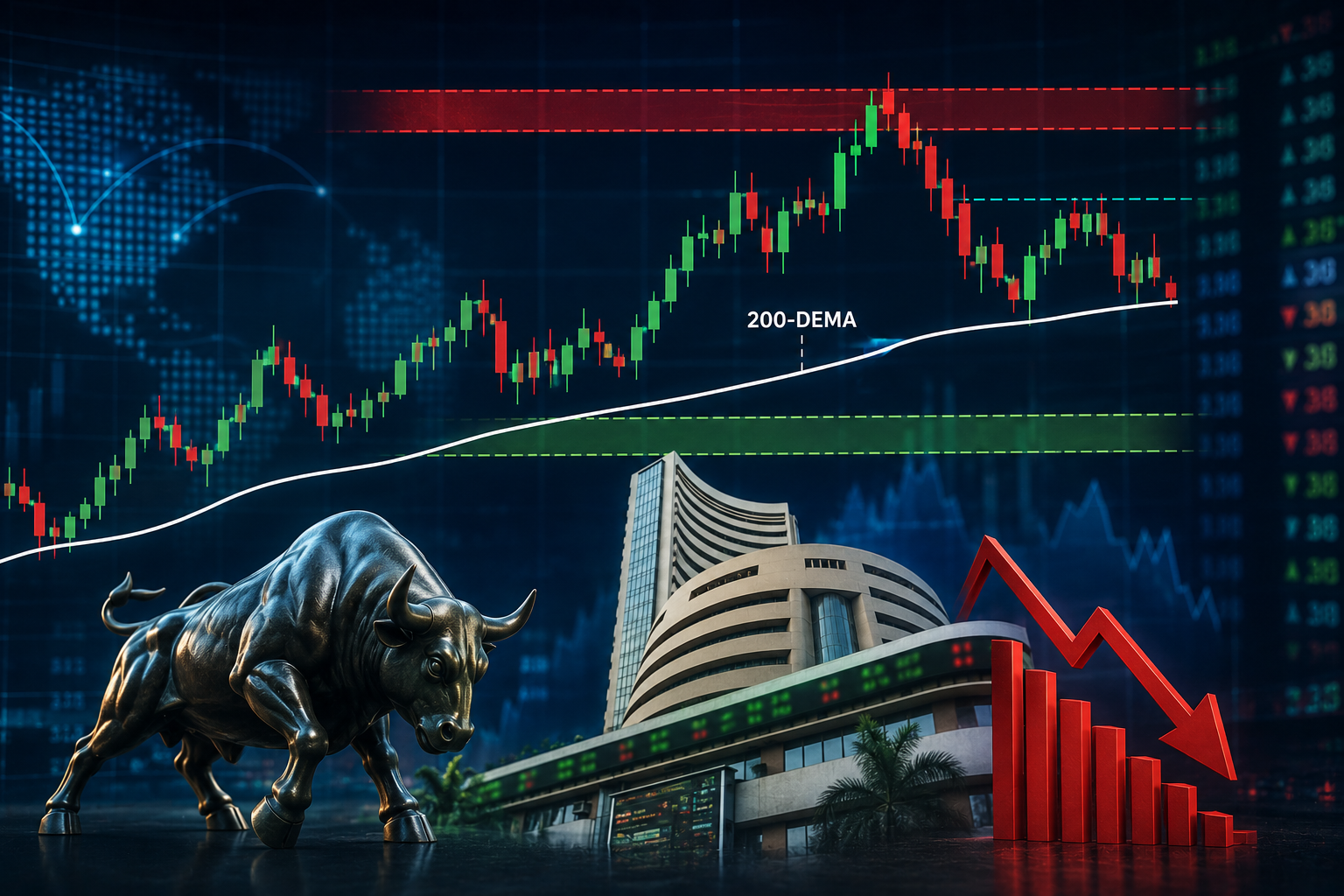
Nifty Hovers Around Crucial 200-Day DEMA; 24,500 Breakout Could Revive Bullish Momentum, While Break Below 24,200 May Deepen Correction
The Nifty 50 is approaching a crucial technical juncture as the benchmark index trades close to its 200-day Exponential Moving Average (200-DEMA). With the index struggling to establish a clear direction, market participants are now assessing whether the current weakness could lead to a technical pullback or develop into a deeper breakdown.
The Nifty has remained subdued in recent sessions amid volatile crude oil prices and persistent uncertainty surrounding the US-Iran geopolitical situation. At the same time, a revival in foreign institutional buying and strong first-quarter earnings from select companies have provided some support to domestic equities.
The Nifty last closed at 24,396, keeping it close to the important 200-DEMA zone.
Technical analysts believe 24,500 is the immediate hurdle for the index, while the 24,200-24,300 region remains a crucial support zone. A sustained breakout above 24,500 could restore positive momentum, whereas a decisive breakdown below the 200-DEMA could accelerate the correction towards 24,200-24,000.
Nifty Tests 200-DEMA Support
The benchmark index has been testing its 200-day exponential moving average near 24,385, making this one of the most important technical levels in the current market.
Dhupesh Dhameja, Derivatives Research Analyst at SAMCO Securities, said the Nifty has been testing support around the 200-DEMA but has not yet given a decisive closing breakdown below the level.
This is important because the 200-DEMA is widely monitored as a long-term trend indicator.
As long as the index manages to hold this area, the possibility of a technical bounce remains open. However, a sustained closing breakdown could signal that the recent weakness is turning into a broader corrective phase.
24,500 Emerges as Key Resistance
Technical analysts are broadly watching 24,500 as the immediate resistance level.
Hariselvan Radhakrishnan, Founder and CEO of HST Wealth, believes that a sustained move above 24,500 could improve the Nifty's momentum and potentially pave the way for a stronger weekly close.
A move above this level would indicate that buyers are regaining control after the recent consolidation.
However, traders are likely to look for confirmation through sustained closing levels, improving market breadth and stronger participation before considering the breakout decisive.
What Happens Above 24,500?
A sustained move above 24,500 could change the short-term technical structure in favour of the bulls.
The breakout could encourage fresh buying in large-cap stocks and provide greater confidence to traders who have been waiting for confirmation of a recovery.
The strength of the move will be important. A breakout accompanied by strong volumes and broader participation would carry greater significance than a brief intraday move above resistance.
If the index fails to sustain above 24,500, the market could once again slip into consolidation.
200-DEMA Breakdown Could Trigger Deeper Correction
The bearish scenario becomes more important if the Nifty closes decisively below its 200-DEMA.
Dhameja cautioned that a sustained close below the indicator could confirm further deterioration and potentially accelerate the corrective move towards 24,200-24,000.
This makes the 24,385 region an important line of defence for the bulls.
A breakdown accompanied by weak market breadth and rising volatility could increase selling pressure across large-cap stocks.
24,200-24,300 Zone Remains Crucial Support
Nagaraj Shetti, Senior Technical Research Analyst at HDFC Securities, described the underlying trend of the Nifty as choppy with a weak bias.
According to Shetti, the index has crucial support around 24,300.
He believes that as long as Nifty sustains above the 24,200-24,300 zone, there remains a possibility of a bounce from lower levels.
The support zone therefore becomes critical for determining whether the current weakness is simply a correction within a broader range or the beginning of a deeper decline.
Nifty Technical Levels at a Glance
| Level | Technical Significance |
|---|---|
| 24,500 | Immediate resistance; sustained breakout could revive momentum |
| 24,385 | Approximate 200-DEMA support |
| 24,300 | Important near-term support |
| 24,200 | Crucial downside threshold |
| 24,000 | Potential next support on breakdown |
These levels are likely to remain important reference points for traders during the coming sessions.
Possibility of a Technical Pullback Remains
Despite the weak bias, analysts have not ruled out a recovery.
The fact that the Nifty continues to hold near its 200-DEMA means buyers still have an opportunity to defend the current levels.
If the index sustains above 24,200-24,300 and subsequently crosses 24,500, the current decline could turn into a technical pullback.
Such a move could also encourage short covering and fresh long positions.
However, the market needs confirmation before a stronger bullish view can be established.
Geopolitical Risks Keep Investors Cautious
The technical setup is unfolding against a challenging global backdrop.
Uncertainty surrounding the US-Iran conflict continues to influence crude oil prices and investor sentiment.
Persistent geopolitical tensions can increase the risk premium in energy markets, keeping oil prices volatile.
For India, higher crude prices are particularly important because they can affect the country's import bill, inflation, corporate costs and the rupee.
This has encouraged investors to remain selective rather than aggressively increase equity exposure.
Softer US Inflation Offers Some Support
There are also positive global factors supporting risk sentiment.
Softer US inflation has helped improve expectations around global monetary conditions, while resilient global equity markets have prevented a sharper deterioration in sentiment.
Radhakrishnan said softer US inflation and resilient global equities have provided a supportive backdrop.
However, the prolonged geopolitical uncertainty continues to sustain a premium in energy markets and is limiting aggressive risk-taking.
FII Buying Provides a Positive Signal
The recent revival in foreign institutional investor buying has also provided some support to domestic equities.
FII flows are particularly important for large-cap stocks, which have a significant influence on the Nifty 50.
If foreign investors continue to return to Indian equities, it could help the benchmark defend its crucial support levels.
However, traders will need to monitor whether the recent improvement in flows develops into a sustained trend.
Q1 Earnings Create Stock-Specific Opportunities
The ongoing Q1 earnings season is another factor influencing market sentiment.
Strong results from select companies have helped offset broader concerns and are creating opportunities at the individual-stock level.
Investors are increasingly differentiating between companies based on earnings performance, management commentary and future growth guidance.
This could keep stock-specific activity elevated even if the benchmark index remains range-bound.
Market Breadth Will Be Important
For a sustainable recovery, analysts will also look for improvement in market breadth.
A Nifty breakout above 24,500 driven by only a handful of heavyweight stocks may not provide sufficient confirmation of a broad-based recovery.
On the other hand, a combination of rising index levels, improving advance-decline ratios and stronger participation across sectors would strengthen the bullish case.
Market breadth could therefore become an important confirmation indicator alongside price levels.
Sectoral Performance Could Remain Divergent
The current environment is likely to produce significant differences between sectors.
Defensive sectors may continue to attract interest during periods of geopolitical uncertainty, while crude-sensitive and import-dependent sectors could remain vulnerable to higher oil prices.
At the same time, companies reporting strong Q1 earnings could outperform regardless of the broader index direction.
Investors may therefore continue to favour sectors and stocks showing relative strength.
Pullback Scenario: What Bulls Need
For the bullish scenario to play out, the Nifty needs to first defend the 24,200-24,385 region.
A successful defence could encourage buyers to push the index towards 24,500.
A sustained close above 24,500 would then provide stronger confirmation of a recovery.
The ideal bullish setup would involve:
- Nifty holding above the 200-DEMA
- Support near 24,200-24,300 remaining intact
- Breakout above 24,500
- Improving market breadth
- Higher trading volumes
- Continued FII participation
Breakdown Scenario: What Bears Need
The bearish case would strengthen if the Nifty decisively breaks below the 200-DEMA.
A move below 24,385, followed by a sustained break below 24,200, could accelerate the corrective trend.
The next major downside reference would then be around 24,000.
A rise in volatility, continued FII selling and higher crude prices could increase the probability of this scenario.
Traders Should Avoid Premature Positioning
The current market structure suggests that the Nifty is at a decision point rather than in a confirmed trend.
Aggressive positioning before the index breaks either side of the important range could expose traders to whipsaws.
A sustained move above 24,500 would favour the bulls, while a decisive breakdown below 24,200 would strengthen the bearish case.
Until then, a selective and level-based trading approach may be more appropriate.
Key Triggers for the Nifty
Investors and traders should monitor the following factors closely:
- Nifty's position relative to the 200-DEMA
- Breakout or rejection near 24,500
- Support around 24,200-24,300
- FII and DII activity
- Brent crude prices
- US-Iran geopolitical developments
- US inflation and Treasury yields
- Market breadth
- Q1 earnings
- India VIX and overall volatility
The interaction between these factors will determine whether the index can regain momentum or move into a deeper correction.
What Investors Should Watch Next
The coming trading sessions could prove important for determining the Nifty's near-term direction.
A successful defence of the 200-DEMA followed by a move above 24,500 could signal that the recent correction is losing steam.
Conversely, a sustained close below the 200-DEMA would raise concerns about further downside.
Investors should therefore focus on closing levels rather than isolated intraday movements, particularly around the 24,385 and 24,500 zones.
Market Outlook
The Nifty 50 remains at a critical technical crossroads, with the index hovering around its 200-DEMA near 24,385.
The immediate trading range of 24,200-24,500 is likely to determine the market's next meaningful direction.
A sustained move above 24,500 would improve the technical setup and could trigger a recovery towards higher levels, particularly if supported by improving market breadth, FII buying and strong earnings.
On the downside, a decisive closing break below the 200-DEMA, followed by weakness below 24,200, could accelerate the correction towards 24,000.
The broader market backdrop remains mixed. Softer US inflation and resilient global equities are supportive, but crude oil volatility, US-Iran geopolitical uncertainty and currency-market pressure continue to limit aggressive risk-taking.
For now, the Nifty's technical bias remains choppy with a weak undertone. Traders should watch 24,500 as the key bullish trigger and 24,200-24,300 as the crucial defensive zone. Until either side is decisively breached, a selective approach with strict risk management is likely to remain preferable.