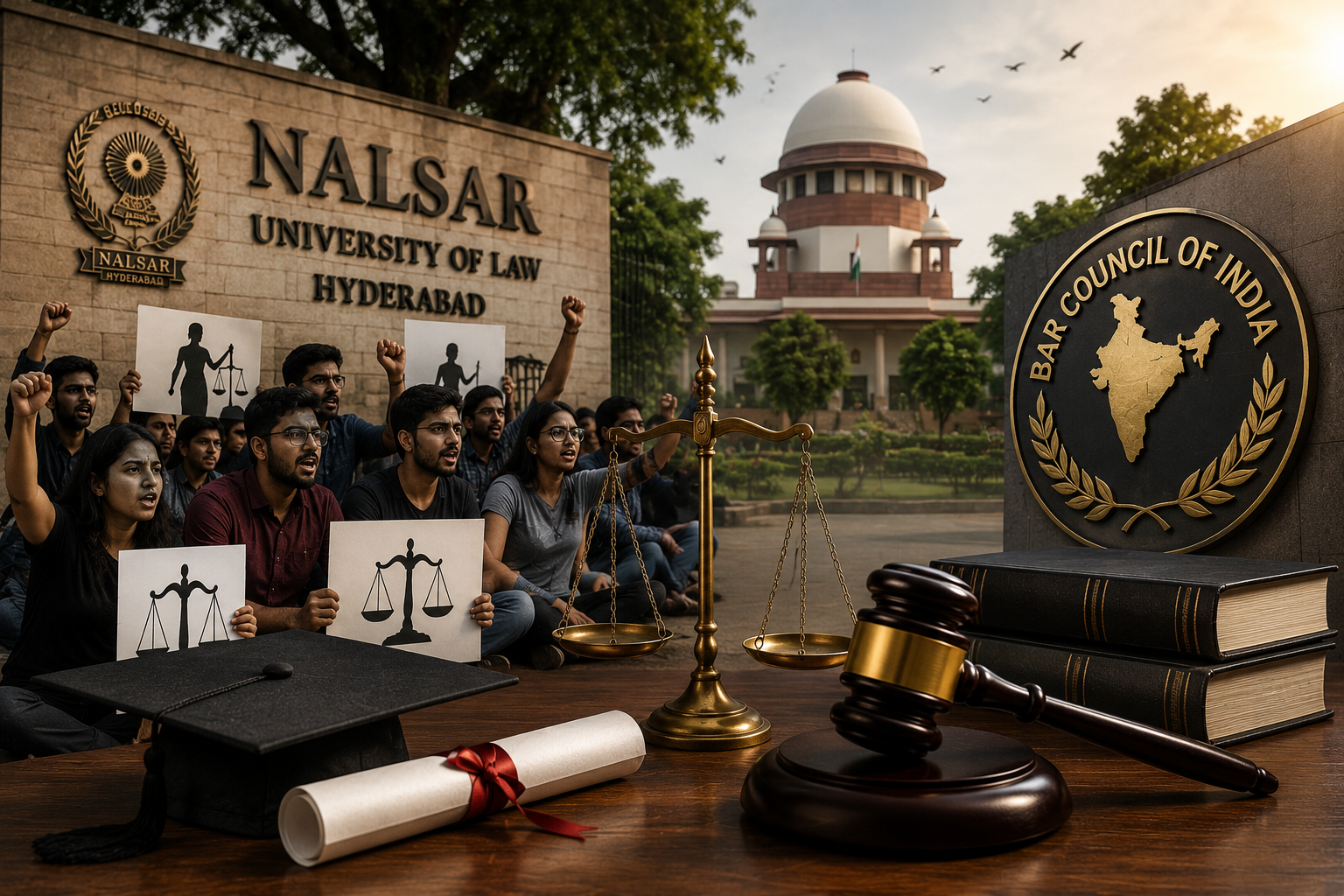
BCI Withdraws Order Blocking Enrolment of Nalsar's 2026 Graduates After Strong Backlash Over Student Campaign Against CJI Surya Kant
The controversy surrounding Nalsar University of Law in Hyderabad took a dramatic turn this week after a student campaign opposing the invitation of Chief Justice of India (CJI) Surya Kant to the university's convocation prompted the Bar Council of India (BCI) to issue a sweeping order against the institution's graduating batch.
The BCI initially directed State Bar Councils not to enrol any law graduate from Nalsar's 2026 batch as an advocate and sought details about students allegedly involved in organising the campaign.
The decision, however, triggered strong criticism from senior lawyers and members of the legal fraternity, who questioned the legality and proportionality of imposing a blanket restriction on an entire graduating class.
Within hours, BCI Chairperson Manan Kumar Mishra withdrew the order, saying that the vast majority of students were innocent and should not suffer because of the alleged conduct of a few.
The Council subsequently said that the proceedings against the 2026 batch had been closed and that all students would be entitled to enrol with State Bar Councils of their choice.
How the Nalsar Controversy Began
The controversy began after Nalsar University of Law invited CJI Surya Kant to attend its convocation as the chief guest.
Although the date of the convocation has not yet been announced, a section of students objected to the invitation and launched a campaign asking the university administration to reconsider the decision.
Around 450 students out of nearly 1,400 students at Nalsar reportedly wrote to the Vice-Chancellor, Registrar and faculty members expressing their concerns.
The students' objection was linked to reported remarks made by CJI Surya Kant during a Supreme Court hearing involving allegations of police brutality against protesters at Jantar Mantar in Delhi.
The issue subsequently became a wider debate about the role of students in expressing disagreement with constitutional authorities and the extent to which such dissent can be exercised within an educational institution.
Students Raise Concerns Over Reported Supreme Court Remarks
According to the reports cited in connection with the controversy, a petition seeking action over alleged police brutality came before a Supreme Court Bench led by CJI Surya Kant.
During the hearing, the CJI reportedly said:
"Please don't waste our time. We don't have time to watch these videos."
The remarks became a key reference point for students opposing the invitation.
In their communication to the university administration, the students argued that receiving their degrees from a dignitary whose reported conduct appeared dismissive of serious allegations of police brutality made them uncomfortable.
They said the issue was particularly significant because their education at Nalsar had emphasised constitutional values, rights and responsibilities.
The student campaign therefore centred on whether the university should reconsider its choice of chief guest rather than on the professional enrolment of the graduating class.
Around 450 Students Back Campaign
The reported participation of around 450 students gave the campaign considerable visibility within the university.
However, the Nalsar student body comprises nearly 1,400 students, meaning that the campaign did not involve the entire university.
This distinction later became important when the BCI imposed its initial restriction on the complete 2026 graduating batch.
The controversy consequently shifted from the question of the convocation invitation to a larger debate over whether an entire group of students should face regulatory consequences because of a campaign allegedly organised by a section of them.
BCI Orders State Bar Councils Not to Enrol Nalsar Graduates
The situation escalated when BCI Chairperson Manan Kumar Mishra directed all State Bar Councils not to enrol law graduates from Nalsar's 2026 batch as advocates.
The order also sought a factual report from the university concerning individuals allegedly instrumental in initiating and organising the campaign against CJI Surya Kant's participation in the convocation.
The university was asked to provide an authenticated factual report within three days.
The BCI further asked the institution to identify, on the basis of verifiable material, persons allegedly involved in initiating, drafting, circulating, coordinating or mobilising the campaign.
BCI Seeks Details of Students Behind Campaign
The BCI's initial action indicated that the Council was examining whether the campaign involved conduct that warranted regulatory intervention.
The Council referred to reports and material available in the public domain concerning what it described as an organised campaign against the invitation of the CJI.
The demand for details of individuals allegedly involved in the campaign added another dimension to the controversy.
Questions were subsequently raised about how far a professional regulator could intervene in a university-level disagreement and whether participation in a campaign expressing a political or constitutional opinion could affect a student's future eligibility to practise law.
Why the Blanket Order Triggered Backlash
The strongest criticism of the BCI's initial decision centred on its application to the entire 2026 batch.
Nalsar's graduating students were not all alleged to have participated in the campaign.
Critics therefore questioned why students who had no role in the dispute should face restrictions on their professional enrolment.
For a law graduate, enrolment with a State Bar Council is a crucial step towards entering legal practice. Any blanket restriction could potentially delay the beginning of professional careers for hundreds of young graduates.
This raised concerns about proportionality and collective punishment.
Senior Lawyers Object to BCI Action
The BCI order attracted criticism from several members of the legal community.
Senior advocate and Supreme Court Bar Association president Vikas Singh strongly objected to the decision.
He argued that a blanket restriction could have the effect of intimidating law students for exercising their constitutional freedom of speech and expression.
BCI member Advocate N Manoj Kumar, who is also associated with the Bar Council of Kerala, opposed the decision as well.
He described the blanket direction as "manifestly arbitrary" and raised concerns regarding the constitutional rights of the graduates.
The objections from members of the legal fraternity increased pressure on the BCI to reconsider its position.
BCI Takes a U-Turn
Following the backlash, Manan Kumar Mishra withdrew the earlier direction.
The BCI acknowledged that the "vast majority" of students were innocent and should not be made to suffer for the alleged misconduct of a few.
The Council subsequently clarified that all students of Nalsar's 2026 batch would be entitled to enrol with State Bar Councils of their choice.
The withdrawal effectively removed the immediate professional consequences faced by the graduating students.
Proceedings Against Entire Batch Closed
The BCI went a step further and announced that proceedings concerning the 2026 batch had been closed.
Mishra said that after considering representations and reactions from senior advocates, members of the Bar, law students and public-spirited citizens, the Council was satisfied that the 2026 batch had no role in any "disturbance or movement."
This meant that the entire graduating batch would not face collective action over the controversy.
The decision brought a rapid end to the regulatory action, although questions surrounding the original BCI order are likely to continue to be debated within the legal community.
Freedom of Speech at the Centre of the Debate
One of the most important issues raised by the Nalsar controversy is the scope of freedom of speech and expression for students.
University campuses frequently become spaces for debate over public policy, constitutional rights and the actions of public authorities.
In the case of a law university, such discussions can have particular significance because students are trained to examine the functioning of institutions through a constitutional and legal framework.
The Nalsar episode has therefore raised questions about where the boundary lies between legitimate criticism and conduct that could attract institutional or regulatory action.
Does Student Dissent Affect Professional Enrolment?
The BCI's initial order also raised a fundamental question: Can participation in a student campaign affect a law graduate's right to enter the legal profession?
The reversal suggests that the Council ultimately concluded that the entire graduating batch should not face professional consequences in the absence of evidence establishing collective involvement.
This distinction between individual responsibility and group liability became central to the controversy.
For students entering the legal profession, the episode also underscores the importance of understanding the relationship between academic institutions, professional regulators and constitutional rights.
Institutional Autonomy Comes Under Focus
The controversy has also placed institutional autonomy under the spotlight.
Universities generally make decisions concerning convocations, guest invitations and academic ceremonies through their own administrative structures.
The Nalsar dispute raised questions about the extent to which a professional regulator should intervene when students challenge such an institutional decision.
At the same time, regulators have responsibilities concerning professional standards and the conduct of individuals entering the legal profession.
Finding the appropriate balance between these roles remains an important issue highlighted by the episode.
BCI's Action and Its Immediate Consequences
Had the initial BCI order remained in place, Nalsar's 2026 graduates could have faced uncertainty over their ability to begin legal practice.
The timing was particularly significant because graduation and professional enrolment are closely connected for law students.
A prolonged restriction could have affected employment opportunities, chamber enrolment, internships transitioning into professional roles and preparations for legal practice.
The BCI's subsequent withdrawal therefore provided immediate relief to the graduating batch.
Why the BCI Reversal Is Significant
The U-turn is significant for several reasons.
First, it acknowledges the distinction between the alleged actions of a section of students and the wider graduating class.
Second, it removes the immediate professional consequences for students who were not alleged to have participated in the campaign.
Third, it demonstrates the pressure that can arise when regulatory decisions have broad consequences for individuals who may not be directly connected to the alleged conduct under examination.
Finally, the episode could become a reference point in future discussions over the limits of regulatory authority and student expression.
Nalsar's Role in the Controversy
Nalsar University of Law now finds itself at the centre of a debate extending beyond the original convocation invitation.
The university has had to navigate competing considerations involving its invited dignitary, student concerns, institutional decision-making and its relationship with the professional regulator.
The episode also puts the spotlight on the responsibilities of university administrations when students raise objections to decisions involving public figures.
How the university handles the eventual convocation and communicates with students could influence the next stage of the controversy.
Convocation Invitation Remains a Separate Question
The BCI's decision to withdraw the enrolment restriction does not automatically resolve the original dispute over the convocation.
The university had invited CJI Surya Kant as chief guest, while a section of students had asked it to reconsider the invitation.
The eventual decision regarding the ceremony, including whether the invitation remains unchanged, will determine whether the issue continues to attract attention.
For now, however, the immediate regulatory dispute concerning the professional enrolment of the 2026 batch has been resolved.
Broader Implications for Law Students
The episode has wider relevance for law students across the country.
Law schools are environments where students regularly engage with constitutional principles, judicial decisions and questions concerning government and public institutions.
The controversy demonstrates that student expression can sometimes intersect with institutional and regulatory concerns.
It also highlights the importance of distinguishing between criticism of a public figure, organised student activity and conduct that may genuinely warrant disciplinary or professional consequences.
Key Questions Raised by the Nalsar Episode
Several questions remain central to the wider debate:
-
What limits should apply to student campaigns within universities?
-
How should institutions respond when students object to an invited dignitary?
-
What role should professional regulators play in university disputes?
-
Can collective action be attributed to an entire graduating class?
-
What safeguards should exist before professional enrolment is restricted?
-
How should freedom of speech be balanced against institutional discipline?
-
Where should the line be drawn between legitimate dissent and actionable misconduct?
These questions extend beyond Nalsar and could influence discussions about legal education and professional regulation more broadly.
A Rapid Chain of Events
The controversy unfolded through a series of developments:
Student campaign: A section of Nalsar students objected to the invitation of CJI Surya Kant as convocation chief guest.
BCI intervention: The Bar Council of India directed State Bar Councils not to enrol Nalsar's 2026 graduates and sought details of students allegedly involved in the campaign.
Legal community backlash: Senior lawyers and members of the legal fraternity criticised the blanket restriction and raised constitutional concerns.
BCI reconsideration: The Council acknowledged that the majority of students were innocent.
U-turn: The BCI withdrew the restriction and said all students could enrol with State Bar Councils of their choice.
Closure: Proceedings against the 2026 batch were closed after the Council said it was satisfied that the batch had no role in any "disturbance or movement."
What Happens From Here?
The immediate issue concerning professional enrolment has been resolved for Nalsar's 2026 graduates.
The students will be able to pursue enrolment with State Bar Councils of their choice, removing the uncertainty created by the BCI's initial order.
Attention is now likely to return to the original dispute over the convocation invitation and the university's response to the student campaign.
The episode may also prompt broader discussion within the legal community about the appropriate limits of regulatory intervention, particularly when decisions can have consequences for an entire group of students.
Conclusion
The Nalsar controversy began with a disagreement over a convocation invitation but quickly evolved into a larger debate involving student dissent, freedom of expression, institutional autonomy and the powers of the legal profession's regulator.
The BCI's initial decision to prevent enrolment of the entire 2026 batch attracted strong criticism because the action extended beyond the students allegedly involved in the campaign.
The subsequent withdrawal of the order and closure of proceedings restored the professional pathway for Nalsar's graduates.
The episode ultimately underlines a broader principle at the heart of the controversy: regulatory action must distinguish between individual responsibility and collective consequences, particularly when the careers of young professionals are involved.
While the immediate dispute over enrolment has ended, the questions raised about student expression, university autonomy and regulatory authority are likely to remain part of India's broader legal and academic debate.