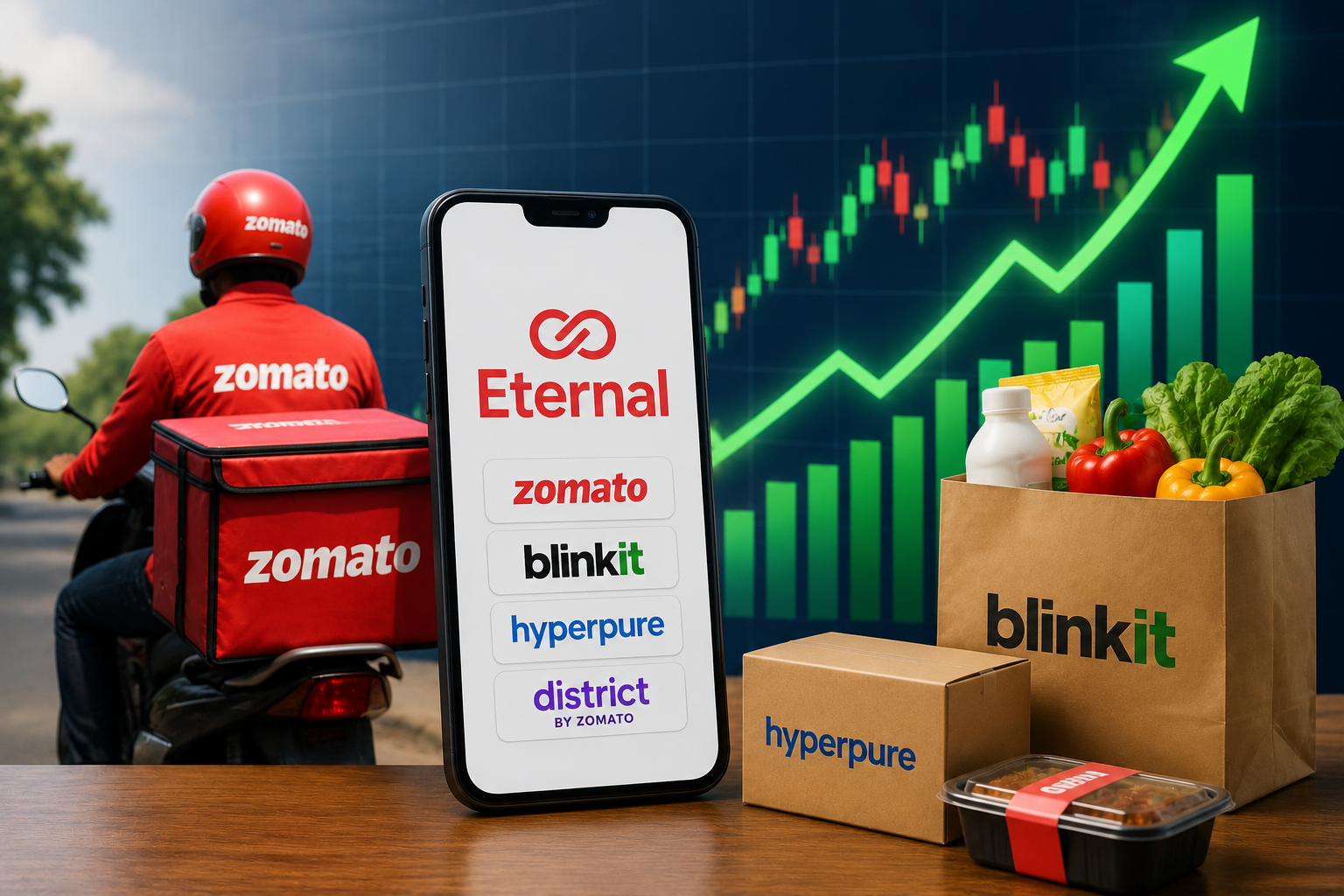
Blinkit Expansion, Rising Quick-Commerce Profitability and Resilient Food-Delivery Growth Strengthen Eternal's Growth Story
Shares of Eternal Ltd, the parent company of Zomato, Blinkit, Hyperpure and District, continued their strong recovery on Thursday, gaining around 2% in intraday trade even as the broader market remained under pressure.
The stock touched an intraday high of ₹319.25 on the BSE, moving closer to its nine-month high. The latest gain extends Eternal's sharp recovery from its March low and reflects growing investor confidence in the company's quick-commerce strategy and improving operating economics.
Eternal's Q1FY27 performance has provided a major fundamental trigger for the recent re-rating. The company reported strong growth in its consumer businesses, with Blinkit emerging as the principal growth engine. Eternal's consolidated adjusted revenue rose 173% year-on-year to ₹20,648 crore, while consolidated adjusted EBITDA increased 223% to ₹555 crore in the June quarter.
Eternal Stock Gains 36% in Two Months
The stock has gained approximately 36% over the past two months, while it has recovered nearly 50% from its 52-week low of ₹212.55 touched on March 12, 2026.
Eternal has also outperformed the broader market during calendar 2026, according to the market data in the source material.
The stock's 52-week high is around ₹368.45, meaning it still has room to reclaim its previous peak if the company's earnings momentum continues.
The recent recovery is particularly notable because investors have shifted their focus from Eternal's historical food-delivery business towards the much faster-growing quick-commerce opportunity.
Blinkit Is the Biggest Driver of the Rally
The biggest reason behind the renewed optimism is Blinkit, Eternal's quick-commerce business.
Blinkit's net order value (NOV) increased 86% year-on-year to ₹17,132 crore in Q1FY27. The company added 200 net new dark stores during the quarter, taking the total network to 2,443 stores.
The scale-up is important because Eternal is attempting to build a dense fulfilment network that can support faster deliveries, a wider assortment and higher order frequency.
The company has identified three key growth drivers for Blinkit:
- Assortment expansion
- Geographic expansion
- Demand densification
Management has also indicated that premiumisation through selected gourmet stores will become another component of assortment expansion.
Blinkit Adds 200 Dark Stores in One Quarter
Blinkit's dark-store network has become one of Eternal's most important competitive assets.
The company added 200 net stores in Q1FY27, taking its total to 2,443. It has also indicated an ambition to reach approximately 3,000 stores by March 2027.
The strategy involves building infrastructure ahead of demand so that customers can be served from locations closer to their homes.
As order density increases, existing stores can potentially generate greater revenue without a proportionate increase in fixed costs.
That creates the possibility of significant operating leverage.
Quick Commerce Is Moving Beyond Metro Cities
Eternal's expansion is not limited to India's largest urban markets.
Management has indicated that Blinkit's growth strategy involves strengthening its presence in the top eight cities while expanding into the next 30 cities.
This creates a significantly larger addressable market.
The expansion is also supported by growing consumer acceptance of quick commerce for everyday purchases, including groceries, household products, personal care and other frequently purchased items.
Order Frequency Is Becoming More Important
An important feature of Blinkit's growth is that consumers are increasingly using the platform more frequently.
Q1 data showed strong growth in monthly transacting users and order frequency, even though average order value declined marginally. Business Standard reported that Blinkit's Q1 NOV increased 19.1% sequentially, while order frequency rose to 3.47 from 3.36 in Q4FY26.
This is important for unit economics.
If customers place more orders through the same platform, the company can potentially improve utilisation of its existing dark-store and delivery infrastructure.
Blinkit Turns Adjusted EBITDA Positive
One of the most significant developments in Q1FY27 was Blinkit's improvement in profitability.
Blinkit's adjusted EBITDA reached ₹102 crore, compared with a loss of ₹162 crore in the year-ago quarter. Its adjusted EBITDA margin improved to 0.6% of NOV.
This marks an important transition for the business.
For several years, the quick-commerce industry has been characterised by aggressive expansion and heavy investment. Investors are now increasingly looking for evidence that scale can translate into sustainable profits.
Blinkit's latest numbers provide an early indication that this transition may be underway.
Management Raises Long-Term Margin Ambition
Eternal has become more confident about Blinkit's long-term profitability.
The company has raised its long-term adjusted EBITDA margin expectation to around 6% of NOV, from the earlier 5-6% range. Management has linked the improvement potential to larger stores, deeper assortments, better warehouse infrastructure and operating efficiencies.
This change is significant because even a small improvement in margins can have a substantial effect when applied to a rapidly expanding NOV base.
Larger Stores Could Improve Economics
Blinkit's strategy is increasingly moving towards larger fulfilment centres rather than simply maximising the number of small dark stores.
The company's steady-state capital expenditure assumption per store has risen to approximately ₹2.5 crore, reflecting investments in larger stores, deeper inventory and improved warehousing technology.
While higher upfront investment raises capital requirements, the objective is to generate greater sales and operating leverage from each location.
The success of this strategy will ultimately depend on whether higher store-level throughput justifies the additional capital deployed.
Food Delivery Remains a Strong Second Engine
Although Blinkit is receiving most of the investor attention, Eternal's food-delivery business continues to provide an important source of growth and cash generation.
The food-delivery business continues to benefit from:
- Growing customer engagement
- Higher order frequency
- Better monetisation
- Advertising revenue
- Improved delivery economics
- Product and platform enhancements
The company's increasing ability to monetise its existing customer base without relying excessively on discounts is particularly important for long-term profitability.
Competition Is Rising in Food Delivery
Eternal's food-delivery business is not operating in isolation.
Competition has increased with the emergence of lower-priced offerings and new platforms.
However, analysts believe Eternal's established scale, restaurant network and customer base provide significant competitive advantages.
JM Financial has argued that the food-delivery business remains capable of high-teens growth, supported by execution and improving unit economics, while the current competitive environment has had limited impact on the company's overall positioning.
Advertising Revenue Strengthens the Business Model
One of Eternal's structural advantages is its advertising ecosystem.
Restaurants, brands and consumer companies can pay for greater visibility on the platform, creating a revenue stream that does not carry the same delivery cost as the underlying food order.
As traffic and customer engagement increase, advertising can potentially become an increasingly important contributor to margins.
This gives Eternal multiple monetisation avenues beyond food-delivery commissions.
Premium Customers Could Help Absorb Cost Inflation
Fuel prices remain an important variable for delivery businesses.
Higher fuel costs can increase delivery expenses and potentially compress margins.
However, analysts at Elara Capital believe Eternal's relatively premium customer base provides greater scope to recover cost increases through platform fees, delivery charges and handling charges.
Eternal's larger scale and stronger advertising base could also provide additional protection compared with competitors operating with thinner profitability cushions.
District Adds Another Growth Opportunity
Eternal is also building its District business, which focuses on going-out and experiences.
District's NOV increased 60% year-on-year to ₹3,218 crore in Q1FY27, highlighting the potential of the business as consumers increasingly use digital platforms to discover restaurants, entertainment and events.
The business remains smaller than Blinkit and food delivery, but its growth provides another potential long-term earnings driver.
Hyperpure Moves Towards Profitability
Eternal's Hyperpure business provides supplies to restaurants.
The segment's like-for-like revenue increased 27% year-on-year, while adjusted EBITDA improved to ₹6 crore in Q1FY27 from a loss of ₹18 crore in the year-ago period.
This improvement is significant because it demonstrates that the company's broader ecosystem is not dependent solely on Blinkit for profitability improvements.
Eternal Is Becoming a Multi-Business Consumer Platform
The transformation of Eternal is central to the stock's long-term investment story.
The company now operates across four major consumer and commerce businesses:
| Business | Primary opportunity |
|---|---|
| Zomato | Food delivery |
| Blinkit | Quick commerce |
| District | Going-out and experiences |
| Hyperpure | Restaurant supplies |
The combination creates opportunities to use a common consumer ecosystem across multiple categories.
A customer who uses Zomato for food delivery can also become a Blinkit customer, while restaurants using Hyperpure can participate in the broader Eternal ecosystem.
Why Investors Are Re-Rating the Stock
The recent rally appears to reflect a combination of factors rather than one isolated development.
1. Blinkit Is Scaling Rapidly
NOV growth remains exceptionally strong, while the store network continues to expand.
2. Blinkit Has Entered Positive EBITDA Territory
The shift from losses to adjusted EBITDA profit represents a major change in the quick-commerce narrative.
3. Margin Expectations Are Improving
Management's 6% long-term adjusted EBITDA margin ambition has strengthened the profitability argument.
4. Food Delivery Remains Resilient
The original business continues to grow while improving monetisation.
5. Multiple Businesses Are Scaling
District and Hyperpure provide additional growth and profitability opportunities.
6. Digital Consumption Continues to Expand
Increasing consumer adoption of app-based commerce provides a structural tailwind.
Key Risks Behind the Rally
Despite the positive developments, investors should not ignore the risks.
Quick-Commerce Competition
Blinkit faces aggressive competition from Zepto, Swiggy Instamart and other well-funded players. New entrants with substantial capital could keep pricing and customer-acquisition intensity elevated.
Capital-Intensive Expansion
The move towards larger stores means greater capital investment per location. Eternal must generate sufficient sales and returns from those stores to justify the investment.
Margin Execution
The company's long-term valuation increasingly depends on margin expansion. Any delay in reaching the targeted profitability levels could affect investor expectations.
Valuation Sensitivity
After a 36% rally in two months, the stock has become more sensitive to earnings disappointments. Strong growth expectations are already embedded in investor sentiment.
Food-Delivery Competition
Lower-priced alternatives could force Eternal to increase incentives or reduce fees, potentially affecting margins.
Regulatory and Labour Costs
Changes in gig-worker regulations, minimum wages or delivery-partner economics could increase operating costs.
What Investors Should Track Going Forward
The most important indicators will be operational rather than simply headline revenue.
Investors should monitor:
- Blinkit NOV growth
- Dark-store additions
- NOV per dark store
- Monthly transacting users
- Order frequency
- Average order value
- Quick-commerce contribution margin
- Blinkit adjusted EBITDA margin
- Food-delivery growth
- Advertising revenue
- District profitability
- Hyperpure profitability
- Capital expenditure per dark store
- Return on capital
These metrics will indicate whether Eternal is creating sustainable operating leverage or simply buying growth through higher investment.
The Big Question: Can Growth Convert Into Profits?
This is perhaps the most important question for Eternal investors.
The company has already demonstrated that it can grow rapidly.
The next phase is about proving that growth can generate high-quality returns on capital.
Blinkit's shift into adjusted EBITDA profitability is encouraging, but the business remains in an investment phase.
The company's ability to reach its long-term margin ambitions while continuing to expand its store network will determine whether the current business model can generate the level of profitability investors are expecting.
Eternal's Long-Term Opportunity
India's digital consumption market remains significantly larger than today's online penetration.
Consumers are increasingly comfortable ordering food, groceries, household products and experiences through mobile applications.
Quick commerce could particularly benefit from this behavioural shift because convenience and speed can encourage customers to move more frequent purchases online.
For Eternal, the opportunity is to build a single ecosystem around these increasingly digital consumption habits.
If successful, Blinkit could become the primary growth engine, while food delivery provides scale and monetisation, and District and Hyperpure add additional avenues for expansion.
Conclusion
Eternal's 36% rally over the past two months reflects a fundamental shift in investor perception.
The market is increasingly looking beyond the company's traditional food-delivery identity and valuing it as a broader digital commerce and consumer technology platform.
The strongest catalyst is Blinkit. The quick-commerce business delivered 86% year-on-year NOV growth to ₹17,132 crore, added 200 stores to reach 2,443 and moved into adjusted EBITDA profitability during Q1FY27.
At the same time, Eternal's consolidated adjusted EBITDA rose 223% year-on-year to ₹555 crore, while its B2C NOV increased 54% to ₹31,120 crore.
The company's raised long-term Blinkit margin ambition of around 6% of NOV provides another reason for investor optimism.
However, the next stage will be more demanding. Eternal needs to demonstrate that rapid dark-store expansion, rising competition and higher capital expenditure can coexist with improving returns.
For investors, the key variables remain Blinkit's growth, store-level economics, margin expansion, capital efficiency, food-delivery monetisation and competitive intensity. The recent rally has strengthened the growth narrative, but sustained earnings execution will ultimately determine whether the stock can move beyond its previous high.