Chandrasekaran's Decision Not to Seek Reappointment Triggers Group-Wide Selling; Investors Now Focus on Succession, Governance and Tata Sons AGM
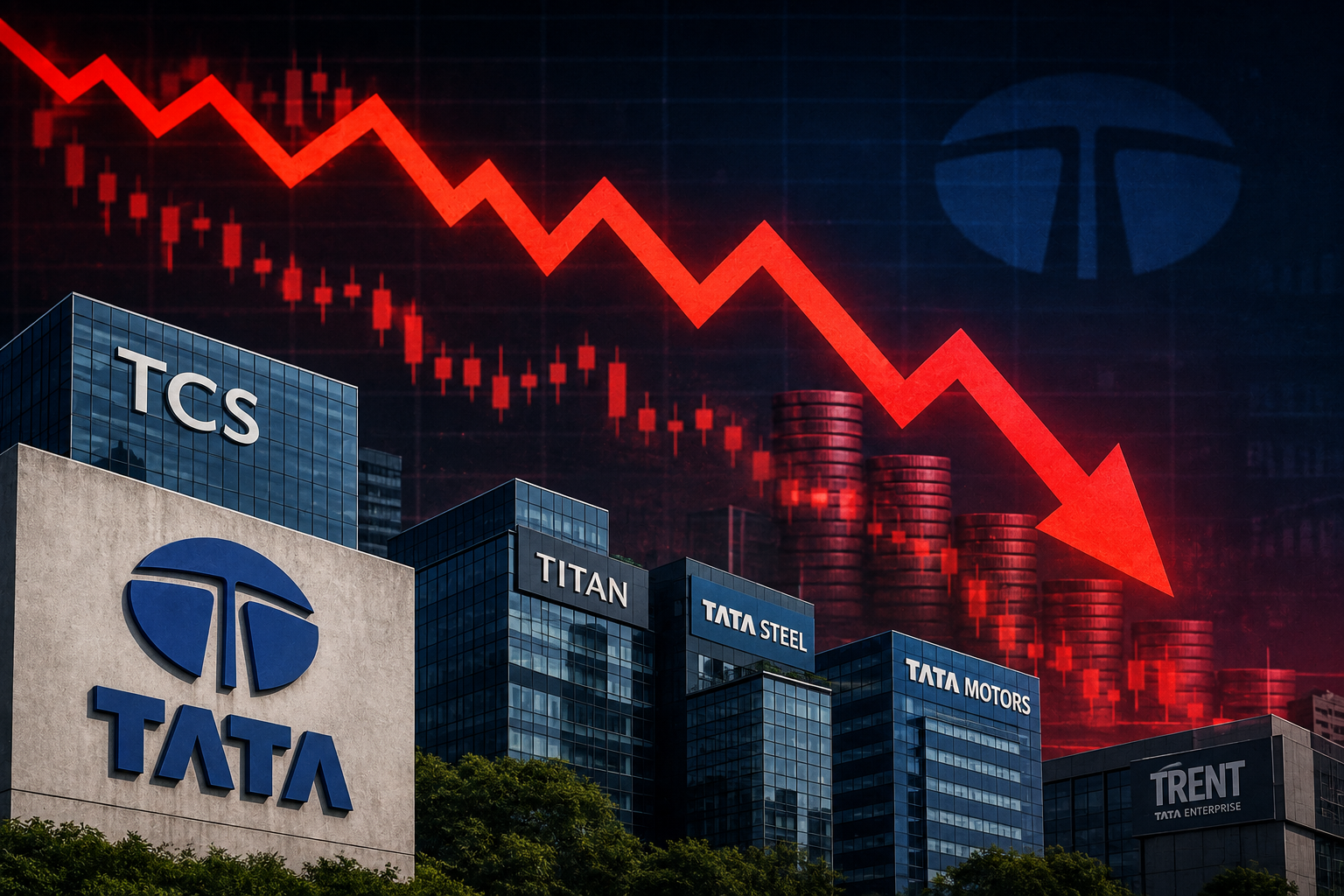
Listed Tata Group companies have witnessed a significant erosion in market value over the past two trading sessions after N Chandrasekaran decided not to seek reappointment as chairman of Tata Sons.
The combined market capitalisation of 26 listed Tata Group companies declined by around ₹43,812 crore to ₹27.04 lakh crore as of 9:23 AM on Thursday, compared with approximately ₹27.48 lakh crore on Tuesday, August 11, according to Capitaline Plus data cited in the market report.
The sell-off has been largely sentiment-driven, with investors assessing what the leadership transition could mean for the group's governance, capital allocation and long-term strategic direction.
However, the market reaction has not been uniform. Tata Motors Commercial Vehicles emerged as a notable outperformer following strong quarterly results, highlighting the continued importance of company-specific fundamentals.
TCS Accounts for 81% of Market-Cap Loss
Tata Consultancy Services (TCS) has been the biggest casualty of the recent selling.
The IT major accounted for around ₹35,421 crore, or approximately 81 per cent, of the total ₹43,812-crore market-cap erosion across the Tata Group companies tracked.
The scale of TCS's contribution is understandable given its position as the group's largest listed company by market value.
The stock's weakness has therefore had an outsized impact on the overall market capitalisation of the Tata Group.
For investors, stabilisation in TCS will be an important factor in determining whether the broader Tata Group sell-off begins to lose momentum.
Titan Emerges as Second-Largest Value Loser
Titan Company recorded the second-largest market-cap erosion among Tata Group companies, with approximately ₹7,040 crore wiped out.
Other major contributors included:
-
Tata Steel: ₹3,371 crore
-
Tata Consumer Products: ₹2,266 crore
-
Tata Motors Passenger Vehicles: ₹2,266 crore
-
Trent: ₹1,717 crore
The broad-based nature of the decline indicates that investors are currently applying a group-level sentiment discount rather than responding solely to company-specific developments.
Why Chandrasekaran's Decision Has Shaken Tata Stocks
N Chandrasekaran's decision not to seek another term as Tata Sons chairman has created a leadership transition at the top of one of India's most prominent corporate groups.
His current term is scheduled to end in February 2027, giving the group time to manage the transition. However, the unexpected nature of the announcement has prompted investors to reassess the succession process and its potential implications.
The market's initial reaction suggests that investors value stability and continuity in Tata Group's leadership structure.
The concern is less about the departure of one individual and more about whether the transition will remain smooth and whether the group's strategic priorities will continue without disruption.
Succession Clarity Becomes the Biggest Trigger
The next chairman of Tata Sons will be one of the most closely watched corporate appointments in India's business landscape.
Investors will assess several factors:
-
The candidate's experience and credibility
-
Relationship with Tata Trusts
-
Ability to manage the group's diverse businesses
-
Approach towards capital allocation
-
Continuity of the existing strategic roadmap
-
Ability to maintain the group's governance standards
A credible and clearly communicated succession plan could help remove the uncertainty premium currently weighing on Tata stocks.
Tata Sons AGM on August 18 in Focus
The Tata Sons Annual General Meeting scheduled for August 18 has now become a crucial event for investors.
The meeting could provide important signals about the leadership transition and the group's succession process.
A clean resolution and clear communication around the transition could support sentiment.
Conversely, any indication of disagreement or prolonged uncertainty could keep Tata stocks under pressure.
The market is therefore likely to treat developments surrounding the AGM as a near-term sentiment catalyst.
Governance Premium Comes Under the Spotlight
The Tata Group has historically commanded a premium in the market because of its reputation for corporate governance, institutional credibility and long-term business orientation.
The current sell-off demonstrates how sensitive investors can be to uncertainty surrounding the group's governance structure.
Anirudh Garg, Fund Manager and Partner at INVasset PMS, said some degree of sentiment pressure across the Tata pack was expected, with the magnitude depending on succession clarity.
The bigger long-term concern, according to the view cited in the market report, would be any prolonged friction between Tata Trusts and Tata Sons.
Such a situation could potentially affect capital allocation and strategic decision-making across the group.
Tata Motors Commercial Vehicles Bucks the Trend
Amid the broad-based decline, Tata Motors Commercial Vehicles (TMCV) emerged as a major exception.
The stock gained around 5 per cent, adding approximately ₹10,533 crore to the market capitalisation of the Tata Group companies.
The stock's rally was driven by strong Q1FY27 earnings and an optimistic demand outlook.
The performance provides an important counterpoint to the broader Tata sell-off: strong fundamentals can continue to attract investors even when group-level sentiment is weak.
Strong Q1 Results Support TMCV
Tata Motors Commercial Vehicles reported healthy results for the June quarter, supported by strong volumes and improving operating performance.
Management remained constructive on the demand outlook and expects the September quarter to deliver double-digit year-on-year volume growth.
July performance was particularly strong despite the monsoon, providing additional confidence around the near-term demand environment.
The company's strong earnings momentum has helped separate its stock performance from the broader Tata Group sentiment shock.
JM Financial Raises TMCV Target
JM Financial retained its BUY rating on Tata Motors Commercial Vehicles while raising its target price to ₹535 from ₹475.
The brokerage cited Q1 margin outperformance and pricing action as key reasons for raising its estimates.
JM Financial revised its FY27 EBITDA margin estimate upward by 30 basis points to 12.3 per cent.
The brokerage's valuation approach also reflects greater confidence in the company's standalone operating performance.
Strong Commercial Vehicle Demand Remains Positive
The commercial vehicle business continues to benefit from several structural demand drivers.
Infrastructure spending, logistics activity, mining, freight movement and improving economic activity are supporting demand for medium and heavy commercial vehicles.
The company's new product range and improving market share are also supporting the growth outlook.
This creates an important distinction between the broader Tata Group governance issue and the underlying operating performance of individual businesses.
Tata Group Stocks Trade Mixed
The Tata Group's stock performance remained mixed during Thursday's session.
Among the gainers were:
-
Tata Motors Commercial Vehicles
-
Tata Teleservices Maharashtra
-
Tata Technologies
-
Nelco
-
Tata Motors Passenger Vehicles
-
Tata Power
These stocks traded higher in the range of around 1 per cent to 5 per cent during the session.
The mixed performance indicates that investors are beginning to differentiate between businesses based on earnings prospects, valuations and their exposure to group-level strategic decisions.
TCS Remains the Critical Stock to Watch
Because TCS accounts for such a large portion of the group's market capitalisation, its performance will remain critical for overall Tata sentiment.
The stock's reaction to the leadership transition is important not only for TCS shareholders but also for investors tracking the Tata Group as a whole.
A stabilisation in TCS could reduce the magnitude of the group's market-cap erosion.
On the other hand, continued selling in TCS could continue to dominate the overall market-cap picture even if other Tata companies recover.
Tata Group's Capital Allocation Under Scrutiny
Another important factor is capital allocation.
The Tata Group has undertaken significant investments across multiple sectors, including:
-
Semiconductors
-
Electronics manufacturing
-
Electric vehicles
-
Batteries
-
Renewable energy
-
Aviation
-
Defence
-
Digital businesses
These businesses require significant capital and long-term strategic commitment.
Investors will therefore want reassurance that the leadership transition will not alter the group's capital allocation priorities or delay major strategic projects.
Will Tata Stocks Recover?
The possibility of a recovery depends heavily on how quickly the leadership uncertainty is resolved.
If the Tata Group communicates a credible succession plan and demonstrates alignment between Tata Trusts and Tata Sons, investor confidence could improve.
In such a scenario, stocks that have declined primarily because of sentiment could potentially recover some of their recent losses.
However, a prolonged succession process or visible disagreement among key stakeholders could result in continued volatility and a higher governance risk premium.
Key Factors Investors Should Monitor
Tata Sons Succession
The identity and credibility of Chandrasekaran's successor will remain the biggest near-term trigger.
August 18 AGM
The Tata Sons AGM could provide important clues regarding the leadership transition.
Tata Trusts-Tata Sons Relationship
Investors will watch for any signs of disagreement that could affect decision-making or capital allocation.
TCS Performance
Given its 81 per cent contribution to the market-cap decline, TCS remains the most important listed Tata stock to monitor.
Capital Allocation
The market will assess whether major investments and expansion plans continue without disruption.
Company-Specific Earnings
Strong earnings could help individual Tata stocks outperform despite broader group-level uncertainty.
What the Current Sell-Off Tells Investors
The sharp decline in Tata Group market capitalisation highlights the importance of governance visibility and succession planning for large corporate groups.
The Tata brand has historically benefited from a strong governance premium. Any uncertainty surrounding leadership can therefore have a valuation impact even when individual businesses continue to perform well.
At the same time, the sharp gain in Tata Motors Commercial Vehicles demonstrates that investors remain willing to reward strong fundamentals.
This suggests that the Tata Group's stocks could increasingly diverge based on their individual earnings outlook rather than moving uniformly.
Market Outlook
The Tata Group has lost nearly ₹44,000 crore in combined market capitalisation over two trading sessions, with TCS accounting for approximately 81 per cent of the decline. The sell-off reflects heightened uncertainty following N Chandrasekaran's decision not to seek reappointment as Tata Sons chairman.
The immediate focus will remain on the August 18 Tata Sons AGM, succession clarity and the relationship between Tata Trusts and Tata Sons.
A transparent and orderly transition could help restore investor confidence, while prolonged uncertainty could keep the governance premium under pressure.
At the same time, investors should differentiate between group-level sentiment risk and company-specific fundamentals. Tata Motors Commercial Vehicles' strong performance following its Q1 results demonstrates that businesses with improving earnings, demand and margins can continue to outperform.
For the broader Tata pack, the key question over the coming months will be whether the group can maintain strategic continuity, disciplined capital allocation and governance credibility during the leadership transition.