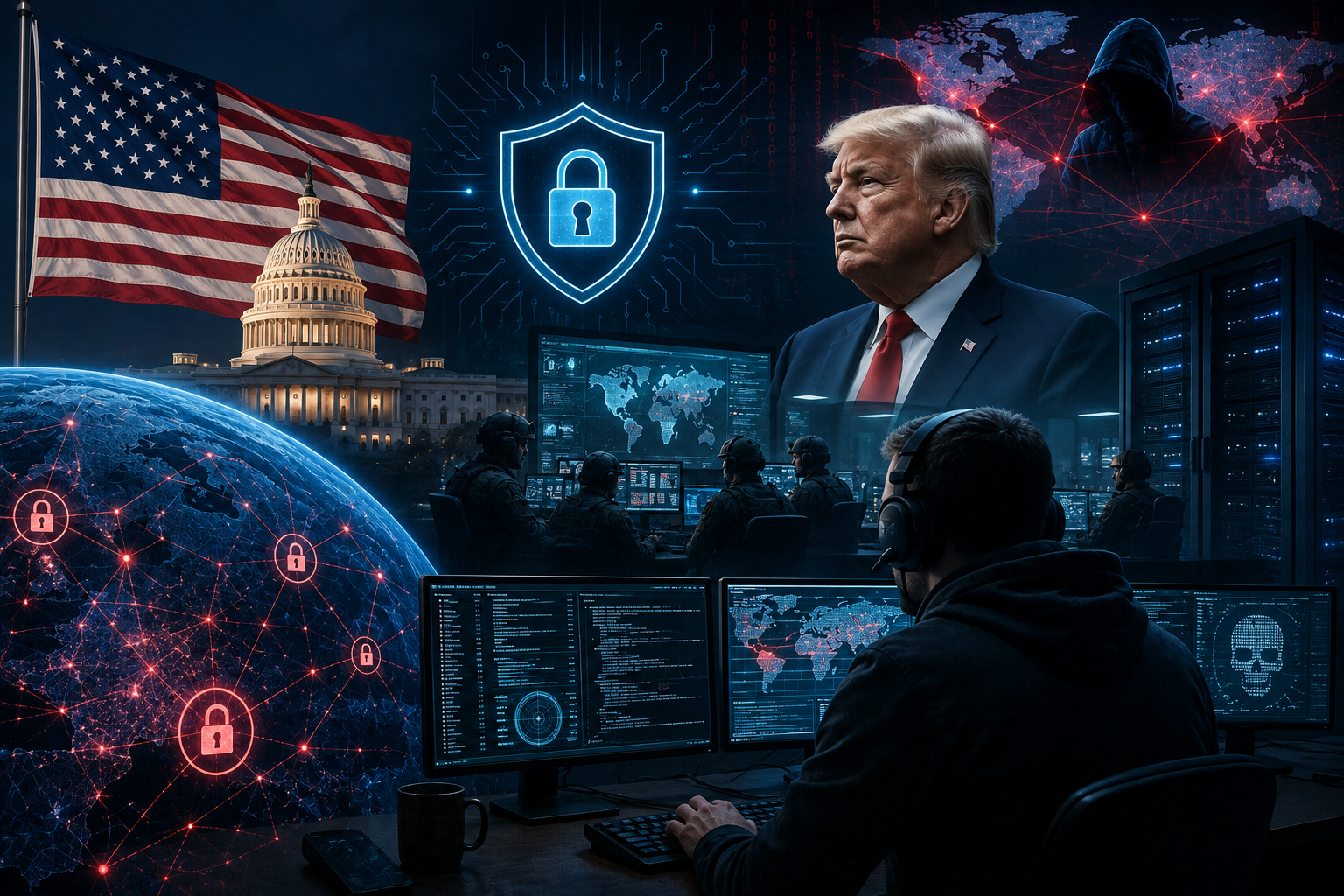
New DHS-Led Programme Will Allow Vetted Private Firms to Conduct Cyber Surveillance and Disruption Operations Under Federal Control
US President Donald Trump has signed a new National Security Presidential Memorandum to expand the government's use of offensive cyber capabilities against foreign-based transnational criminal organisations, marking a significant shift in the role private-sector cybersecurity companies could play in US cyber operations.
Under the new framework, vetted private companies will be allowed to participate in cyber operations under the direction, control and authority of the US government. The initiative is aimed at disrupting foreign criminal networks involved in ransomware, financial fraud and other cyber-enabled crimes targeting Americans.
The programme will be established through the Department of Homeland Security (DHS) and overseen in coordination with the Department of Justice (DOJ). The move could significantly expand the pool of technical expertise available to US authorities as cybercrime becomes increasingly sophisticated and international in nature.
Trump Administration Takes More Aggressive Cyber Approach
The latest memorandum builds on the Trump administration's broader shift towards a more offensive cybersecurity strategy.
Rather than relying primarily on defensive measures such as protecting government networks, identifying malware and blocking attacks, the administration has increasingly emphasised deterrence and proactive disruption of cyber adversaries.
The administration's 2026 National Cybersecurity Strategy had already called for greater private-sector participation in identifying and disrupting adversary networks. The newly announced programme takes that approach further by creating a formal government-controlled framework for private companies to participate in offensive cyber operations.
Private Companies to Operate Under Federal Oversight
The new policy does not give private cybersecurity companies unrestricted authority to conduct cyberattacks independently.
Instead, participating companies will operate under federal supervision and will have to be vetted before taking part.
The memorandum directs DHS, through the Homeland Security Task Force's National Coordination Center, to establish a programme for conducting specific cyber operations against foreign transnational criminal organisations.
The operations will be overseen by DHS and the Justice Department, providing a government chain of authority over participating private-sector firms.
This distinction is important because offensive cyber operations can cross national borders and potentially affect third-party systems. Government control is intended to provide a legal and operational framework around activities that would otherwise expose private companies to substantial risks.
Cyber Surveillance and Disruption Operations
The programme will allow approved companies to participate in both cyber surveillance operations and cyber-effects operations against specified targets.
According to the memorandum, cyber effects can include actions designed to manipulate, disrupt, deny or degrade information systems and networks.
The framework is primarily aimed at foreign transnational criminal organisations whose activities affect Americans.
The White House specifically cited ransomware attacks, financial fraud and other cyber-enabled crimes as examples of threats the initiative is designed to address.
Ransomware and Financial Fraud in Focus
Ransomware has become one of the most damaging forms of cybercrime globally, with criminal groups targeting businesses, hospitals, government agencies and other organisations.
Financial fraud networks have also become increasingly sophisticated, using digital infrastructure, cryptocurrency and cross-border operations to target victims.
The US administration argues that conventional law-enforcement tools can be difficult to deploy against criminal groups operating outside US jurisdiction.
Offensive cyber capabilities could therefore allow authorities to disrupt infrastructure and operations without relying exclusively on arrests or traditional international law-enforcement cooperation.
Private-Sector Expertise Becomes a Strategic Asset
Cybersecurity companies often possess highly specialised capabilities in areas such as threat intelligence, malware analysis, network mapping and identification of criminal infrastructure.
The new programme seeks to bring some of this expertise closer to government operations.
The administration's broader cybersecurity strategy has argued that the private sector can help expand national cyber capabilities by identifying and disrupting adversary networks.
For the cybersecurity industry, the policy could potentially create new government contracts and specialised demand for companies with advanced threat-intelligence and cyber-operation capabilities.
The 'Cyber Letters of Marque' Debate
The policy has been compared by some supporters to the historical concept of letters of marque, under which governments authorised privately owned ships to attack or capture enemy vessels.
The modern comparison has led to the phrase "cyber letters of marque" being used in the debate over private-sector offensive cyber capabilities.
However, the current memorandum is better understood as a government-controlled programme involving vetted private companies, rather than a blanket licence for businesses to independently attack cybercriminals.
The distinction is important because the legal authority, target selection and operational control remain central to the programme.
Why the Policy Is Controversial
The expansion of private-sector participation in offensive cyber operations has raised significant concerns among cybersecurity experts and legal specialists.
One of the biggest risks is unintended escalation.
A cyber operation directed at a criminal organisation could potentially affect infrastructure belonging to unrelated companies, individuals or third parties. Criminal groups may also retaliate against the company or government infrastructure associated with the operation.
Legal and jurisdictional questions become even more complicated when the targeted systems are located outside the United States.
Earlier analysis of the administration's cyber strategy highlighted concerns around the legal framework for private-sector offensive operations, attribution problems and the possibility that attackers could deliberately hide behind compromised third-party infrastructure.
Attribution Remains a Major Challenge
One of the fundamental difficulties in offensive cyber operations is determining who is actually behind an attack.
Cybercriminal organisations can use compromised servers, proxy infrastructure and stolen credentials to conceal their identities and locations.
If a private company incorrectly attributes an attack and conducts an offensive operation against the wrong infrastructure, the consequences could extend well beyond the original criminal activity.
This makes intelligence verification, government oversight and rules of engagement critical components of the new programme.
Escalation Risks Could Increase
Cyber operations do not always remain confined to their original target.
A disruption operation against a criminal network could potentially trigger retaliation, expose sensitive capabilities or result in an adversary targeting critical infrastructure.
The possibility of escalation is particularly important when operations involve foreign jurisdictions.
Critics of private-sector offensive cyber activity have previously argued that criminal networks are resilient and can adapt quickly to takedowns, while aggressive operations can create unintended consequences if attribution or targeting is inaccurate.
Cybersecurity Industry Could Benefit
From an investment perspective, the policy could create additional opportunities for the US cybersecurity ecosystem.
Companies specialising in threat intelligence, cyber threat hunting, endpoint security, network security, malware analysis, digital forensics and advanced cyber operations could potentially benefit from increased government spending and contracting.
The new programme also strengthens the strategic importance of cybersecurity as a national-security capability rather than simply an IT function.
Demand for sophisticated cyber tools could therefore increase as governments seek to identify, monitor and disrupt increasingly complex criminal networks.
Artificial Intelligence Could Become Increasingly Important
Artificial intelligence is also likely to play a growing role in the cybersecurity environment.
Cyber defenders are already using AI for threat detection, anomaly identification, automated analysis and incident response. At the same time, criminals can use AI to automate phishing, fraud, reconnaissance and other malicious activities.
The expansion of offensive cyber operations could therefore accelerate government demand for AI-enabled cybersecurity technologies.
Companies capable of combining AI, threat intelligence and real-time network analysis could become strategically important as the US expands its cyber capabilities.
Government-Industry Collaboration Enters a New Phase
The new programme represents a deeper form of cooperation between government agencies and private cybersecurity companies.
Traditionally, the private sector has played a major role in defending corporate networks and sharing threat intelligence with government agencies.
The new framework could move that relationship further towards joint intelligence gathering and government-directed disruption operations.
The administration believes this could allow the US to respond more quickly to cyber threats by combining government authority with private-sector technical expertise.
Participating Firms Face Higher Compliance Requirements
Private companies taking part in the programme are likely to face substantially greater legal and operational responsibilities than conventional cybersecurity contractors.
According to the memorandum, participating companies must maintain a bond or escrow of at least $1 million.
Such requirements indicate that the government expects firms to meet strict standards before being authorised to participate.
Companies will also have to operate within government-approved parameters, potentially making compliance, auditing, documentation and operational security major requirements.
Impact on Global Cybersecurity Policy
The US move could have implications beyond American borders.
If the programme proves effective, other governments could consider similar public-private models for combating ransomware groups and international cybercrime.
At the same time, the expansion of government-directed offensive cyber operations could contribute to a broader global cyber arms race.
Countries may increasingly develop capabilities not only to defend their networks but also to disrupt foreign cyber infrastructure.
This could make cyberspace an even more important component of international security and geopolitical competition.
Cybercrime Is Becoming a National-Security Issue
The policy reflects a broader transformation in how governments view cybercrime.
Ransomware groups and financial fraud networks can now operate across borders while causing significant economic damage without deploying conventional military force.
Criminal groups can target companies, financial institutions and individuals from infrastructure located thousands of kilometres away.
For governments, this creates a difficult enforcement problem: the victims may be domestic, while the criminals and their infrastructure may be overseas.
The Trump administration's approach is to use offensive cyber capabilities to close that gap.
Key Areas to Watch
Government contracts: Increased spending could benefit cybersecurity and threat-intelligence companies.
Offensive cyber technology: Demand for advanced surveillance and disruption capabilities could increase.
AI cybersecurity: AI-powered detection and threat analysis could become increasingly important.
Legal framework: The extent of private-sector authority and government oversight will remain closely watched.
International response: Other countries may reassess their own offensive cyber capabilities.
Escalation risk: Retaliation and unintended effects remain major concerns.
Market Outlook
Trump's decision to bring vetted private-sector companies into government-controlled offensive cyber operations could create a structural positive for the US cybersecurity and defence-technology ecosystem.
The immediate investment impact is likely to be concentrated in companies providing cyber threat intelligence, network security, advanced analytics, AI-enabled security and government cyber services. The policy could increase demand for sophisticated cybersecurity capabilities as Washington seeks to disrupt ransomware, financial fraud and other foreign cybercrime networks.
However, investors should also watch the legal, regulatory and geopolitical risks. Offensive cyber operations involving foreign infrastructure could trigger retaliation or unintended consequences, while companies participating in the programme could face significantly higher compliance and operational responsibilities.
Over the medium term, the key question will be whether the new framework can demonstrate measurable success in disrupting major criminal networks without creating significant escalation risks. If successful, the policy could accelerate the shift from traditional cybersecurity spending towards active defence, threat intelligence, AI-powered security and offensive cyber capabilities.