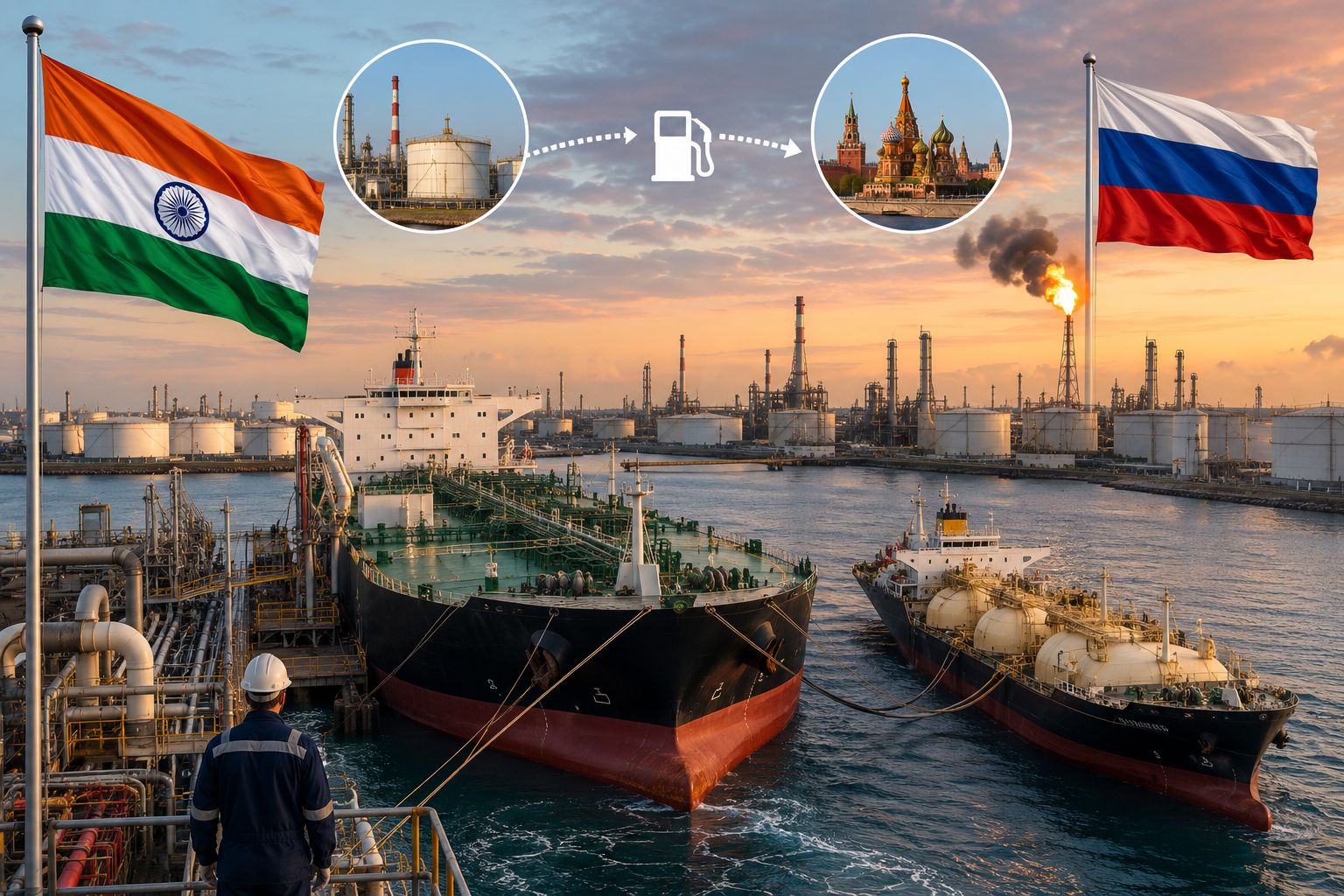
First-ever Indian gasoline shipments to Russia highlight the severity of Moscow’s fuel crunch, while India’s refining sector gains a more prominent role in reshaped global energy trade
Russia has started importing gasoline from India as repeated Ukrainian attacks on its oil-refining infrastructure reduce domestic fuel production, forcing Moscow to look overseas for supplies.
The development marks a striking reversal in traditional energy flows. Russia is one of the world's major crude-oil producers and historically a significant exporter of refined petroleum products. Yet disruptions at its refineries have become severe enough for the country to source motor fuel from India, thousands of kilometres away.
The first reported shipment of Indian gasoline reached Russia on August 5, according to Kpler data cited in the latest reports. Additional cargoes may follow, suggesting that the development could become more than a one-off transaction. (Українські Національні Новини (УНН))
The shift is significant for both countries. For Russia, it highlights growing pressure on the downstream energy system. For India, it underlines the increasing importance of its large refining capacity in global petroleum-product markets.
Russia Faces a Refining, Not Crude, Problem
Russia remains a major crude-oil producer, but crude production alone does not guarantee adequate domestic supplies of petrol or diesel.
Crude must be processed through refineries before it can become usable transport fuel.
The recent attacks have targeted that processing infrastructure, reducing refinery availability and creating an imbalance between crude production and finished-product supply.
This distinction is crucial.
Russia can continue producing crude while simultaneously experiencing a gasoline shortage.
That is precisely the situation now forcing Moscow to consider increasingly distant sources of refined fuel.
Ukrainian Strikes Hit Russian Refining Capacity
Ukrainian attacks on Russian energy infrastructure have intensified, with refineries and processing facilities among the targets.
Lower refinery runs have reduced the volume of gasoline available to the domestic market.
Recent reports indicate that the disruption has become substantial enough for Russian companies to seek additional supplies from abroad. Earlier Reuters reporting said Russian oil companies had approached Indian refiners for more gasoline after losing a significant portion of refining capacity. (Moneycontrol)
The longer refinery outages continue, the greater the pressure on Russia's domestic fuel balance.
Moscow Prioritises Domestic Fuel Supplies
Russia has responded by restricting fuel exports and prioritising domestic consumption.
That policy makes economic sense during a shortage: retaining available gasoline within the country can help prevent more severe price increases and supply disruptions.
However, the policy also removes Russia as a supplier from portions of the international refined-fuel market.
This creates an unusual situation in which Russia, traditionally an exporter, is simultaneously reducing exports and increasing imports.
India Emerges as a New Source
The first reported shipment from India marks an important development in the changing trade pattern.
The fuel originated from Nayara Energy's Vadinar refinery in Gujarat, which has a processing capacity of around 400,000 barrels per day.
Reuters had previously reported that traders were selling gasoline produced by Nayara Energy into Russia, while India's Oil Minister Hardeep Singh Puri said Indian companies were not directly selling fuel to Russia but acknowledged that Russian buyers could obtain Indian-origin fuel through traders. (The Economic Times)
This distinction is important because the trade can involve intermediaries rather than a direct refiner-to-Russian-company transaction.
Nayara Energy's Russia Connection
Nayara Energy has a particularly unusual position in the global oil market.
Russian oil major Rosneft holds a 49% stake in Nayara, making the Indian refiner closely linked to Russia's energy sector.
Its Vadinar refinery has also remained heavily dependent on Russian crude following sanctions-related changes in its supply chain.
The refinery's ability to process Russian crude into refined products means that Russian-origin crude can effectively become Indian-produced gasoline and other petroleum products.
This creates an increasingly interconnected India-Russia energy relationship.
Vadinar Refinery Becomes Strategically Important
The Vadinar refinery is located on India's western coast, providing access to major international shipping routes.
Its coastal location makes it suitable for both importing crude and exporting refined products.
The refinery's large scale also gives Nayara the ability to produce substantial quantities of gasoline and other fuels.
As global trade routes are disrupted by sanctions and geopolitical conflicts, large coastal refineries such as Vadinar can become important balancing points in the international petroleum market.
The First Shipment Was a Long Journey
The reported inaugural cargo illustrates how complicated the new supply chain has become.
A Russian-flagged products tanker, identified in shipping data as Cyclone, reportedly loaded approximately 42,000 tonnes of gasoline at Vadinar in June.
The cargo was subsequently transferred to another vessel near Egypt before continuing towards Russia.
The shipment eventually arrived in early August.
The lengthy voyage is significant because Russia has nearby fuel-producing countries and refineries, yet it still sourced gasoline from India.
That suggests the domestic shortage has become serious enough to justify the additional transportation and logistical costs. (Українські Національні Новини (УНН))
More Cargoes Could Follow
Shipping data suggests that additional Indian gasoline shipments may be moving through similar routes.
Another tanker reportedly loaded close to 40,000 tonnes of gasoline at Vadinar in July, while another vessel also departed the refinery carrying gasoline.
Some of the cargoes are believed to have involved ship-to-ship transfers near Egypt.
If these movements continue, India could become a recurring source of gasoline for Russia rather than simply providing emergency supplies.
Why Ship-to-Ship Transfers Matter
A ship-to-ship, or STS, transfer involves moving cargo from one vessel to another.
STS operations are widely used in global shipping for logistical reasons.
They can allow:
-
Cargo consolidation
-
Vessel changes
-
Route optimisation
-
Reduced port delays
-
Greater shipping flexibility
In sanctioned energy markets, however, such operations receive additional scrutiny because they can make cargo movements more complex to trace.
The reported Indian-to-Russian gasoline route demonstrates how sanctions and geopolitical disruptions are creating increasingly complicated supply chains.
Egypt Becomes an Important Transit Point
The reported transfers around Damietta, Egypt, are also notable.
The eastern Mediterranean provides a strategic location between Asian supply routes and European/Russian destinations.
Moving cargo between vessels around Egypt allows traders to reorganise shipments before the final leg of the journey.
This is another example of how geopolitical disruptions are changing established shipping patterns.
Russia's Fuel Problem Has Become a Logistics Problem
The gasoline shortage is no longer simply about refinery capacity.
It is also about finding, transporting and financing alternative supplies.
An imported cargo from India involves:
Refinery production → vessel loading → long-distance shipping → possible ship-to-ship transfer → onward transportation → Russian delivery
Every additional stage adds cost and complexity.
The fact that Russia is willing to use such a route illustrates the pressure facing its domestic fuel market.
Why Russia Cannot Simply Increase Refinery Output
Restarting a refinery after an attack is not always straightforward.
Damage can affect:
-
Distillation units
-
Catalytic cracking systems
-
Reformers
-
Storage facilities
-
Power systems
-
Loading infrastructure
-
Pipeline connections
Even when physical damage appears limited, safety inspections and repairs can delay a return to full capacity.
Repeated attacks can make the situation even more difficult because operators must repair facilities while preparing for the possibility of further disruptions.
Domestic Gasoline Prices Become a Concern
Fuel shortages can quickly translate into higher domestic prices.
Gasoline is a highly visible consumer product, and sharp price increases can create political and economic pressure.
Higher fuel prices also feed into the wider economy through transportation and logistics costs.
That can eventually affect:
-
Food distribution
-
Industrial transportation
-
Agriculture
-
Consumer inflation
-
Business operating costs
Russia therefore has a strong incentive to stabilise gasoline availability.
Why Moscow Is Restricting Exports
Russia's export restrictions are designed to preserve domestic supplies.
By reducing exports, the government can redirect available production towards Russian consumers.
But the strategy has a global consequence.
Less Russian gasoline available to international buyers means other producers may need to fill the gap.
This can support international refining margins and potentially increase competition for available cargoes.
India Could Benefit From Stronger Product Demand
Indian refiners could potentially benefit if international demand for gasoline remains elevated.
India has become an important refining hub because of its large processing capacity and strategic coastal location.
When overseas markets experience supply disruptions, Indian refiners can redirect refined products towards those markets when economics and regulations permit.
This flexibility can provide an additional source of earnings for refining companies.
But Sanctions Create Significant Risks
The opportunity comes with substantial regulatory and geopolitical complications.
Nayara has faced restrictions and operational challenges following European Union sanctions.
Reuters reported that the company has relied heavily on traders for crude imports and refined-fuel exports as sanctions complicated conventional commercial relationships. (The Economic Times)
For companies involved in Russia-linked energy trade, sanctions compliance remains a critical consideration.
Potential risks include:
-
Banking restrictions
-
Insurance limitations
-
Vessel sanctions
-
Payment difficulties
-
Counterparty risk
-
Secondary-sanctions exposure
-
Regulatory uncertainty
India-Russia Energy Trade Becomes More Interconnected
The gasoline shipments add another layer to the already significant India-Russia energy relationship.
India has become one of the largest buyers of Russian crude, while Russian-linked interests remain involved in India's refining industry.
The latest development effectively creates a circular energy relationship:
Russia supplies crude → Indian refinery processes crude → Refined fuel can be exported → Russia becomes a buyer of the refined product
This demonstrates how sanctions and geopolitical developments can reshape commodity trade without necessarily eliminating the underlying economic relationships.
India Is Becoming a Global Refining Hub
The development also highlights India's transformation from primarily an oil-importing economy into a major global refining centre.
India imports crude because domestic production is insufficient to meet refinery demand.
Its sophisticated refining infrastructure then converts that crude into higher-value petroleum products.
Some of those products are consumed domestically, while others are exported.
This gives India an important role in balancing global refined-product markets.
Refining Margins Could Become More Important
If Russian refinery disruptions reduce global gasoline availability, refined-product prices could strengthen relative to crude.
That could improve refining margins, particularly for efficient coastal refineries capable of exporting fuel.
Indian refiners may therefore benefit if the disruption persists.
However, the benefit is not guaranteed.
Higher crude prices, freight costs or regulatory restrictions could offset gains from stronger product prices.
The Difference Between Crude and Product Markets
Investors should distinguish between the impact on crude markets and the impact on refined products.
A refinery outage does not necessarily remove crude from the global market.
Instead, it reduces the conversion of crude into usable products.
That means the initial impact may be more pronounced in:
-
Gasoline
-
Diesel
-
Jet fuel
-
Refining margins
rather than in crude-oil supply itself.
Global Fuel Markets Could Tighten
Russia is one of the world's largest petroleum producers.
If its domestic refinery disruptions continue, Moscow may need to absorb refined products from other countries while simultaneously reducing its own exports.
This could tighten international fuel markets.
Other refiners may face increased demand, potentially supporting margins.
The effect will depend heavily on the duration and scale of the Russian refinery outages.
Middle East Risks Add Another Layer
The Russian fuel shortage is developing against a wider backdrop of geopolitical uncertainty in the Middle East.
Any disruption to major oil-producing regions or shipping routes could further tighten global energy markets.
The simultaneous presence of Russian refinery disruptions and Middle East supply risks creates the possibility of greater volatility in petroleum prices.
For energy-intensive economies, this could become an important inflation risk.
Implications for India
For India, the development presents both opportunities and challenges.
Potential Benefits
Indian refiners could gain from stronger international demand.
Higher refining margins could support earnings for companies with export-capable refineries.
India's strategic importance in global fuel markets could also increase.
Potential Risks
Higher global crude prices would increase India's import bill.
If geopolitical tensions push oil sharply higher, the rupee could come under pressure and domestic inflation could increase.
India therefore benefits from higher refining activity but remains vulnerable to crude-price shocks.
Impact on Indian Refiners
The development could be relevant for India's refining sector, particularly companies with significant export capabilities.
The key variables are:
-
Gross refining margins
-
Crude procurement costs
-
Export realisations
-
Freight rates
-
Currency movements
-
Regulatory restrictions
Companies that can efficiently shift between domestic and export markets may have an advantage during periods of global disruption.
Nayara Faces a Different Situation
Nayara's position is more complicated than that of many other Indian refiners because of its Russian ownership connection and sanctions exposure.
The company needs to balance:
Refinery utilisation + crude availability + export markets + sanctions compliance
Its ability to maintain efficient operations and market refined products will be important for the company's financial performance.
What Happens If Russian Refinery Attacks Continue?
If attacks continue at the current pace, Russia may need additional imports.
That could create sustained demand for gasoline from India and potentially other countries.
The longer the disruptions continue, the greater the likelihood that Russia will need to establish alternative fuel-supply channels.
This could make Indian gasoline a recurring component of Russian imports.
What If Russian Refineries Recover?
A rapid recovery in refinery operations would reduce the need for imported gasoline.
In that scenario, the current India-Russia trade could remain a temporary emergency response.
This is why refinery utilisation data will be one of the most important indicators to monitor.
Diesel Could Become the Next Concern
Gasoline is currently the most visible shortage.
However, prolonged refinery disruptions could eventually affect other petroleum products.
Diesel is particularly important because of its use in:
-
Heavy transport
-
Agriculture
-
Mining
-
Construction
-
Industry
-
Military logistics
If diesel supplies become constrained, Russia could face an even broader downstream energy challenge.
Why This Matters for Global Investors
The development is a reminder that geopolitical conflicts increasingly affect physical commodity supply chains.
Investors should not focus only on crude oil production figures.
They should also monitor:
-
Refinery outages
-
Product inventories
-
Export restrictions
-
Shipping routes
-
Freight rates
-
Sanctions
-
Refining margins
These factors can sometimes move markets faster than changes in headline crude production.
Key Takeaways
Russia is importing Indian gasoline
The first reported shipment arrived in Russia on August 5, marking a significant change in trade flows. (Українські Національні Новини (УНН))
Ukrainian attacks are disrupting refining
Repeated strikes have reduced Russian refinery operations and tightened domestic gasoline supplies.
Nayara Energy is central to the story
The Vadinar refinery has emerged as a source of gasoline for the Russia-linked trade route, while Rosneft holds a 49% stake in Nayara. (The Economic Times)
Ship-to-ship transfers are being used
Cargoes have reportedly been transferred between vessels near Egypt before continuing towards Russia.
Russia is prioritising domestic demand
Moscow has restricted fuel exports as it attempts to stabilise domestic supplies.
Indian refiners could benefit
A tighter global refined-product market could support refining margins, although sanctions and crude-price risks remain.
Oil-importing economies remain vulnerable
A wider geopolitical escalation could push crude prices higher and increase inflationary pressure.
What Investors Should Watch Next
1. Russian Refinery Utilisation
A recovery would reduce the need for imports; continued outages would increase pressure.
2. Additional Indian Cargoes
More shipments would suggest the Russia-India gasoline trade is becoming established.
3. Global Gasoline Cracks
Stronger gasoline margins could benefit export-oriented refiners.
4. Brent Crude
A sustained crude-price increase could offset some refining benefits.
5. Sanctions Developments
New restrictions could materially alter shipping and payment arrangements.
6. Tanker Freight Rates
Long-distance fuel movements could increase demand for suitable product tankers.
7. Russian Fuel Export Policy
Any extension or tightening of export restrictions could affect global product availability.
Market Outlook
Russia's move to import gasoline from India is a major signal of stress in its downstream energy system. The significance lies not simply in the volume of fuel involved, but in the fact that a major oil producer and historically important refined-product exporter is sourcing gasoline from a distant refining hub.
For India, the development reinforces the strategic value of its refining infrastructure. The country can potentially benefit from disruptions in global product markets because its refiners have the ability to process large volumes of crude and redirect refined products towards international markets.
However, the opportunity must be balanced against sanctions, shipping, payment and geopolitical risks, particularly for Nayara Energy because of Rosneft's 49% ownership stake. Earlier Reuters reporting also showed that Indian-origin gasoline had already been reaching Russia through traders, demonstrating that this is not an entirely new trade relationship. (The Economic Times)
For the broader market, the key question is whether Russian refinery disruptions remain temporary or become prolonged. Continued Ukrainian attacks could force Russia to import more gasoline and potentially other refined products, while further reducing its exports.
That scenario could support global gasoline prices, refining margins and tanker demand, while potentially increasing volatility in crude and energy markets.
For Indian investors, the key sectors to monitor are refining, oil marketing, shipping and energy infrastructure. At the same time, higher global crude prices could increase India's import bill and put pressure on inflation and the rupee.
The most important indicators going forward will be Russian refinery utilisation, additional Indian gasoline shipments, global refining margins, Brent crude prices, tanker freight rates, sanctions developments and Russia's fuel-export policy.
The latest development ultimately shows how the global energy market is being reshaped by geopolitics: Russian refinery disruptions are creating demand for Indian refined fuel, while India's refining capacity is becoming an increasingly important component of the global energy-supply network. (RBC Ukraine)