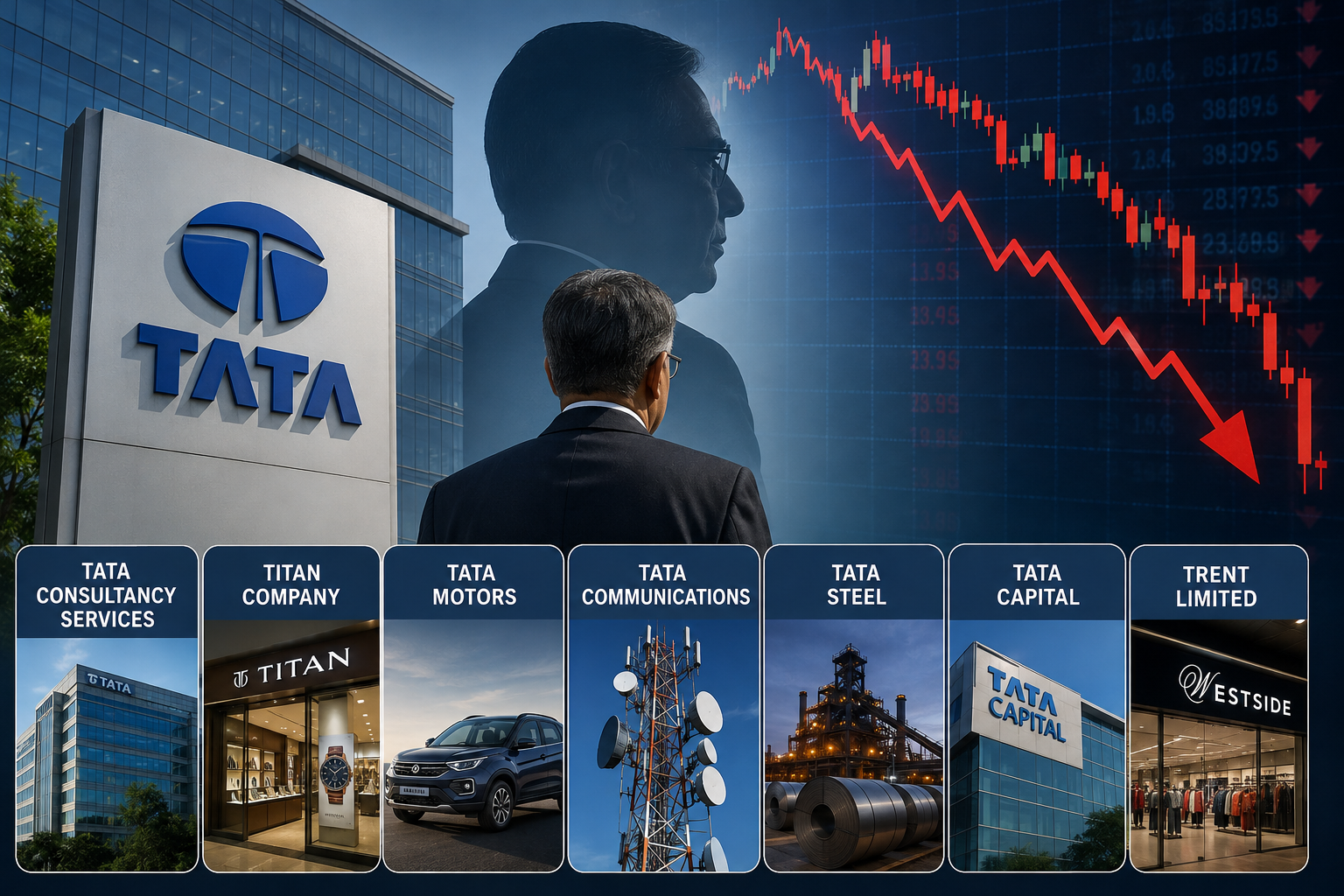
TCS, Titan, Tata Motors and other Tata stocks fall up to 5% as investors react to leadership transition; analysts say individual businesses remain fundamentally independent
Tata Group stocks came under pressure on Wednesday after N Chandrasekaran decided not to seek reappointment as chairman of Tata Sons, triggering a wave of selling across several listed Tata companies.
Stocks including Tata Consultancy Services (TCS), Titan, Tata Communications and Tata Motors Passenger Vehicles traded lower during intraday deals, with some counters falling as much as 4–5%.
The immediate market reaction reflects uncertainty surrounding the leadership transition and the eventual choice of Chandrasekaran's successor. However, analysts believe the impact on the operating businesses could remain limited over the longer term because Tata Group companies have their own management teams, boards and business-specific growth drivers.
The key issue for investors, therefore, is whether the leadership change represents a fundamental shift in Tata Group's strategy or merely a change at the promoter and holding-company level.
Why Tata Group Stocks Fell After Chandra's Exit
The initial decline in Tata stocks appears to be largely sentiment-driven.
Chandrasekaran has been one of the most prominent figures in the Tata Group since taking over as chairman of Tata Sons in 2017. Before that, he served as chief executive officer of TCS and played a major role in shaping the group's strategic direction.
His decision to step down creates uncertainty around succession, particularly because the market does not yet have complete clarity about who will take over the chairman's role.
Investors typically react cautiously when there is an unexpected change at the top of a large business group, particularly one with a broad portfolio spanning technology, automobiles, steel, consumer products, financial services, aviation and electronics.
Tata Sons Chairman Does Not Run Listed Companies Day-to-Day
One of the most important factors investors need to understand is the distinction between Tata Sons and the operating companies.
Tata Sons is the principal holding company and promoter of several Tata businesses. However, listed companies such as TCS, Titan, Tata Motors, Tata Steel and Indian Hotels have their own boards and professional management teams.
Their day-to-day operations are not directly managed by the chairman of Tata Sons.
As a result, a change in the chairman's office does not automatically mean a change in the business strategy, management or operating performance of every Tata company.
This is one of the main reasons analysts expect the long-term impact on individual stocks to be limited.
Each Tata Company Has Its Own Earnings Drivers
The Tata Group is extremely diversified, and its listed companies operate in very different industries.
The factors affecting TCS are completely different from those influencing Tata Steel or Titan.
For example:
-
TCS is driven by global technology spending, AI adoption, deal wins and IT budgets.
-
Titan depends on jewellery demand, consumer spending, gold prices and retail expansion.
-
Tata Motors is influenced by commercial vehicles, passenger vehicles, EVs and JLR.
-
Tata Steel is exposed to steel prices, raw-material costs and global demand.
-
Indian Hotels is driven by tourism, occupancy, room rates and hotel expansion.
-
Tata Capital depends on credit growth, asset quality, interest rates and financial-sector demand.
Therefore, investors should be careful about treating all Tata stocks as one single investment proposition.
TCS Faces Company-Specific Challenges
TCS remains one of the largest and most important companies within the Tata Group, but its current challenges are primarily industry-specific.
The global IT services industry is undergoing a significant transformation due to artificial intelligence, changing technology spending patterns and pressure on traditional outsourcing models.
Clients are increasingly looking for productivity improvements and AI-led solutions, while discretionary technology spending remains sensitive to global economic conditions.
Consequently, TCS's future performance will depend heavily on its ability to convert its AI capabilities and large deal pipeline into sustainable revenue growth.
The leadership transition at Tata Sons is unlikely to change these fundamental drivers.
Titan's Consumer Story Remains Independent
Titan is another major Tata company whose long-term performance is driven largely by consumer demand.
The company has established strong positions in jewellery, watches and other lifestyle categories.
Jewellery demand is influenced by household income, consumer confidence, gold prices, wedding expenditure and market-share gains.
Titan's premium valuation also means that investors are likely to focus closely on earnings growth.
The Tata Sons transition may temporarily influence sentiment, but the company's long-term stock performance will ultimately depend more on its ability to grow revenue, expand its retail network and maintain profitability.
Tata Motors Has Multiple Operating Variables
Tata Motors has a particularly complex earnings profile because of its exposure to multiple automotive businesses.
The domestic commercial vehicle business is linked to economic activity, freight movement, infrastructure spending and industrial production.
The passenger vehicle business depends on new model launches, SUV demand, electric vehicles and competitive intensity.
Jaguar Land Rover adds another layer of global exposure, with performance influenced by luxury-vehicle demand, currency movements, tariffs and economic conditions in key international markets.
These factors are likely to have a much larger influence on Tata Motors' earnings than the leadership transition at Tata Sons.
Tata Steel Remains Exposed to Commodity Cycles
Tata Steel's performance is similarly driven by industry-specific variables.
Steel prices, iron ore and coking coal costs, European operations, global demand and Chinese production remain critical factors.
The company has limited control over many of these variables.
Consequently, investors evaluating Tata Steel should continue to focus on the steel cycle, capacity utilisation, spreads and cost management rather than placing excessive emphasis on the Tata Sons chairman transition.
Tata Capital Represents a Domestic Growth Opportunity
Tata Capital is among the Tata businesses with substantial exposure to India's domestic economic cycle.
Its growth depends on consumer and business credit demand, interest rates, asset quality and lending margins.
As India's financialisation continues, the long-term opportunity for diversified financial-services businesses remains significant.
However, investors will need to monitor credit costs and asset quality alongside loan growth.
Again, these company-specific variables are likely to determine the stock's long-term performance more than the change at Tata Sons.
Tata Group's 2026 Performance Has Been Highly Divergent
The performance of Tata stocks during calendar 2026 itself demonstrates that there is no uniform Tata Group trend.
According to the data cited in the report, stocks including Nelco, Tata Technologies, Titan Company, Oriental Hotels, Tata Capital, Tata Steel and Trent had gained between approximately 7% and 39% through August 11.
In contrast, Tata Elxsi, TCS, Rallis India, Tata Teleservices (Maharashtra), Tata Chemicals and Tata Consumer Products had declined by as much as 27%.
The Nifty 50 had also declined approximately 6% over the same period.
This wide divergence reinforces the argument that stock-specific fundamentals remain much more important than the Tata Group identity alone.
Succession Is the Biggest Near-Term Unknown
While the operating companies have independent management structures, the identity of the next Tata Sons chairman remains an important issue.
The successor will be expected to maintain the group's governance standards while overseeing an increasingly diverse portfolio.
The Tata Group has expanded into several capital-intensive and strategically important areas in recent years, including:
-
Semiconductor manufacturing
-
Electronics
-
Aviation
-
Electric vehicles
-
Financial services
-
Digital businesses
-
New-age manufacturing
The next chairman will therefore inherit a significantly more complex group than the one Chandrasekaran took charge of.
Capital Allocation Will Be Closely Watched
One of the biggest responsibilities of the Tata Sons leadership is maintaining discipline around capital allocation.
The group has made substantial investments in new businesses and expansion projects.
These investments could create significant long-term value if executed successfully, but they also require large amounts of capital and may take several years to generate attractive returns.
Investors will therefore watch whether the new leadership continues the existing investment strategy or adopts a more selective approach.
Air India Remains a Major Strategic Bet
The Tata Group's acquisition and restructuring of Air India is one of its most visible recent strategic moves.
The airline business requires significant investment in aircraft, technology, infrastructure, customer experience and network expansion.
The integration of Air India and Vistara has also created a much larger aviation platform.
While the business could become strategically important over the long term, investors will continue to monitor whether the airline can achieve sustainable profitability.
The chairman transition could lead to greater scrutiny of the group's capital allocation towards aviation, but there is no indication from the supplied analyst views that the overall strategy will necessarily change immediately.
New Businesses Need Strong Execution
The Tata Group has been investing heavily in businesses that could become important future growth engines.
Semiconductors and electronics manufacturing are among the most prominent examples.
These businesses have the potential to strengthen India's manufacturing ecosystem and provide Tata Group with new strategic opportunities.
However, they also require substantial capital expenditure and technological expertise.
The next phase of Tata's growth will therefore depend not just on entering new industries but also on achieving scale, profitability and competitive advantages.
Governance Remains a Major Tata Strength
The Tata brand has traditionally carried a strong reputation for governance and institutional credibility.
This creates what analysts describe as a governance premium for many Tata companies.
Investors may be willing to assign higher valuations to businesses because of confidence in the group's governance standards, management quality and long-term orientation.
The leadership transition therefore needs to be handled carefully.
A transparent and orderly succession process could preserve this premium, while prolonged uncertainty could temporarily weaken investor confidence.
Analysts Call It a Governance Event, Not an Earnings Event
An important distinction highlighted by analysts is that Chandrasekaran's exit is primarily a governance and succession event rather than an earnings event.
There has been no immediate change to the revenue outlook, margins, production volumes or demand environment of most Tata operating companies because of the chairman's decision.
This suggests that investors should avoid extrapolating the initial stock-market reaction into a long-term earnings forecast.
The fundamental question remains whether the companies themselves continue to deliver.
Short-Term Volatility Could Continue
Despite the limited long-term fundamental impact, Tata stocks could remain volatile in the near term.
Investors may continue to adjust positions until greater clarity emerges on the succession process.
Stocks that have high valuations or are already facing earnings concerns could experience greater volatility.
Conversely, companies with strong earnings visibility and independent growth drivers could recover more quickly once the initial uncertainty fades.
Could the Tata Premium Return?
The answer will depend significantly on the succession process.
If Tata Sons identifies a credible leader who can maintain governance standards and provide strategic continuity, the current uncertainty could gradually disappear.
A clear succession roadmap could therefore become a positive catalyst for Tata stocks.
Investors may once again shift their focus from group-level governance questions to individual company earnings.
Tata Stocks That Could Be More Resilient
Companies with strong standalone business models and relatively self-sustaining earnings engines may be better positioned to absorb temporary sentiment pressure.
These include businesses such as:
TCS
Strong global client relationships, technology capabilities and cash generation provide a significant degree of operational independence.
Titan
Its strong consumer franchise and distribution network remain important long-term advantages.
Trent
The company's retail expansion and growth strategy are primarily driven by consumer demand and store economics.
Indian Hotels
Hospitality demand, room rates and expansion remain the key drivers.
Tata Capital
Domestic credit growth and financialisation provide a structural opportunity.
Stocks Requiring Greater Fundamental Scrutiny
Not every Tata stock should automatically be viewed as a buying opportunity following the sell-off.
Companies facing existing operational challenges, elevated valuations or large capital requirements may require more detailed analysis.
For example, investors should independently assess:
-
Earnings growth
-
Valuation
-
Debt levels
-
Return ratios
-
Free cash flow
-
Capital expenditure
-
Competitive position
-
Management execution
The Tata brand alone should not be considered sufficient justification for owning a stock.
What Investors Should Watch Next
Several developments could determine how Tata stocks perform from here.
Tata Sons Succession
The identity and credibility of the next chairman will be the most important immediate development.
Governance Continuity
Investors will assess whether the new leadership maintains the group's established governance standards.
Capital Allocation
The market will watch investments in aviation, semiconductors, electronics and other emerging businesses.
Individual Earnings
Quarterly results will remain the most important fundamental driver for listed Tata companies.
Valuations
Stocks trading at premium multiples will require continued earnings delivery.
Foreign Institutional Flows
Global investor sentiment can significantly influence large-cap Tata companies such as TCS and Tata Motors.
Risk of Treating Tata Group as One Stock
One of the biggest mistakes investors could make is treating the Tata Group as a single stock.
The group contains companies with very different:
-
Business models
-
Growth rates
-
Debt profiles
-
Valuations
-
Capital requirements
-
Competitive environments
-
Management structures
A decline in one Tata company does not necessarily create a buying opportunity in another.
The leadership transition should therefore be viewed as a group-level event, while investment decisions should remain company-specific.
Long-Term Tata Story Remains Intact
Despite the current uncertainty, the Tata Group's broader long-term strategy remains supported by India's structural growth opportunities.
The group has exposure to several important themes, including:
-
Digitalisation
-
Artificial intelligence
-
Premium consumption
-
Electric mobility
-
Financialisation
-
Manufacturing
-
Semiconductors
-
Electronics
-
Aviation
-
Tourism
-
Infrastructure
If these businesses execute effectively, they could create multiple long-term growth engines.
The challenge for the next chairman will be ensuring that this diversification translates into sustainable returns on capital.
Market Outlook
The initial fall in Tata Group stocks following N Chandrasekaran's decision to step down as Tata Sons chairman appears to be primarily a sentiment and governance-related reaction rather than an immediate deterioration in the earnings outlook of the group's listed companies.
The distinction between Tata Sons and individual operating companies is critical. TCS, Titan, Tata Motors, Tata Steel, Tata Capital and Indian Hotels have their own management teams and independent business drivers.
The near-term focus will remain on succession clarity and governance continuity. A credible and orderly transition could help restore the governance premium associated with Tata companies and allow investors to refocus on earnings.
At the same time, the leadership transition provides an opportunity for the next Tata Sons chairman to review capital allocation, particularly across newer and capital-intensive businesses such as aviation, semiconductors and electronics.
For investors, the key approach should be to evaluate each Tata stock independently on earnings growth, valuation, balance-sheet strength, competitive position and capital allocation, rather than assuming that all Tata companies will move in the same direction.
If the succession process remains orderly, analysts' view that the current weakness is largely temporary could prove correct. The next major catalyst will be clarity on the new leadership and whether the group can maintain its governance standards while converting its ambitious expansion strategy into sustainable shareholder returns.