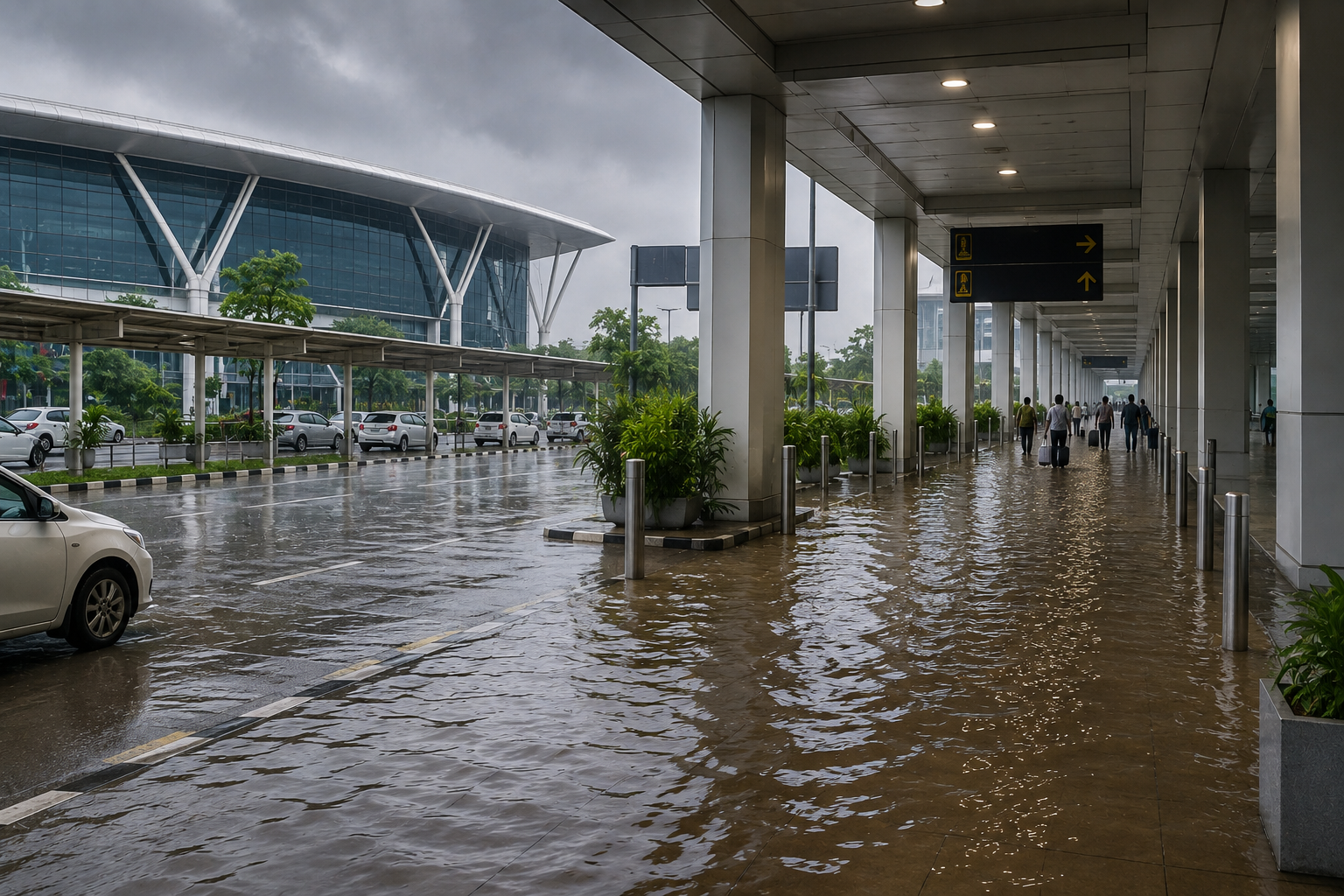
Rainwater enters terminal-parking passage at newly operational Jewar airport; water cleared within 30 minutes as operator reviews drainage system
Noida International Airport in Jewar, Uttar Pradesh, witnessed temporary waterlogging after an intense spell of rainfall on Tuesday, bringing the newly operational airport's rainwater-management and passenger-access infrastructure under scrutiny.
The airport operator said extremely heavy rainfall over a short period caused rainwater to enter the passage connecting the terminal with the parking area. Airport teams responded promptly and cleared the accumulated water in less than 30 minutes.
Despite the incident, the airport said there was no disruption to flight operations. Traffic was temporarily diverted through an alternative route, while passengers were allowed to be picked up directly at the kerb.
The incident came into focus after videos showing waterlogging at parts of the airport circulated on social media, raising questions about the preparedness of the recently opened facility to handle intense monsoon rainfall.
Water Cleared Within 30 Minutes
According to the airport operator, the water accumulation was limited to a passage connecting the terminal and parking area.
Teams were deployed immediately after the rainfall caused water to enter the passage. The airport said the water was cleared within approximately 30 minutes, allowing normal movement to resume.
During the response period, vehicle traffic was redirected through an alternative route.
Passengers were also permitted to use direct kerbside pick-up arrangements, reducing the impact on people travelling to and from the terminal.
The quick response helped prevent the temporary waterlogging from developing into a larger operational disruption.
No Flights Were Cancelled or Disrupted
One of the most important points highlighted by the airport is that flight operations were not affected.
The water accumulation occurred in an access passage rather than an area directly involved in aircraft movement.
The airport continued handling flights while teams worked to clear the affected section.
This means the incident was primarily a landside infrastructure issue, rather than an interruption to runway, aircraft or air-traffic operations.
For passengers, however, even temporary waterlogging at terminal access points can create inconvenience, particularly during periods of heavy rainfall.
Social Media Videos Trigger Attention
Videos of waterlogging at the airport quickly circulated online, drawing significant public attention.
The visuals generated criticism and questions about the quality and capacity of the drainage infrastructure at one of India's newest airports.
The response also highlights the challenges faced by newly commissioned infrastructure projects, where early operational experience can expose areas requiring modification or improvement.
The airport operator has said it is reviewing the incident and will take corrective action wherever necessary.
Airport Operator to Review Incident
The airport authorities have indicated that the incident is being examined to determine whether any improvements are required.
The review could focus on the drainage capacity of the affected area, water-flow patterns during high-intensity rainfall and the effectiveness of existing stormwater-management arrangements.
Such reviews are particularly important because the airport is expected to expand substantially over the coming years.
Addressing potential drainage weaknesses at an early stage could help avoid larger problems as passenger volumes and vehicle movements increase.
Newly Operational Airport Faces Monsoon Challenge
Noida International Airport is still in the early stages of commercial operations.
The airport was inaugurated on March 28, 2026, and commercial operations began on June 15, with IndiGo operating the first commercial flight.
The current monsoon season therefore represents one of the first significant tests of the airport's supporting infrastructure under intense rainfall.
An isolated incident does not necessarily indicate a systemic infrastructure problem. However, repeated waterlogging during subsequent heavy-rain events would require closer attention.
The performance of the airport during the remainder of the monsoon could provide authorities with valuable information for future infrastructure upgrades.
Why Airport Drainage Infrastructure Matters
Drainage is a critical but often overlooked part of airport infrastructure.
An airport must manage rainwater across several areas, including:
- Terminal access roads
- Parking areas
- Passenger walkways
- Service roads
- Aircraft aprons
- Runway surroundings
- Drainage channels
- Stormwater retention and discharge systems
Poor drainage can result in traffic congestion, passenger inconvenience and damage to infrastructure.
At a large airport, the consequences can become more significant because thousands of passengers and vehicles may need to move through the facility within a short period.
Heavy Rainfall Can Test Even Large Infrastructure
The airport operator attributed the incident to extremely heavy rainfall over a short period.
Short-duration, high-intensity rainfall can place substantial pressure on drainage systems because large volumes of water arrive faster than the system can immediately discharge them.
This is different from prolonged but moderate rainfall, where water can generally be managed over a longer period.
For infrastructure planners, the ability to handle peak rainfall intensity can therefore be as important as the total amount of rainfall received.
Temporary Waterlogging Did Not Affect Aircraft Movement
The fact that aircraft operations remained unaffected is significant.
Airports typically have separate systems for managing water around operational areas, including runways and aircraft movement zones.
The waterlogging reported at Noida International Airport occurred around the terminal-parking access area.
Maintaining a clear separation between passenger infrastructure and aircraft-operational areas helped ensure that flights continued even while the access route was being addressed.
Alternative Traffic Route Helped Maintain Passenger Movement
The airport temporarily rerouted traffic through an alternative route.
This is an important operational contingency because passenger access can become congested quickly if one route is blocked.
The ability to divert vehicles while simultaneously clearing the affected passage helped limit the broader impact.
Passengers could also be picked up directly at the kerb, allowing them to avoid unnecessary movement through the affected area.
First Phase Designed for 12 Million Passengers
Noida International Airport is being developed as a major aviation hub for the Delhi-NCR region.
Its first phase is designed to handle approximately 12 million passengers annually.
The airport is directly connected to the six-lane Yamuna Expressway, providing road connectivity to Noida, Greater Noida and surrounding areas.
As passenger traffic expands, the importance of efficient access roads, parking facilities and drainage infrastructure will increase.
A system that works effectively for initial passenger volumes must eventually be capable of supporting significantly higher traffic.
Long-Term Capacity Target of 70 Million Passengers
The airport is being developed in four phases, with the master plan envisaging annual passenger-handling capacity of around 70 million passengers after completion of the fourth phase.
This makes Noida International Airport one of the most significant long-term aviation infrastructure projects in the region.
The planned expansion will require corresponding improvements in:
- Terminal capacity
- Road connectivity
- Parking
- Public transport
- Drainage
- Ground handling
- Passenger processing
- Cargo infrastructure
The current waterlogging incident could therefore provide an early opportunity to strengthen infrastructure before traffic volumes become much larger.
Yamuna Expressway Connection Strengthens Accessibility
The airport's direct connection to the Yamuna Expressway is expected to be an important advantage for passenger access.
The expressway connects the airport with several important parts of the National Capital Region and Uttar Pradesh.
However, reliable connectivity depends not only on the highway itself but also on the final approach roads, parking facilities and terminal access arrangements.
During extreme weather, these supporting systems become particularly important.
Airport Could Transform Jewar Region
The development of Noida International Airport is expected to have broader economic implications for the Jewar region and surrounding areas.
The airport could support growth in:
- Logistics
- Warehousing
- Industrial development
- Hospitality
- Commercial real estate
- Retail
- Transportation
- Tourism
- Employment
Improved connectivity could also encourage companies to establish operations around the airport.
As a result, reliable airport operations will be important not only for passengers but also for the wider regional economic development expected around the project.
Cargo and Logistics Potential
The airport's long-term significance extends beyond passenger aviation.
Its location and road connectivity could support the development of an important logistics and cargo ecosystem.
Efficient cargo operations require reliable access roads, storage facilities and supporting infrastructure.
Any infrastructure weakness that affects road movement or terminal access could therefore have implications for the wider airport ecosystem as traffic grows.
Extreme Weather Preparedness Is Becoming More Important
The incident also highlights a broader infrastructure challenge: preparing for increasingly intense weather events.
Large infrastructure projects need to account for high-intensity rainfall, flooding risks and other extreme-weather conditions during both design and operation.
For airports, weather resilience is particularly important because disruptions can affect thousands of passengers and multiple airlines simultaneously.
The ability to identify vulnerabilities early and make targeted improvements can significantly reduce the risk of larger operational disruptions later.
What Could Be Improved?
The airport's review could examine several areas.
Drainage Capacity
Authorities could assess whether the drainage network has sufficient capacity for extreme short-duration rainfall.
Water Flow Management
Engineers could study where rainwater accumulated and whether changes to gradients or drainage channels are required.
Passenger Access
Alternative routes could be strengthened to ensure uninterrupted passenger movement during future incidents.
Parking and Road Design
The relationship between terminal access roads, parking areas and stormwater drainage could be reviewed.
Real-Time Monitoring
Additional monitoring systems could help airport teams identify water accumulation quickly during severe rainfall.
Incident Should Be Viewed in Context
While the waterlogging generated significant attention, the airport's statement makes clear that the episode was temporary and did not disrupt flights.
The water was reportedly cleared in under 30 minutes.
Therefore, the incident should not automatically be interpreted as evidence of a major airport infrastructure failure.
The more meaningful assessment will depend on what the airport's review finds and whether similar incidents occur again.
Repeated Incidents Would Require Greater Attention
One isolated waterlogging event following exceptionally heavy rainfall may be manageable.
However, repeated incidents during normal or moderately heavy rainfall would raise more serious questions about drainage design and capacity.
The airport's performance during subsequent rainfall events will therefore be an important monitorable.
If corrective measures are implemented successfully, the incident could ultimately become an example of early-stage infrastructure refinement rather than a long-term operational concern.
Passenger Experience Remains Important
Although no flights were disrupted, passenger experience can still be affected by waterlogging.
Airport users expect seamless movement from the parking area or road network into the terminal.
Water accumulation can create inconvenience for passengers carrying luggage, elderly travellers and families with children.
Maintaining dry, accessible and safe terminal approaches is therefore important for the airport's overall passenger experience.
New Infrastructure Under Public Scrutiny
Large infrastructure projects often receive intense public scrutiny during their initial operating period.
Every operational issue can attract significant attention because passengers and the public expect newly commissioned facilities to meet high standards.
For Noida International Airport, early response and transparency will therefore be important.
Communicating clearly about what happened, what caused it and what corrective action is being taken can help maintain confidence in the project.
Broader Infrastructure Lessons
The incident offers a broader lesson for infrastructure developers.
Infrastructure planning should account not only for normal operating conditions but also for extreme events.
Drainage systems, access roads and passenger facilities need sufficient resilience to cope with peak demand and adverse weather conditions.
Early operational incidents can provide valuable information that can be incorporated into future expansion phases.
What Investors and Industry Participants Should Watch
The airport's development has implications for several industries, including aviation, infrastructure, logistics, hospitality and real estate.
Key developments to monitor include:
- Passenger traffic growth
- Airline additions
- Cargo operations
- Road connectivity improvements
- Public transport links
- Commercial development around Jewar
- Infrastructure expansion
- Monsoon resilience
- Airport operating performance
Successful expansion could create a larger economic ecosystem around the airport over the coming years.
Market Outlook
The waterlogging at Noida International Airport is an important reminder that airport infrastructure must be designed to withstand not only normal passenger traffic but also extreme weather conditions.
The immediate impact of Tuesday's rainfall was limited. Airport teams cleared the water in under 30 minutes, traffic was rerouted and no flights were disrupted.
The next important step is the operator's review of the incident and the corrective measures that may follow.
As the airport moves from its initial 12-million-passenger annual capacity toward a planned 70-million-passenger capacity, infrastructure resilience will become increasingly important.
For the aviation and infrastructure sectors, the episode should be viewed as an early operational test. The ability to learn from the incident, strengthen drainage systems and maintain passenger access during extreme rainfall will be critical to ensuring that Noida International Airport can scale smoothly as one of India's major future aviation hubs.