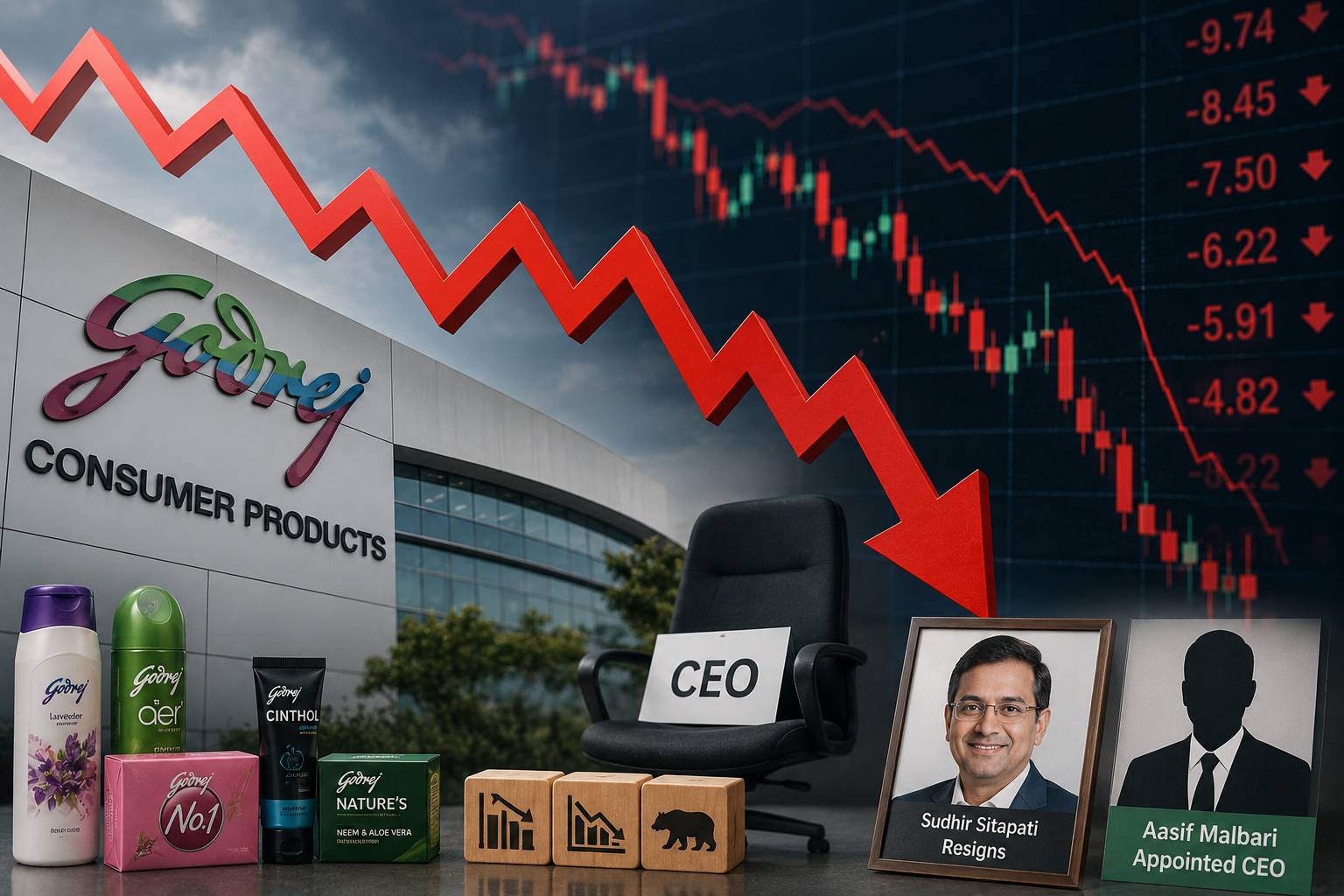
GCPL stock hits 52-week low after sudden CEO resignation; Aasif Malbari takes charge as management reiterates growth strategy and FY27 targets
Shares of Godrej Consumer Products (GCPL) came under heavy selling pressure on Wednesday, August 12, after the company announced the immediate resignation of Managing Director and Chief Executive Officer Sudhir Sitapati.
The stock plunged as much as 10% to ₹916.20 on the BSE, touching a fresh 52-week low and falling below its previous low of ₹967.25 recorded on April 2, 2026.
The sharp decline reflects investor concerns over the sudden leadership transition, particularly because Sitapati's tenure had recently been extended until August 2031. The unexpected departure has raised questions about management continuity and execution at a time when GCPL is attempting to accelerate growth and improve profitability.
However, the company has moved quickly to appoint an internal successor. Aasif Malbari, who was serving as Global Chief Financial Officer and President of Godrej Africa, has been appointed as the new MD & CEO with immediate effect.
GCPL Stock Falls 30% From 52-Week High
The latest sell-off has pushed GCPL shares significantly lower from their previous peak.
The stock has now corrected around 30% from its 52-week high of ₹1,308.40, recorded on September 4, 2025.
At around 9:18 AM on Wednesday, GCPL was trading nearly 8% lower at ₹937.25 on the BSE, while the benchmark Sensex was down around 0.32%.
Trading activity surged sharply following the announcement. Around 2.9 million shares changed hands across the NSE and BSE within the first three minutes of trade, indicating intense investor activity.
The stock's fall below its previous 52-week low also indicates that the leadership change has become a significant near-term sentiment trigger.
Why Did GCPL Shares Fall So Sharply?
The immediate concern is the unexpected nature of Sitapati's resignation.
Investors generally place a premium on management stability, particularly when a company is implementing a multi-year strategy.
The situation is more significant because Sitapati's tenure had recently been extended to 2031. His immediate departure therefore surprised the market and created uncertainty around the company's leadership and execution plans.
The stock reaction does not necessarily indicate that the company's underlying business has deteriorated overnight. Rather, investors are reassessing the risks associated with the leadership transition.
The market will now look for evidence that the company's growth strategy remains on track under the new management.
Sudhir Sitapati Steps Down With Immediate Effect
GCPL's board announced the appointment of Aasif Malbari as MD & CEO after Sudhir Sitapati stepped down from the position.
Sitapati had been leading GCPL's transformation and growth strategy, making his sudden exit particularly important for investors.
The transition comes after a period in which the company has focused on strengthening its core categories, expanding household penetration and developing newer growth businesses.
The market's initial reaction suggests that investors will need time to gain confidence in the new leadership structure.
Aasif Malbari Appointed as New MD & CEO
GCPL has chosen an experienced internal executive to take over the top role.
Aasif Malbari brings around three decades of experience across the FMCG and automobile sectors, including roles at GCPL, Tata Motors and Hindustan Unilever.
Before taking over as CEO, Malbari served as GCPL's Global CFO and President of Godrej Africa.
His previous involvement in business strategy and operations provides him with familiarity with the company's businesses, financial priorities and international operations.
This internal succession could potentially reduce the disruption associated with an external leadership change.
New CEO Reassures Investors on Strategy
One of the most important messages from the management transition is that GCPL's core strategy remains unchanged.
The company continues to focus on broad-based volume growth, higher household penetration and improving the conversion of revenue growth into profitability.
Management has also reaffirmed its FY27 targets, including high-single-digit volume growth and double-digit revenue and EBITDA growth.
The company has indicated that it remains on track to exceed these targets.
For investors, this is an important signal because a sudden CEO change can often lead to concerns over strategic redirection.
At present, GCPL is indicating that the change is primarily a leadership transition rather than a fundamental change in its business strategy.
Faster Execution Is Now the Key Test
While the strategy remains unchanged, the new leadership is expected to focus more heavily on execution.
Analysts believe that greater speed and agility in decision-making could be important for GCPL as it seeks to improve its financial performance.
The company has already spent the past few years strengthening its core categories and investing in newer businesses.
The next challenge is to convert these investments into stronger revenue growth, higher margins and improved earnings.
This means the market will increasingly judge Malbari not on whether he changes the strategy, but on how effectively he executes the existing one.
Management Restructuring Could Follow
GCPL is also planning to evolve its management structure.
The company is expected to appoint separate CEOs for the India business and regional operations, reporting to the global CEO.
Both internal and external candidates are reportedly being considered for the India CEO position.
The move could create greater accountability across geographies and potentially allow individual businesses to respond more quickly to market conditions.
However, investors will want to see whether the new structure actually improves execution rather than adding complexity to the organisation.
Africa Business Could Provide a Blueprint
Malbari's experience in Africa is likely to play an important role in his new position.
GCPL's Africa operations have demonstrated stronger performance in recent periods, making them an important reference point for the new CEO.
Analysts expect Malbari to attempt to replicate some of the execution improvements achieved in Africa across the company's other markets.
The challenge will be adapting those strategies to different competitive and consumer environments, particularly in India.
GCPL's Operating Performance Has Been a Concern
The CEO transition comes at a time when GCPL's operating performance has faced challenges.
According to brokerage analysis, consolidated EBITDA remained broadly flat between FY24 and FY26.
This means investors were already expecting the company to deliver stronger growth and better profitability.
The leadership change therefore creates additional scrutiny because the new CEO inherits a business that needs to demonstrate acceleration.
The ability to improve operating performance will be a crucial factor in determining whether the current stock weakness is temporary.
Valuation Correction Has Already Taken Place
Brokerage commentary also points out that some of the disappointment around GCPL's earnings performance has already been reflected in the stock.
The company has seen approximately 15% and 30% corrections over the past one and two years, respectively.
This indicates that investors have already reduced their valuation expectations following the weaker operating performance.
Consequently, the latest fall may represent a fresh leadership-related risk premium rather than a complete reassessment of the company's business fundamentals.
A successful transition and improvement in earnings could therefore help the stock stabilise over time.
Core Categories Remain the Foundation
GCPL continues to focus on strengthening its core categories.
For an FMCG company, growth in household penetration remains one of the most important long-term drivers.
Increasing the number of households using a product, expanding distribution and improving product availability can help create sustainable volume growth.
The company is also continuing to invest in newer businesses and growth opportunities.
The challenge for management will be balancing these investments with the need to deliver stronger profitability.
India's FMCG Opportunity Remains Attractive
Despite the leadership uncertainty, GCPL continues to operate in a structurally attractive sector.
India's FMCG industry is supported by several long-term trends, including:
-
Rising household consumption
-
Urbanisation
-
Rural income growth
-
Premiumisation
-
E-commerce penetration
-
Quick-commerce expansion
-
Increasing branded-product adoption
-
Rising household penetration
These factors provide a long-term opportunity for companies with strong brands and distribution networks.
The key question is whether GCPL can capture a larger share of this opportunity.
Rural and Urban Demand Will Remain Important
GCPL's growth strategy will also depend on the performance of both urban and rural consumption.
Urban consumers are increasingly shifting towards premium and specialised products, while improving rural demand can provide volume growth across mass-market categories.
A balanced recovery in both markets could support GCPL's volume-growth targets.
However, competition remains intense, and consumers are becoming increasingly price-sensitive in several categories.
Competition Remains a Key Challenge
The Indian FMCG market has several large domestic and multinational players competing across personal care and household categories.
GCPL therefore needs to maintain strong brands, effective distribution and competitive pricing.
The company also needs to ensure that new products and businesses can scale without putting excessive pressure on profitability.
Faster execution will be particularly important in this environment.
FY27 Guidance Becomes More Important After CEO Change
Management's reaffirmation of FY27 guidance will now come under greater scrutiny.
GCPL is targeting:
-
High-single-digit volume growth
-
Double-digit revenue growth
-
Double-digit EBITDA growth
-
Continued improvement in profitability
If the company delivers these targets, investors could gradually become more comfortable with the leadership transition.
Conversely, any downgrade in guidance could reinforce concerns around execution and prolong the stock's weakness.
What Could Trigger a Recovery in GCPL Shares?
Several developments could help rebuild investor confidence.
Smooth Leadership Transition
A seamless transition under Malbari would reduce concerns about operational disruption.
Strong Volume Growth
Consistent high-single-digit volume growth would demonstrate that the company's core businesses remain healthy.
EBITDA Improvement
A sustained improvement in margins could help reverse concerns created by the relatively weak FY24-FY26 operating performance.
India CEO Appointment
The appointment of a capable India CEO could provide greater clarity around the company's domestic strategy.
Faster Execution
Improved speed in product launches, distribution expansion and business decisions could strengthen investor confidence.
Key Risks Investors Should Monitor
Leadership Uncertainty
The sudden CEO exit may continue to weigh on sentiment until the new leadership establishes credibility.
Weak Historical Earnings Growth
The flat consolidated EBITDA performance over FY24-FY26 remains an important concern.
Execution Risk
Maintaining the existing strategy is not enough; GCPL needs to demonstrate measurable improvement in execution.
Competitive Pressure
Intense competition across India's FMCG sector could restrict pricing power and market-share gains.
New Business Investments
The company's investments in newer businesses need to generate sufficient returns over time.
What Investors Should Track in Coming Quarters
The next two to four quarters could be particularly important for assessing the success of the management transition.
Investors should monitor:
Volume growth: Whether GCPL can sustain high-single-digit growth.
Revenue growth: Whether top-line growth remains in double digits.
EBITDA margin: Whether profitability improves alongside revenue.
India performance: The pace of growth in GCPL's largest market.
Africa performance: Whether Malbari can sustain the region's strong performance.
Management restructuring: Progress on appointing India and regional CEOs.
New businesses: Whether investments in growth initiatives begin contributing meaningfully.
Stock's Near-Term Outlook Remains Volatile
The 10% fall in GCPL shares indicates that investors are likely to remain cautious in the near term.
The stock may continue to experience volatility as the market assesses the implications of the leadership change.
However, the presence of an internal successor, unchanged strategy and reaffirmed FY27 guidance provide some degree of continuity.
The company's ability to demonstrate stronger operating performance will ultimately be more important than the initial market reaction.
Long-Term Story Depends on Execution
GCPL's long-term investment case has not fundamentally changed overnight.
The company still has established brands, a broad distribution network, exposure to India's consumption growth and opportunities across multiple emerging markets.
The central issue is execution.
After a period of relatively subdued operating performance, GCPL needs to demonstrate that the new management can deliver faster growth while improving profitability.
If Malbari successfully accelerates execution without materially changing the company's strategic direction, the current leadership uncertainty could eventually fade.
Market Outlook
The 10% fall in Godrej Consumer Products shares following Sudhir Sitapati's sudden resignation reflects near-term concerns over leadership continuity rather than an immediate deterioration in the company's underlying business.
The appointment of Aasif Malbari provides an element of internal continuity, while the reaffirmation of FY27 guidance indicates that management does not currently intend to make a major strategic shift.
However, the market will demand evidence.
GCPL has experienced relatively weak consolidated EBITDA growth over FY24-FY26, and the new CEO will therefore need to demonstrate that the company's strategy can translate into stronger volumes, revenue and profitability.
The key monitorables for investors will be FY27 guidance delivery, volume growth, EBITDA margins, India business performance, management restructuring and the pace of execution.
In the near term, the stock could remain volatile as investors digest the unexpected transition. Over the medium to long term, however, consistent earnings improvement and successful execution will be the decisive factors in determining whether GCPL can regain investor confidence.