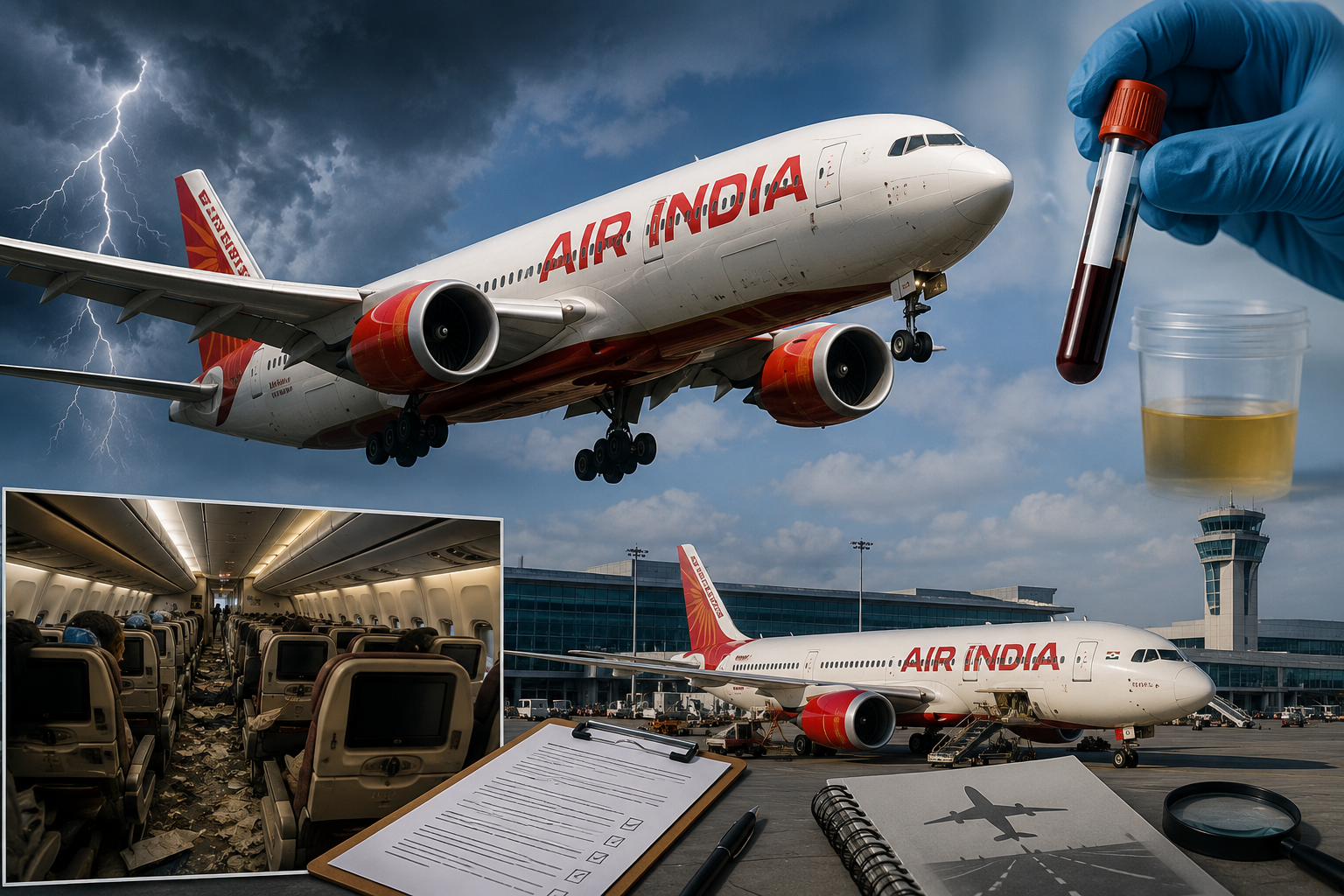
Confirmatory test reportedly detects marijuana in pilot-in-command’s sample after AI2379 suffered sudden 300-foot altitude loss; AAIB probe continues
The investigation into the Air India Phuket-Delhi flight incident has taken a significant turn after the pilot-in-command reportedly returned a positive result for marijuana in a second, confirmatory drug test.
The development follows an earlier post-flight screening that was described by the Ministry of Civil Aviation (MoCA) as “non-negative”. The pilot's sample was subsequently sent to a designated laboratory for confirmatory testing, which has now reportedly returned positive for marijuana.
The development has intensified scrutiny of the circumstances surrounding Air India flight AI2379, which was operating from Phuket to Delhi on August 4 when the aircraft experienced a sudden loss of approximately 300 feet in altitude.
The aircraft landed safely in Delhi, but the incident resulted in injuries to 20 passengers and four cabin crew members, with several requiring hospital treatment.
Importantly, the drug-test result is only one element of an ongoing investigation. It does not by itself establish that the pilot was impaired at the time of the flight or that the test result caused the aircraft's altitude change. The Aircraft Accident Investigation Bureau (AAIB) is examining the complete chain of events.
What Happened on Air India Flight AI2379?
Air India flight AI2379 was operating from Phuket to Delhi on August 4, 2026, using an Airbus A320.
The aircraft was carrying 137 passengers, including three infants, and eight crew members comprising two pilots and six cabin crew.
During the flight, the aircraft experienced a sudden altitude variation of around 300 feet. The aircraft subsequently continued its journey and landed safely in Delhi.
The sudden movement caused passengers and crew members to sustain injuries. According to the latest information from the aviation ministry, 20 passengers and four cabin crew members were injured, taking the total number of injured people to 24.
The incident was initially described in the context of turbulence, but investigators are examining several possible contributing factors rather than relying on a single explanation.
Pilot's First Drug Screening Was 'Non-Negative'
After the aircraft landed in Delhi, both pilots underwent mandatory screening for psychoactive substances.
The initial screening result for the pilot-in-command came back “non-negative”.
A preliminary screening result is not necessarily a final positive finding. Such results require confirmatory testing before authorities can establish whether a prohibited substance is actually present.
The sample was therefore sent to a designated laboratory.
The second test has now reportedly confirmed the presence of marijuana.
Both pilots were removed from the flying roster while the investigation was underway.
What Does a Positive Confirmatory Test Establish?
The confirmatory test is an important development, but it needs to be interpreted carefully.
A positive toxicology result can establish the presence of a substance or its metabolites in the tested sample, depending on the testing method and sample type. It does not automatically establish the degree of impairment at the exact time an aircraft was being operated.
Therefore, investigators will need to consider the test result alongside other evidence, including the timing of the sample, medical information, flight data, crew statements and aircraft-system information.
The AAIB has specifically urged the public and media not to draw conclusions based on incomplete or selectively available information while the investigation continues.
AAIB Leads the Investigation
The Aircraft Accident Investigation Bureau (AAIB) is conducting the investigation into the incident.
The bureau is examining the aircraft and its systems while collecting and preserving flight data, operational information and maintenance records.
The investigation is expected to examine multiple areas, including:
-
Flight-data records
-
Aircraft-system performance
-
Weather and atmospheric conditions
-
Pilot and cabin-crew actions
-
Maintenance history
-
Medical information
-
Drug-testing results
-
Operational records
-
Statements from people involved in the incident
The objective is to establish the sequence of events and identify any contributing factors.
AAIB Warns Against Premature Conclusions
The AAIB has stressed that certain records, statements, medical information and other material collected during an investigation are protected and confidential.
The bureau has asked concerned parties, including the media and the public, to respect the investigation process.
This is particularly relevant following the latest drug-test development because the test result has generated significant public attention.
The final investigation needs to determine whether the result has any connection with the flight incident or represents a separate regulatory and medical issue.
Airbus and France's BEA Join the Probe
The investigation has also attracted international technical participation.
France's Bureau of Enquiry and Analysis for Civil Aviation Safety (BEA) and aircraft manufacturer Airbus have joined the investigation.
Their involvement can provide specialist expertise in analysing aircraft systems, flight parameters and technical data.
The participation of Airbus is particularly relevant because the aircraft involved was an Airbus A320.
However, their participation does not indicate that a technical fault has been established as the cause of the incident. The investigation remains ongoing.
Aircraft Systems Also Under Examination
Investigators are examining the aircraft itself and its systems as part of the broader probe.
Recent reporting has raised questions about possible aircraft-system issues, but these reports should not be treated as established findings until the AAIB releases verified conclusions.
The investigation will need to determine whether the aircraft's systems were functioning normally at the time of the altitude change.
Flight-data information should be particularly important because it can help investigators reconstruct the aircraft's speed, altitude, vertical movement and system status during the event.
24 People Reportedly Injured
The number of injured people has increased from the initial reports.
According to the Ministry of Civil Aviation, 20 passengers and four cabin crew members were injured during the incident.
The sudden movement of an aircraft can cause injuries when passengers or crew members are not secured in their seats.
The fact that four cabin crew members were also injured underlines the sudden nature of the event.
The aircraft nevertheless completed the flight and landed safely in Delhi.
Why the Incident Is Being Treated Seriously
The incident has been classified as serious, making the investigation particularly important for aviation safety.
A sudden loss of altitude involving a commercial aircraft requires authorities to establish whether the event resulted from atmospheric conditions, aircraft systems, human factors or a combination of circumstances.
The investigation is therefore not limited to the pilot's medical or toxicology status.
Aviation safety investigations generally seek to understand the complete chain of events so that corrective measures can be introduced if necessary.
Air India CEO Summoned by Civil Aviation Ministry
The incident has also triggered scrutiny at the airline-management level.
Air India's outgoing CEO Campbell Wilson has been summoned by the Ministry of Civil Aviation to provide an update on the Phuket-Delhi incident.
The ministry's intervention reflects the seriousness with which the incident is being treated.
The government is expected to examine the airline's response, safety procedures and actions taken following the event.
The airline will also have to cooperate with the ongoing investigation and implement any measures required by the aviation authorities.
Why Pilot Drug Testing Matters
Pilot fitness is one of the most important components of commercial aviation safety.
Pilots are responsible for operating aircraft in complex environments where decision-making, alertness, coordination and reaction time are critical.
Consequently, aviation regulations include procedures relating to psychoactive-substance testing.
The latest incident has brought renewed attention to how airlines conduct such tests, how preliminary results are handled and what happens when a confirmatory test is positive.
The case could also prompt greater public scrutiny of compliance with existing pilot-fitness requirements.
Screening Test vs Confirmatory Test
There is an important distinction between the first and second tests.
A screening test is intended to identify whether a particular substance may be present. A non-negative result indicates that further testing is required.
A confirmatory test provides a more definitive assessment using a laboratory testing process.
In the AI2379 case, the initial screening was reported as non-negative and the subsequent confirmatory test reportedly detected marijuana.
The regulatory consequences will depend on the applicable aviation rules, the complete test records and the outcome of the relevant proceedings.
The Drug Test Is Not the Whole Investigation
One of the most important points for investors, passengers and the public is that the positive test should not be treated as the sole explanation for the aircraft's altitude loss.
The AAIB is examining aircraft systems, operational records and flight data alongside medical information.
Aviation incidents can result from multiple interacting factors.
For example, investigators may need to determine whether the aircraft encountered an atmospheric disturbance, whether any system malfunction occurred, how the crew responded and whether other operational circumstances were involved.
Only after analysing the full evidence can investigators determine the contributing factors.
Flight Data Could Provide Crucial Answers
Modern commercial aircraft generate extensive operational data.
Investigators can use flight-data information to reconstruct what happened during an event, including changes in altitude, speed, aircraft attitude and system performance.
The data can help establish the precise sequence of events surrounding the reported 300-foot altitude change.
Cockpit and operational records can also help investigators understand how the flight crew responded.
This technical evidence will be critical in separating confirmed facts from speculation.
Passenger and Crew Statements Also Matter
Investigators can also use statements from passengers and crew to establish what was experienced inside the aircraft.
Such accounts can provide information about the timing of the sudden movement, cabin conditions, passenger injuries and crew actions.
However, eyewitness accounts can differ, particularly during a sudden and stressful event.
For that reason, investigators generally compare such statements with objective aircraft and operational data.
Safety Procedures Under the Spotlight
The incident has renewed attention on several layers of airline safety.
These include:
Pilot fitness: Ensuring flight crew members meet medical and regulatory requirements.
Drug and alcohol testing: Maintaining reliable screening and confirmatory-testing procedures.
Aircraft maintenance: Ensuring aircraft systems are properly inspected and maintained.
Operational procedures: Ensuring crews follow prescribed procedures during unexpected events.
Incident reporting: Ensuring information is accurately collected and communicated to investigators.
The strength of an aviation safety system depends on all of these layers working together.
Potential Impact on Air India's Operations
For Air India, the immediate priority will be to cooperate with the investigation and address any issues identified by the authorities.
If the investigation identifies gaps in pilot screening, operational procedures or aircraft maintenance, the airline could face additional regulatory requirements.
The incident could also lead to increased scrutiny of the airline's internal safety-management systems.
However, it would be premature to conclude that the incident represents a systemic problem across the airline without the findings of the investigation.
Could the Incident Lead to Tighter Pilot Screening?
The latest development could lead regulators and airlines to review existing procedures for psychoactive-substance testing.
Areas that could receive additional attention include:
-
Frequency of random testing
-
Post-incident testing protocols
-
Laboratory confirmation procedures
-
Documentation and chain of custody
-
Handling of non-negative results
-
Pilot removal from active flying duties
-
Communication between airlines and regulators
Any changes would depend on the findings of the investigation and the regulator's assessment of existing procedures.
Aviation Industry Faces Heightened Safety Scrutiny
The incident comes at a time when aviation safety remains a major focus for airlines, regulators and passengers.
Commercial aviation operates through multiple safety barriers designed to prevent individual failures from becoming major incidents.
The latest Air India case demonstrates why pilot fitness, aircraft maintenance and operational oversight must be examined together.
The final investigation could provide lessons for the wider Indian aviation industry, particularly if authorities identify procedural weaknesses.
What Happens Next?
The next stage will focus on the AAIB's continuing investigation.
Authorities are expected to analyse flight data, aircraft systems, maintenance records, operational information, medical evidence and the pilot's toxicology results.
The participation of Airbus and France's BEA could provide additional technical expertise.
The aviation ministry will also continue monitoring Air India's response.
Any action against the pilot or the airline will depend on the applicable rules and the findings of the relevant authorities.
Key Questions the Investigation Must Answer
Several questions remain open:
What caused the 300-foot altitude loss?
Investigators need to determine whether turbulence, aircraft systems, crew actions or a combination of factors contributed to the event.
Was the aircraft technically sound?
Aircraft-system data and maintenance records will help establish whether any technical issue played a role.
What does the toxicology result establish?
The confirmatory test reportedly detected marijuana, but investigators must establish its relevance to the flight and assess the result within the broader evidence.
Were all safety procedures followed?
Authorities will examine whether pilot screening, aircraft operations and other required procedures were properly followed.
Are additional safeguards required?
If investigators identify gaps, regulators may consider changes to procedures across the aviation sector.
Market Outlook
The Air India Phuket-Delhi incident has become a significant aviation-safety case following the reported positive confirmatory drug test of the pilot-in-command.
However, the test result should not be treated as proof that the pilot's alleged substance use caused the aircraft's 300-foot altitude change. The AAIB is examining the complete set of technical, operational, medical and flight-data evidence before reaching conclusions.
The immediate focus will remain on the AAIB investigation, the aircraft's technical records, flight data, pilot and crew information and the circumstances surrounding the injuries.
For Air India, the episode reinforces the importance of strict pilot-fitness protocols, robust drug-testing systems, aircraft maintenance and transparent safety procedures.
The final findings will be crucial not only for determining what happened on AI2379, but also for identifying whether additional safeguards are needed across India's commercial aviation sector.