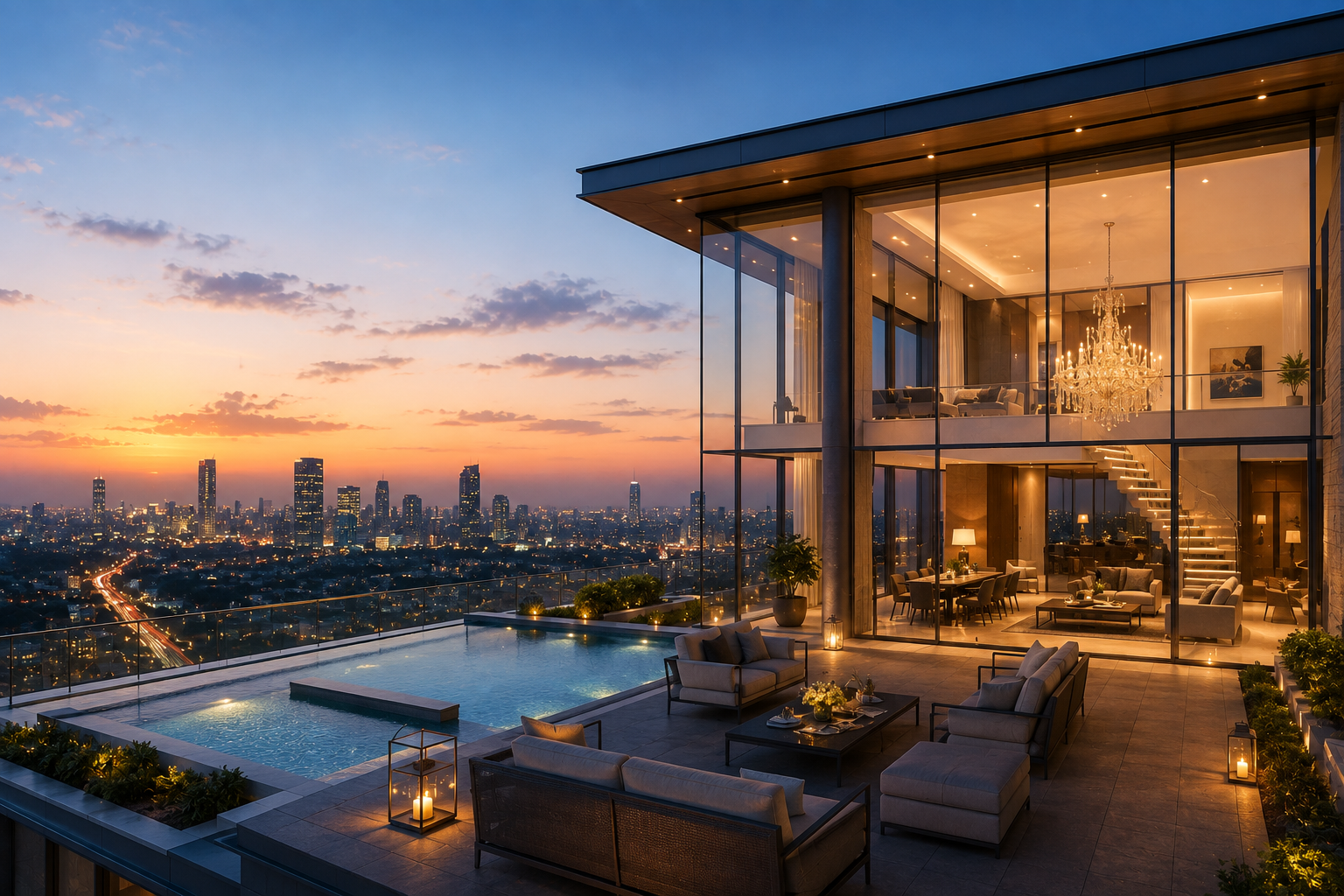
The Dahlias transaction values the 10,500 sq ft carpet-area residence at nearly ₹2.6 lakh per sq ft as demand for trophy homes strengthens across India's premium property markets
Real estate major DLF Ltd has sold a penthouse for ₹271 crore at its super-luxury residential project The Dahlias in Gurugram, marking one of India's most significant single-unit residential transactions.
The penthouse was purchased by entrepreneur Manav Sardana, who was associated with Imperial Auto. The residence has a super area of approximately 17,200 sq ft and a carpet area of around 10,500 sq ft.
At the transaction value, the property works out to approximately ₹1.58 lakh per sq ft on a super-area basis and nearly ₹2.6 lakh per sq ft on carpet area.
The deal highlights the rapid escalation in India's ultra-luxury housing market, where large residences in established premium locations are increasingly commanding exceptionally high ticket sizes.
The Dahlias: DLF's ₹40,000-Crore Luxury Housing Project
DLF launched The Dahlias in October 2024 at DLF Phase 5 in Gurugram.
Spread across approximately 17 acres, the super-luxury development comprises around 420 apartments and penthouses.
The project has been positioned at the very top end of Gurugram's residential market, targeting ultra-high-net-worth individuals looking for exceptionally large residences, premium amenities, privacy and exclusivity.
DLF expects the project to generate more than ₹40,000 crore in revenue over its development cycle.
More than 65% of the project's units have already been sold, highlighting the depth of demand at the premium end of Gurugram's housing market.
₹271 Crore for a Single Residence
The size of the transaction makes the latest sale particularly notable.
The penthouse has a super area of 17,200 sq ft, while the carpet area is approximately 10,500 sq ft.
At ₹271 crore, the transaction translates into:
-
₹1.58 lakh per sq ft on super area
-
Nearly ₹2.6 lakh per sq ft on carpet area
The difference between the two calculations highlights why carpet-area pricing is particularly important when comparing ultra-luxury residential transactions.
The deal demonstrates how prices can rise significantly when buyers are competing for a limited number of large residences in premium developments.
Apartments at The Dahlias Start at ₹100 Crore
The project operates at a price level far above conventional luxury housing.
Apartments are priced in the range of approximately ₹100 crore to ₹170 crore, while penthouses command substantially higher prices.
This makes The Dahlias one of India's most exclusive residential developments.
The ₹271-crore transaction represents the upper end of the project's pricing spectrum and demonstrates the willingness of wealthy buyers to pay a significant premium for the largest and most exclusive residences.
Gurugram Emerges as a Major Ultra-Luxury Housing Market
Mumbai has historically dominated India's luxury housing market, but Gurugram has emerged as a major competitor in recent years.
The city's premium residential markets around Golf Course Road and DLF Phase 5 have attracted entrepreneurs, corporate leaders, business families and high-net-worth individuals.
The growth of the corporate ecosystem in Gurugram has created a large pool of affluent buyers looking for premium residences close to their workplaces and social infrastructure.
Golf Course Road's Transformation
Golf Course Road has evolved into one of India's most expensive residential corridors.
The area benefits from:
-
Premium residential developments
-
Large corporate offices
-
High-income employment
-
International schools
-
Luxury retail
-
Hospitality infrastructure
-
Connectivity with Delhi
-
Proximity to major business districts
This combination has helped transform the area from a conventional suburban housing market into a destination for trophy residential properties.
DLF's Luxury Residential Ecosystem
The Dahlias is part of DLF's broader luxury residential ecosystem in Gurugram.
The developer has established several premium developments in and around DLF Phase 5, creating a concentrated market for high-end housing.
The ecosystem has helped establish the area as an address for India's wealthiest homebuyers.
For DLF, the strategy also allows the company to monetise premium land at substantially higher realisations than conventional residential projects.
Why Buyers Are Paying ₹100-200 Crore for Homes
At the ultra-luxury end, buyers are not simply paying for square footage.
They are paying for a combination of:
-
Location
-
Privacy
-
Security
-
Architecture
-
Amenities
-
Views
-
Large floor plans
-
Limited supply
-
Developer reputation
-
Community exclusivity
For ultra-high-net-worth individuals, the availability of a genuinely large residence in a premium location can be more important than the absolute price.
This creates a separate pricing dynamic from the broader residential market.
Scarcity Is Driving Premium Pricing
One of the most important factors behind the high prices is limited supply.
Large residences of 10,000 sq ft or more are rare in established metropolitan locations.
Even when buyers have substantial purchasing power, there are relatively few properties capable of meeting their requirements.
This creates a scarcity premium.
Projects such as The Dahlias are designed specifically to address this segment by offering large residences within a managed luxury community.
Post-Pandemic Wealth Creation Supports Luxury Demand
Luxury housing demand has strengthened significantly across India's major cities since the Covid-19 pandemic.
The increase has been supported by several structural factors.
Rising Entrepreneurial Wealth
India has witnessed strong growth in entrepreneurial wealth, particularly in technology, manufacturing, financial services and consumer businesses.
Capital-Market Gains
Equity-market wealth creation has increased the purchasing power of high-net-worth investors.
Preference for Larger Homes
The pandemic increased awareness of space, privacy and home-based work requirements.
Premium Lifestyle Spending
High-income households are increasingly willing to spend on premium residential amenities.
These factors have created a favourable environment for ultra-luxury housing.
Gurugram Offers a Different Luxury Proposition From Mumbai
Mumbai remains the country's deepest market for trophy residences, but Gurugram offers a different proposition.
Mumbai's luxury market is strongly associated with:
-
Sea-facing properties
-
South Mumbai addresses
-
Extremely limited land
-
High-density urban development
Gurugram, in contrast, can offer:
-
Larger apartment sizes
-
Larger residential communities
-
Extensive landscaped spaces
-
More parking
-
Newer developments
-
Integrated amenities
-
Greater privacy
For certain buyers, the additional space can justify the premium pricing.
DLF's Luxury Strategy
The Dahlias is an important part of DLF's broader strategy of focusing on premium residential developments.
Large-ticket projects can generate substantial booking value without requiring the sale of thousands of units.
This model is particularly attractive when the developer controls land in established premium locations.
However, such developments also require significant investment in construction quality, architecture, amenities and project execution.
DLF's FY27 Sales Booking Target
DLF has set a sales booking target of approximately ₹20,000 crore for FY27.
The company recorded sales bookings of around ₹20,143 crore during FY26, compared with a record ₹21,223 crore in FY25.
Although FY26 bookings declined from the previous year's record level, the company continues to maintain an ambitious target for FY27.
Luxury developments are expected to remain an important contributor to this strategy.
Q1 Sales Bookings Fell 94%
DLF's first-quarter sales bookings declined sharply to around ₹657 crore.
The fall was largely linked to the absence of a major project launch during the quarter.
Real estate companies can experience substantial quarter-to-quarter fluctuations because sales bookings are heavily influenced by the timing and scale of project launches.
Therefore, the weak first-quarter number does not necessarily indicate a comparable decline in underlying demand.
DLF Remains Confident on FY27 Guidance
Despite the sharp decline in first-quarter bookings, DLF remains confident about achieving its full-year sales booking target.
The company expects project launches in subsequent quarters to provide a significant boost to bookings.
The strong demand for The Dahlias and other premium developments could support the overall sales pipeline.
The key factor will be the timing and success of upcoming launches.
DLF's Profit Rises Despite Lower Income
DLF reported a 4% increase in consolidated net profit to ₹793.90 crore for the June quarter.
The profit growth came despite a substantial decline in total income.
Consolidated total income fell to ₹1,605.56 crore, compared with ₹2,980.88 crore in the corresponding quarter of the previous year.
The divergence between income and profit underlines the impact of business mix, project timing and revenue recognition in the real estate sector.
Project Launch Timing Remains Critical
Real estate revenue and bookings are often uneven across quarters.
A large project launch can generate several thousand crores of bookings in a single period, while a quarter without a significant launch can produce comparatively low numbers.
This makes annual performance and project pipeline more important than individual quarterly booking numbers.
For DLF, the luxury portfolio provides an opportunity to generate substantial booking values from relatively limited inventory.
DLF's Large Development Platform
DLF has one of India's largest real estate development platforms.
The group has developed more than 185 real estate projects, covering over 352 million sq ft.
It also has approximately 275 million sq ft of development potential across residential and commercial segments.
This large development pipeline provides the company with multiple opportunities to launch projects across price segments and locations.
Ultra-Luxury Housing Is Becoming a Bigger Segment
India's luxury housing market is gradually becoming more segmented.
There is a clear distinction between:
-
Premium housing
-
Luxury housing
-
Super-luxury housing
-
Ultra-luxury or trophy residences
The Dahlias operates at the highest end of this spectrum.
Demand in this segment is less dependent on conventional mortgage affordability and more closely linked to wealth creation, business performance and investment liquidity.
High-Value Transactions Could Become More Frequent
The ₹271-crore transaction demonstrates the increasing depth of India's luxury housing market.
As India's population of high-net-worth and ultra-high-net-worth individuals grows, demand for trophy properties could continue to increase.
However, supply remains highly limited.
This combination of rising wealth and restricted supply could support further appreciation in select luxury micro-markets.
NRI Buyers Add Another Demand Pool
Luxury developers are also increasingly targeting non-resident Indians.
Gurugram is particularly attractive to NRIs who have business, family or investment connections in the National Capital Region.
The city's proximity to Delhi, international airport connectivity and expanding luxury ecosystem can make it attractive for buyers seeking a large home in North India.
NRI demand can also help diversify the buyer base for premium projects.
Brand Reputation Matters More at the Top End
For a buyer spending ₹100 crore or more, the developer's reputation becomes an important consideration.
High-net-worth buyers are likely to place greater emphasis on:
-
Construction quality
-
Project management
-
Security
-
Maintenance
-
Amenities
-
Community quality
-
Long-term asset value
Established developers can therefore have an advantage when competing for ultra-luxury customers.
Infrastructure Supports Gurugram's Luxury Market
The continued expansion of Gurugram's infrastructure is another factor supporting premium housing demand.
Improved roads, metro connectivity, commercial development and airport access have increased the attractiveness of the city's established premium corridors.
The concentration of corporate offices also reduces commuting requirements for many high-income residents.
Luxury Housing Has Different Demand Drivers
Unlike mass-market housing, ultra-luxury property demand is less sensitive to conventional affordability indicators.
Buyers often have substantial financial resources and may use a combination of business wealth, investment gains and accumulated capital to finance purchases.
This makes the segment more resilient to moderate changes in mortgage rates.
However, it remains sensitive to broader wealth creation and financial-market conditions.
Risks to the Luxury Housing Market
The ultra-luxury segment also faces several risks.
Wealth-Creation Slowdown
A prolonged slowdown in equity markets or business wealth creation could reduce the pool of potential buyers.
High Ticket Sizes
Properties priced above ₹100 crore have a relatively narrow buyer base.
Project Execution
Large developments require significant capital and long construction timelines.
Market Concentration
Demand can be concentrated in a limited number of locations and projects.
Valuation Risk
Rapid price appreciation could eventually reduce affordability even for wealthy buyers if income and wealth growth fail to keep pace.
What the ₹271-Crore Deal Means for DLF
The transaction reinforces DLF's positioning in India's premium residential market.
It demonstrates that the company can command exceptionally high prices for large residences in strategic locations.
It also supports the broader thesis behind DLF's luxury housing strategy: premium land and limited inventory can generate substantial revenue when matched with strong demand.
The bigger question for investors is whether such strong demand can be sustained across the company's wider project portfolio.
What the Deal Means for Gurugram
The transaction is also significant for Gurugram's real estate market.
It confirms that the city is no longer simply a market for premium apartments priced in the ₹5-20 crore range.
A growing segment of the market now caters to buyers willing to spend ₹50 crore, ₹100 crore or even more on a single residence.
This represents a major transformation in the city's residential market.
From Luxury Homes to Trophy Assets
Ultra-luxury residences are increasingly being treated as trophy assets.
For wealthy buyers, ownership can provide:
-
Prestige
-
Privacy
-
Lifestyle benefits
-
Scarcity value
-
Potential long-term capital appreciation
This changes the way such properties are valued.
The buyer may not be making a purchase solely based on rental yield or conventional investment metrics.
The Bigger Trend: India's Luxury Housing Boom
The DLF transaction is part of a broader trend in India's housing market.
The top end of the market is witnessing:
-
Larger homes
-
Higher ticket sizes
-
Premium amenities
-
Stronger brand positioning
-
Increased NRI participation
-
Greater demand for exclusive communities
-
Rising per-square-foot prices
Developers with access to premium land and strong brands are particularly well positioned to benefit.
Market Outlook
DLF's ₹271-crore sale at The Dahlias provides another strong indication that India's ultra-luxury residential market remains robust, particularly in premium micro-markets such as Gurugram and Mumbai.
The most significant aspect of the transaction is the nearly ₹2.6 lakh per sq ft carpet-area pricing, which demonstrates the premium buyers are willing to pay for exceptionally large and exclusive residences.
For DLF, The Dahlias remains a strategically important project, with expected revenue of more than ₹40,000 crore and over 65% of units already sold. The development can continue to support the company's luxury housing strategy and contribute to its broader FY27 sales booking ambitions.
The immediate focus for investors will be whether DLF can convert its strong luxury demand into its ₹20,000-crore FY27 sales booking target, particularly after the weak first quarter caused by the absence of a major project launch.
For Gurugram, the transaction strengthens the city's position as a serious contender in India's ultra-luxury housing market. The combination of premium corporate employment, infrastructure, limited supply of very large residences and rising wealth is creating a powerful foundation for the segment.
However, ultra-luxury housing remains a niche market with a limited buyer pool. Sustained demand will ultimately depend on continued wealth creation and the ability of developers to maintain exclusivity without creating excessive supply.
Overall, the outlook for premium and ultra-luxury housing remains positive, with DLF's latest transaction showing that India's wealthiest buyers continue to demonstrate strong appetite for trophy residences even at exceptionally high price points.