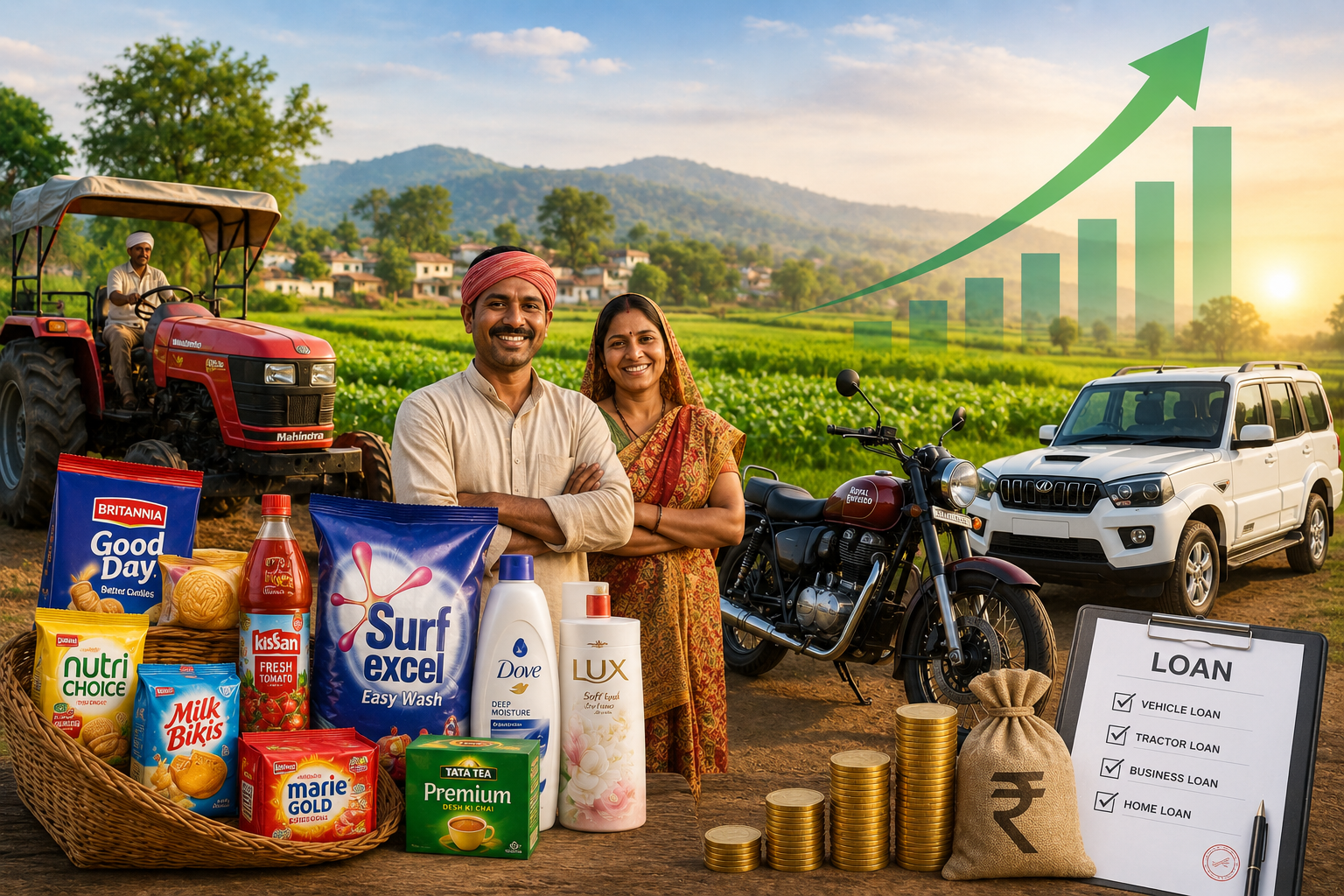
Strong farm incomes, government support, GST benefits and improving credit conditions could keep rural demand resilient in FY27
India's rural economy is showing signs of a broad-based recovery, prompting global brokerage UBS to identify a basket of stocks that could benefit from improving rural consumption and investment during FY27.
UBS has selected Britannia Industries, Hindustan Unilever (HUL), Mahindra & Mahindra (M&M), Eicher Motors, Cholamandalam Financial Holdings and Shriram Finance as preferred stocks to play the rural recovery theme.
According to UBS India economist Tanvee Gupta Jain, rural households are entering FY27 with comparatively healthier balance sheets after two relatively strong crop years. Better farm cash flows, government support measures and improved access to credit could continue to support purchasing power.
At the same time, the brokerage has cautioned that the pace of rural growth could moderate during FY27, particularly if weather conditions weaken agricultural output or higher food prices reduce real household purchasing power.
Why UBS Is Bullish on Rural Recovery
Rural demand is driven by several interconnected factors, but UBS identifies four major pillars:
-
Farm income
-
Wage income
-
Government transfers
-
Access to credit
The improvement across these areas has created a more favourable environment for rural consumption.
Two relatively strong crop years have helped strengthen rural household finances. Meanwhile, government welfare programmes, infrastructure spending and improving credit availability are providing additional support.
This combination is particularly important for sectors such as FMCG, automobiles, tractors and rural-focused financial services.
Two Strong Crop Years Improve Rural Balance Sheets
Agricultural income remains one of the most important drivers of India's rural economy.
The relatively strong performance of the past two crop years has helped improve cash flows for rural households. Better farm income can increase savings, reduce financial stress and create room for discretionary spending.
This creates a stronger base for FY27 compared with periods when rural households were dealing with weak agricultural output or consecutive weather disruptions.
For consumer companies, stronger rural balance sheets can eventually translate into higher volumes.
Government Transfers Could Support Purchasing Power
UBS expects government support measures to remain an important source of rural income.
The brokerage highlighted large cash-transfer programmes implemented by several states, estimated at around $20 billion, along with continued welfare spending and public investment in rural infrastructure.
These measures can provide additional income support to households, particularly in regions where agricultural income remains volatile.
The impact could extend beyond basic consumption as stronger household cash flows can also support vehicle purchases, consumer durables and demand for financial products.
VB-GRAM-G Could Provide Another Rural Income Buffer
Another factor highlighted by UBS is the VB-GRAM-G rural employment scheme, which came into effect on July 1 and replaced MGNREGA.
The programme could provide an additional income cushion for rural households by supporting employment opportunities.
However, UBS has cautioned that the scheme has been operational for only a few weeks, making it too early to assess its full macroeconomic impact.
The effectiveness of the programme will become clearer as implementation progresses and its impact on rural wages and household income becomes visible.
GST Benefits Could Strengthen Consumption
GST-related changes are also supporting the rural consumption outlook.
Lower tax rates on selected goods can improve affordability and potentially encourage higher consumption.
The impact is particularly relevant for consumer companies because rural households are generally more price-sensitive than urban consumers.
If tax savings translate into lower retail prices, companies with extensive rural distribution networks could see improved volumes.
Rural Recovery Is Broad-Based
UBS believes the current recovery is broader than a traditional agricultural cycle.
Industry commentary indicates improving demand across:
-
Consumer staples
-
Consumer discretionary products
-
Automobiles
-
Agricultural equipment
-
Financial services
Several companies have also raised their FY27 volume-growth expectations, citing stronger rural demand.
This suggests that the recovery is gradually spreading from farm income into broader consumption and investment.
UBS's Preferred Stocks for Rural Recovery
UBS has identified six stocks across FMCG, automobiles and financial services as preferred plays on the rural recovery.
Britannia Industries
Britannia Industries provides direct exposure to India's packaged food consumption.
The company's extensive distribution network reaches a large number of smaller towns and rural markets, making rural volume growth an important part of its long-term expansion opportunity.
As household incomes improve, consumers could gradually increase spending on branded packaged foods.
Britannia's relatively defensive product portfolio also gives it exposure to everyday consumption rather than purely discretionary spending.
However, the stock has so far lagged the broader market in FY27.
Hindustan Unilever
HUL is another major FMCG company with extensive rural penetration.
Its portfolio covers personal care, home care, foods and other everyday-use categories.
A sustained recovery in rural purchasing power could improve volume growth across several of these segments.
HUL's distribution infrastructure provides an important competitive advantage in smaller towns and villages.
However, its stock performance has also been relatively subdued compared with the Nifty 50 during FY27 so far.
Mahindra & Mahindra
M&M offers a more diversified way to participate in India's rural recovery.
Its tractor business has direct exposure to farm incomes, while its automotive business benefits from improving consumer confidence and vehicle demand.
A strong agricultural cycle can support tractor purchases, while higher rural incomes can increase demand for SUVs and utility vehicles.
M&M shares have gained around 19% in FY27 so far, according to the data cited in the report.
Eicher Motors
Eicher Motors provides exposure to the two-wheeler and premium motorcycle market through Royal Enfield.
Improving rural incomes and employment conditions can support discretionary purchases such as motorcycles.
The company has also benefited from increasing demand for premium motorcycles in India's smaller cities and towns.
Eicher Motors has gained around 22% in FY27, making it one of the better-performing stocks among UBS's rural recovery picks.
Shriram Finance
Shriram Finance provides exposure to rural and semi-urban credit demand.
The company has a strong presence in vehicle financing and serves customers across smaller cities and towns.
Improving rural economic activity can increase demand for commercial vehicles and other financed assets.
Higher farm incomes can also strengthen borrowers' repayment capacity.
Shriram Finance has been the strongest performer among UBS's preferred rural recovery stocks, gaining approximately 28% in FY27 so far.
Cholamandalam Financial Holdings
Cholamandalam Financial Holdings offers another route to India's rural and semi-urban credit cycle.
Improving household incomes and economic activity can support demand for vehicle loans and other financial products.
The company can benefit if rural credit growth remains strong and asset quality remains stable.
Its shares have gained around 19% in FY27, according to the cited market data.
Performance Gap Is Important
The performance of UBS's preferred stocks has been mixed.
| Stock | FY27 Performance |
|---|---|
| Shriram Finance | +28% |
| Eicher Motors | +22% |
| M&M | +19% |
| Cholamandalam Financial Holdings | +19% |
| Britannia Industries | Up to +2% |
| HUL | Up to +2% |
| Nifty 50 | ~10% |
The divergence highlights different stages of the rural recovery trade.
Financial and auto stocks have already reflected a significant portion of the improvement in rural expectations, while large FMCG stocks have performed more modestly.
FMCG Stocks Could Benefit From Volume Recovery
Britannia and HUL could become important beneficiaries if rural consumption growth accelerates.
FMCG companies typically benefit when consumers move from purchasing only essential products to buying higher-value or branded products.
The rural market also offers substantial headroom because per-capita consumption of several packaged products remains below urban levels.
If rural volume growth improves, the earnings trajectory of large FMCG companies could strengthen.
M&M Has Multiple Rural Demand Levers
M&M stands out because of its exposure to more than one rural growth driver.
The tractor business is closely linked to agricultural income, while the automotive business benefits from consumer confidence and financing availability.
This gives the company multiple avenues to benefit from an improvement in rural economic activity.
A stronger tractor cycle combined with sustained SUV demand could support overall growth.
Eicher Offers Rural Discretionary Exposure
Eicher Motors represents a different type of rural recovery opportunity.
Motorcycles are not agricultural inputs, but they remain an important mobility and discretionary purchase for rural and semi-urban households.
When employment and incomes improve, consumers may be more willing to purchase premium motorcycles.
The company's strong brand positioning could help it capture this incremental spending.
Rural Credit Could Amplify the Consumption Cycle
Credit availability can accelerate the rural recovery.
A household with improved income but limited savings may still delay a vehicle or durable purchase.
Access to affordable financing can bring that purchase forward.
This creates an important link between improving rural incomes and financial companies.
NBFCs with strong rural distribution can therefore benefit from both higher credit demand and improving economic activity.
Four Factors Will Determine Rural Demand
UBS's framework suggests that investors should monitor four major indicators.
Farm Income
Higher crop prices and strong agricultural output can improve household cash flows.
Wage Income
Higher rural wages can broaden the recovery beyond farming households.
Government Transfers
Welfare schemes and employment programmes can provide additional income support.
Credit Availability
Easier access to financing can accelerate consumption and investment.
The strength of the rural recovery will depend on how these factors develop together.
Monsoon Remains a Major Risk
The biggest uncertainty for the rural economy remains weather.
An uneven monsoon can affect crop output, irrigation availability and farm income.
While the overall rural economy has entered FY27 from a stronger position, a significant weather shock could slow consumption growth.
The impact may not be immediate because households currently have stronger balance sheets, but a prolonged agricultural disruption could eventually affect spending.
Food Inflation Creates a Mixed Picture
Higher food prices have two opposing effects.
For farmers who are net sellers of agricultural products, higher prices can increase income.
But for rural households that purchase food rather than sell agricultural produce, higher prices reduce real purchasing power.
This creates a delicate balance.
If food inflation rises faster than rural income, the benefits of nominal income growth could be diluted.
Rural Recovery May Moderate in FY27
UBS does not expect the current pace of rural growth to continue indefinitely.
The brokerage expects rural demand to remain more resilient than during previous periods of monsoon-related stress, but growth could moderate from current levels.
This distinction is important for investors.
The rural recovery does not necessarily need to accelerate further to remain positive for companies. Even a normalisation to a sustainable growth rate could support earnings if the starting point remains strong.
Rural Demand Could Support Multiple Sectors
The impact of rural recovery extends well beyond FMCG.
Consumer Staples
Britannia and HUL can benefit from higher rural volumes.
Automobiles
M&M and Eicher Motors can benefit from stronger vehicle demand.
Agricultural Equipment
Tractor and farm machinery demand can improve as farm incomes strengthen.
Financial Services
Shriram Finance and Cholamandalam can benefit from higher rural borrowing.
Consumer Discretionary
Improving income can gradually increase spending on non-essential products.
Rural India Could Become a Larger Growth Engine
India's rural population represents a substantial consumer base.
As incomes rise, households increasingly shift from unbranded and basic products towards branded goods, premium products and organised financial services.
This creates a long-term structural opportunity for companies with strong distribution networks.
The current recovery could therefore represent more than a short-term cyclical improvement if income growth, infrastructure development and financial inclusion continue.
What Investors Should Watch
Several indicators will help determine whether the rural recovery is sustainable.
Monsoon Distribution
Overall rainfall is important, but its geographic and temporal distribution is equally critical.
Rural Wage Growth
Higher wages would broaden the recovery beyond agricultural households.
Tractor Sales
Tractor volumes are an important indicator of farm investment sentiment.
Two-Wheeler Sales
Motorcycle demand can provide an indication of rural discretionary spending.
FMCG Volumes
Volume growth will show whether stronger rural income is translating into actual consumption.
Rural Credit
Loan growth and asset quality will indicate whether financial conditions remain supportive.
Food Inflation
Food prices will determine how much of the income improvement translates into real purchasing power.
Key Risks to the Rural Recovery Theme
Despite the favourable backdrop, investors need to monitor several risks.
Weather Shock
A poor or uneven monsoon could affect farm output and incomes.
Food Inflation
Higher food costs could reduce real purchasing power.
Valuation Risk
Several rural recovery stocks have already delivered strong gains and may have priced in part of the expected recovery.
Credit Quality
Rapid credit growth without adequate underwriting could increase asset-quality risks for NBFCs.
Rural Demand Normalisation
If demand growth slows faster than expected, earnings upgrades could become harder to sustain.
Why the Theme Still Matters
The rural recovery theme remains significant because it connects India's agricultural cycle with consumption, automobiles and financial services.
A stronger rural household balance sheet can create a chain reaction:
Better crops → higher farm income → stronger consumption → higher vehicle demand → increased borrowing → improved corporate volumes
The extent to which this chain continues through FY27 will determine the earnings benefits for the companies identified by UBS.
Market Outlook
UBS's rural recovery basket highlights an important opportunity in India's FY27 consumption cycle. Britannia, HUL, M&M, Eicher Motors, Shriram Finance and Cholamandalam Financial Holdings provide exposure to different parts of the rural economy, ranging from everyday consumption and automobiles to agricultural activity and credit.
The underlying backdrop remains supportive. Two relatively strong crop years have improved rural household finances, while government transfers, rural infrastructure spending and GST-related benefits could provide additional support.
The performance gap among the preferred stocks is also noteworthy. Shriram Finance, Eicher Motors, M&M and Cholamandalam Financial Holdings have already outperformed the Nifty 50, while Britannia and HUL have lagged. This means the market may increasingly differentiate between companies where rural recovery is already reflected in valuations and those where earnings improvement still needs to materialise.
The biggest near-term variable remains the monsoon and agricultural income cycle. Food inflation will also require close monitoring because higher prices can support farmer incomes while simultaneously reducing the purchasing power of rural consumers.
Overall, the rural recovery outlook remains constructive but more measured. The strongest opportunity could emerge if rural volume growth remains healthy even as the pace moderates from current levels.
For the broader market, sustained rural demand would be positive for FMCG volumes, tractor sales, two-wheelers, vehicle financing and consumer discretionary spending, making rural recovery an important earnings theme for the remainder of FY27.