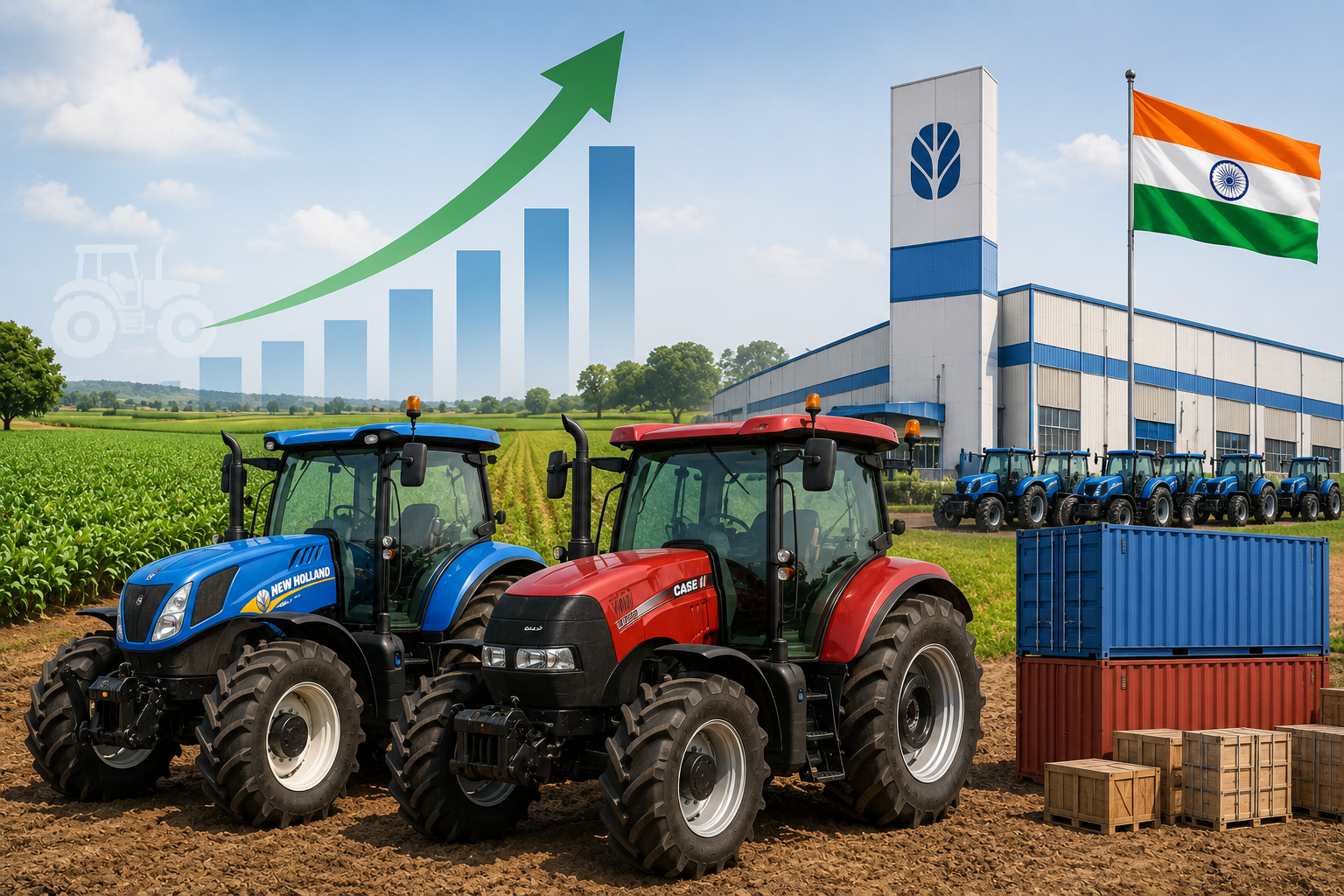
New Holland and Case IH maker significantly outpaces the domestic tractor industry as rural demand, wider product offerings and agricultural mechanisation drive growth
CNH India's tractor business delivered a strong performance in the first half of calendar 2026, with domestic sales rising 42% year-on-year to 30,248 units.
The company significantly outperformed the overall Indian tractor industry, which grew around 25% during the same period. The strong sales growth helped CNH India achieve its highest-ever market share in the country, according to Narinder Mittal, President and Managing Director of CNH India.
The company, which operates the New Holland and Case IH brands, is simultaneously preparing for a major expansion of its manufacturing capacity as it seeks to capture a larger share of India's rapidly evolving agricultural mechanisation market.
CNH India Outpaces the Domestic Tractor Market
CNH India's 42% growth in the first six months of 2026 compares with approximately 25% growth for the overall domestic tractor industry.
The company sold more than 30,000 tractors domestically during the period, marking a significant improvement in its competitive position.
Management attributed the performance to stronger product offerings, an expanding dealer network, favourable agricultural conditions and increasing adoption of technology among farmers.
The company's financing arm, CNH Capital, has also supported customers with financing solutions, helping improve access to tractors and agricultural equipment.
GST Cut and Monsoon Boosted Tractor Demand
The domestic tractor industry benefited from supportive demand conditions during the first half of the year.
A reduction in Goods and Services Tax (GST), combined with favourable monsoon conditions, helped improve farmer sentiment and supported tractor purchases.
Good rainfall is particularly important for the agricultural economy because it affects crop production, farm incomes and farmers' ability to invest in machinery.
However, CNH management expects some moderation in the second half as market sentiment has become less favourable.
Management Still Sees Healthy Full-Year Demand
Despite the expected moderation, CNH India remains positive about the broader demand environment.
Management expects the Indian tractor industry to deliver healthy growth for the full calendar year, although the pace may slow from the exceptionally strong first-half performance.
The company believes structural factors such as agricultural mechanisation, rising demand for higher-horsepower tractors and greater adoption of technology will continue supporting the market.
Exports Rise Around 20%
CNH India's export business also recorded strong growth.
The company exported 6,666 tractors during the first half of 2026, representing growth of around 20% from the year-ago period.
The increase came despite temporary disruption caused by US tariffs earlier in the year.
Management said the tariff-related situation has eased and export shipments have resumed.
The company continues to serve customers across the United States, Europe and other global markets from its Indian manufacturing operations.
US Market Accounts for 30% of Exports
The United States contributes approximately 30% of CNH India's export mix, making it an important market for the company's international operations.
Despite the earlier tariff disruption, CNH does not currently plan to significantly diversify away from its existing export markets.
Management indicated that demand across the US, Europe and other regions remains broadly stable, although product requirements and the mix of tractors vary from market to market.
India Becoming a Global Manufacturing Hub
CNH India is becoming increasingly important within the company's global operations.
The India strategy is built around four major pillars:
-
Domestic tractor sales
-
International exports
-
Technology and engineering development
-
Component sourcing for global manufacturing
The India Technology Center in Gurgaon plays a role in CNH's global technology and product development activities.
At the same time, Indian suppliers provide components that are used in manufacturing facilities around the world.
Component Exports Add Strategic Importance
CNH's Indian operations extend beyond the export of finished tractors.
The company also exports components such as power take-offs and axles to international manufacturing facilities.
This allows India to participate in CNH's global supply chain at multiple levels.
Increasing localisation could also improve cost competitiveness and strengthen India's role as a manufacturing base for the company.
CNH Plans Fourth Manufacturing Facility
A major part of CNH India's growth strategy is its planned fourth manufacturing facility near Greater Noida.
The company has been allotted approximately 100 acres by the Yamuna Expressway Authority for the proposed plant.
The new facility will be located close to the company's existing manufacturing operations in Greater Noida.
It is expected to serve both domestic and export markets.
New Plant Could Take Capacity to 1.2 Lakh Tractors
The proposed manufacturing facility is expected to be commissioned in early 2028.
CNH India's current annual tractor production capacity is approximately 70,000 units.
After the new facility becomes operational, total capacity could rise to around 120,000 tractors annually.
The existing plant produced approximately 59,000 tractors in 2025.
The scale of the planned expansion indicates that management expects India's tractor market to continue expanding over the medium to long term.
Capacity Expansion Could Support Market Share Gains
Additional manufacturing capacity could give CNH greater flexibility to respond to domestic demand.
It would also provide more capacity for exports.
Higher production scale can potentially improve manufacturing efficiency and operating leverage if capacity utilisation remains healthy.
More importantly, the new plant will give the company the production capability required to pursue its market-share ambitions.
CNH Targets Double-Digit Market Share
CNH India's current market share is approximately 4.5%, significantly below the largest players in India's tractor industry.
Management, however, believes the company can increase its share substantially over the next five to six years.
The company has expressed confidence about potentially reaching double-digit market share.
Achieving this target would require a combination of:
-
New product launches
-
Lower-horsepower offerings
-
Dealer network expansion
-
Higher production capacity
-
Stronger rural penetration
-
Competitive financing
-
Technology-led differentiation
Expanding Beyond the 45 HP Segment
CNH has historically been stronger in tractors in the 45-50 HP and above category.
The company is now expanding into lower-horsepower segments to increase its addressable market.
Its Smart Series and compact tractor offerings are part of this strategy.
A broader portfolio could allow CNH to participate in a greater range of agricultural applications and customer segments.
Compact Tractor Launch Planned for 2028
CNH plans to introduce a new compact tractor in the 25-30 HP range during the second half of 2028.
The model is expected to target both Indian and international markets, including the US and Europe.
The move could strengthen CNH's presence among smaller farmers and customers looking for compact and versatile machinery.
It also represents a shift in the company's strategy towards a more complete tractor portfolio.
Product Portfolio Now Covers a Wider Range
CNH management believes there is limited product coverage remaining in its Indian portfolio.
The company currently offers tractors ranging from compact models to machines of up to 300 HP.
Its portfolio also includes:
-
Harvesters
-
Sugarcane harvesting equipment
-
Balers
-
Agricultural implements
-
Specialised farm machinery
This broad portfolio could help CNH capture more value from India's agricultural mechanisation cycle.
India's Agricultural Mechanisation Opportunity
CNH sees significant long-term potential in India because several agricultural activities remain substantially under-mechanised.
The opportunity extends beyond traditional tractor ownership.
Management highlighted particularly low levels of mechanisation in:
-
Sugarcane harvesting
-
Biomass handling
-
Baling
-
Cotton picking
-
Several specialised agricultural operations
Increasing mechanisation in these segments could create a new source of demand for agricultural equipment manufacturers.
Sugarcane Mechanisation Remains Low
Mechanisation in sugarcane harvesting is estimated at only around 4%, despite India being the world's second-largest sugarcane producer.
The low penetration indicates significant room for growth in mechanical harvesting equipment.
CNH already offers specialised machinery for sugarcane-related operations.
Higher mechanisation could improve productivity while reducing dependence on manual labour during harvesting.
Biomass and Baling Could Become Important Growth Areas
CNH also sees opportunities in biomass management and baling.
Mechanisation in this segment is estimated at around 2%, leaving a large potential market.
Government initiatives promoting biomass-based power generation and compressed biogas are supporting demand for agricultural residue management equipment.
CNH offers multiple types of balers, including small square, round and large balers.
Cotton Picking Remains Largely Unmechanised
Cotton harvesting represents another major opportunity.
Mechanical cotton picking remains extremely limited in India compared with several developed agricultural markets.
Greater mechanisation could eventually create demand for specialised harvesting machinery.
However, adoption will depend on factors such as farm size, crop economics, machinery affordability and the development of suitable equipment for Indian farming conditions.
Small Farm Sizes Could Slow Mechanisation
One of India's structural challenges is its fragmented agricultural landholding pattern.
Average farm holdings are close to one hectare or smaller in many parts of the country.
This makes it difficult for individual farmers to justify purchasing expensive specialised machinery.
As a result, CNH believes India's mechanisation story cannot rely exclusively on individual ownership.
Custom Hiring Could Drive Equipment Adoption
Custom hiring centres and equipment rental models could play a major role in increasing mechanisation.
Under these models, farmers can access tractors and specialised equipment without purchasing the machinery themselves.
This can improve equipment utilisation while lowering the upfront financial burden for smaller farmers.
The development of such models could therefore expand the addressable market for high-value agricultural machinery.
Higher-Horsepower Tractors Gaining Popularity
While CNH is expanding into compact tractors, management expects demand for higher-horsepower tractors to remain strong.
The Indian market is gradually moving towards the 45 HP-and-above segment, driven by the need for greater productivity and the increasing use of multiple agricultural implements.
Higher-horsepower tractors can perform a wider range of activities and are often suitable for larger and more mechanised farming operations.
CNH's extensive high-horsepower portfolio gives it exposure to this trend.
Technology Is Becoming a Competitive Advantage
Technology is becoming increasingly important in India's agricultural equipment market.
Farmers are looking for machinery that can:
-
Improve productivity
-
Reduce fuel consumption
-
Increase operating efficiency
-
Reduce labour dependence
-
Support multiple farming operations
CNH's global technology capabilities give its Indian operations access to advanced engineering and product development.
Management believes technology-led products can help the company differentiate itself from competitors.
Dealer Network Will Be Critical
A strong dealer network remains essential for gaining market share in India's tractor industry.
Farmers typically depend on local dealers for:
-
Product demonstrations
-
Financing support
-
Servicing
-
Spare parts
-
Maintenance
-
After-sales support
CNH's plans to expand its dealer network could therefore be as important as its product launches in driving market-share gains.
Rural Economy Remains the Main Demand Driver
The tractor market remains closely linked to rural economic conditions.
Farm income, crop prices, rainfall, government support, credit availability and agricultural output all influence tractor purchasing decisions.
A strong rural economy can encourage farmers to replace older machinery or invest in higher-value tractors.
Conversely, weak crop prices or an uneven monsoon could delay purchases.
This makes rural demand one of the most important variables for CNH India's growth.
US Tariffs Remain an Export Risk
Although tariff-related disruption has eased, US trade policy remains a risk for CNH India's export business.
With approximately 30% of exports linked to the US market, changes in tariffs could influence the competitiveness of Indian-made tractors.
The company currently believes the overall market pool remains stable, but future changes in trade policy could alter the economics of individual markets.
Global Product Mix Could Help Manage Volatility
CNH manufactures products tailored to different geographic markets.
This market-specific approach provides some flexibility in managing changes in demand.
If demand shifts between regions, the company can potentially adjust its product mix and production allocation.
However, the ability to do so will depend on capacity, product specifications and trade policies.
India Could Gain From Global Supply Chain Diversification
CNH's growing use of Indian suppliers could create an additional structural advantage.
India has developed a strong ecosystem of automotive and engineering component manufacturers.
As global manufacturers seek efficient and diversified supply chains, India's manufacturing capabilities could become increasingly valuable.
CNH's decision to expand Indian production and component sourcing reflects this broader trend.
CNH's India Strategy Goes Beyond Tractor Sales
The company's long-term strategy indicates that India is not simply a sales market for CNH.
It is increasingly becoming a:
-
Manufacturing hub
-
Export base
-
Technology centre
-
Component sourcing location
-
Product development centre
This could increase the strategic importance of India within CNH's global operations.
Key Growth Drivers
CNH India's growth over the coming years could be supported by:
-
Strong domestic tractor demand
-
Agricultural mechanisation
-
Expansion into compact tractors
-
Rising demand for 45 HP-plus tractors
-
Dealer network expansion
-
New manufacturing capacity
-
Export growth
-
Component localisation
-
Specialised harvesting equipment
-
Biomass and baling opportunities
-
Technology adoption
-
Custom hiring models
Key Risks
Despite the strong outlook, several factors could affect the growth trajectory.
Rural Demand Risk
A slowdown in farm incomes could reduce tractor purchases.
Monsoon Risk
Agricultural activity remains sensitive to rainfall.
Trade Policy Risk
US tariffs and other trade measures could affect exports.
Competitive Pressure
CNH faces strong competition from established tractor manufacturers with extensive dealer networks.
Capacity Utilisation Risk
The planned manufacturing expansion will require sufficient demand to generate attractive returns.
Fragmented Landholdings
Small farm sizes can slow the adoption of expensive specialised machinery.
Market-Share Execution
Reaching double-digit market share will require sustained investment in products, distribution and after-sales service.
What Could Drive the Next Phase of Growth?
The next phase of CNH India's growth is likely to depend on whether the company can convert its strong H1 momentum into sustained market-share gains.
The immediate focus will be on maintaining domestic sales growth while expanding into lower-horsepower categories.
Over the medium term, the new manufacturing facility could become a major growth catalyst.
The specialised equipment opportunity could provide an additional source of revenue beyond conventional tractor sales.
Market Outlook
CNH India's 42% increase in domestic tractor sales during H1 2026, compared with 25% growth for the overall industry, highlights a significant improvement in the company's competitive momentum.
The key positive is that growth is not being driven by a single factor. Favourable agricultural conditions, GST support, a wider product range, stronger dealer coverage and rising demand for technology-enabled machinery are collectively supporting sales.
The planned manufacturing expansion near Greater Noida is potentially the biggest medium-term catalyst. Increasing capacity from around 70,000 tractors to nearly 120,000 units annually would provide CNH with the scale required to pursue its ambitious goal of double-digit market share.
The expansion into the 25-30 HP compact tractor segment is equally important because it broadens the company's addressable market beyond its traditional strength in higher-horsepower tractors.
However, the second half of 2026 could see some moderation following the exceptionally strong first-half performance. Rural income trends, crop prices, monsoon conditions and financing availability will remain key demand indicators.
Exports provide another growth opportunity, although US tariffs and broader global trade policies remain risks. The company's growing role in global component sourcing and technology development provides additional strategic value to its Indian operations.
Overall, CNH India's medium- to long-term outlook remains constructive, particularly because India's agricultural mechanisation levels remain low across several high-value segments.
The biggest opportunity may ultimately lie beyond conventional tractor sales, with sugarcane harvesting, baling, biomass management, cotton picking and specialised agricultural equipment offering significant room for penetration.
The key monitorable will be whether CNH can sustain its industry outperformance, expand its dealer network and convert its capacity and product investments into consistent market-share gains.