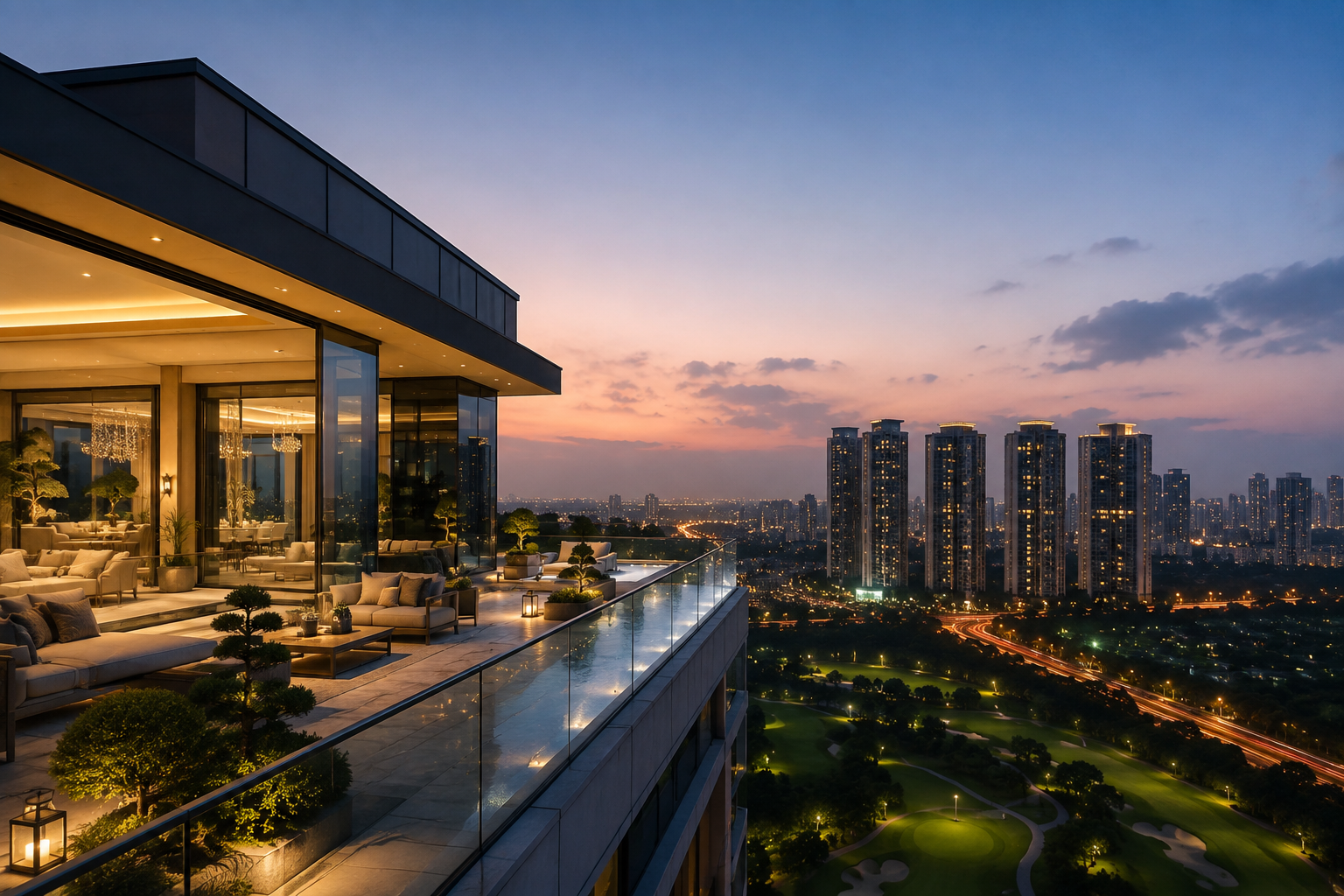
Gurugram’s ultra-luxury housing market enters a new pricing era as a single penthouse deal pushes effective carpet-area value to nearly ₹2.6 lakh per sq ft
Gurugram's luxury residential market has reached a new milestone with entrepreneur Manav Sardana reportedly purchasing a penthouse at DLF's The Dahlias for ₹271 crore.
The transaction stands out not merely because of its massive ticket size, but because the entire amount relates to a single residential unit. The deal highlights the rapid expansion of India's ultra-luxury housing market and the growing willingness of high-net-worth buyers to pay a substantial premium for scarce, large-format homes in branded developments.
The penthouse has a super area of approximately 17,200 sq ft and a carpet area of around 10,500 sq ft. At ₹271 crore, the transaction translates into approximately ₹1.58 lakh per sq ft on the super-area basis and nearly ₹2.6 lakh per sq ft on carpet area.
The transaction is among the most expensive single-unit residential deals reported in India and further strengthens Gurugram's position in the country's trophy-home market.
₹271 Crore Deal Highlights a New Price Benchmark
The headline value of ₹271 crore is significant on its own, but the effective price per sq ft makes the transaction even more noteworthy.
Mumbai continues to record some of India's largest residential transactions, particularly for large duplexes, triplexes and multiple-home purchases.
However, the Dahlias transaction is different because the entire ₹271 crore consideration is linked to one penthouse.
The nearly ₹2.6 lakh per sq ft carpet-area value demonstrates how premium pricing can rise when limited supply, large floor plates, location, brand and exclusivity converge.
Understanding the ₹2.6 Lakh Per Sq Ft Valuation
The difference between super area and carpet area is crucial in evaluating the transaction.
The penthouse has a super area of approximately 17,200 sq ft but a carpet area of around 10,500 sq ft.
The effective calculation is:
-
Transaction value: ₹271 crore
-
Super area: 17,200 sq ft
-
Super-area price: approximately ₹1.58 lakh per sq ft
-
Carpet area: 10,500 sq ft
-
Carpet-area price: approximately ₹2.6 lakh per sq ft
The carpet-area calculation therefore provides a much higher effective valuation.
This is why the transaction is being viewed as an important price discovery event for India's ultra-luxury residential market.
The Dahlias Prices Have Crossed the ₹1 Lakh Mark
The ₹271-crore transaction comes at a time when pricing at The Dahlias has moved sharply higher.
DLF management has indicated that the project is now witnessing price realisations of more than ₹1 lakh per sq ft, while residences on higher floors can command approximately ₹1.20 lakh-₹1.25 lakh per sq ft.
The project's entry-level pricing has also crossed ₹100 crore.
Premium residences are reportedly being offered in the ₹160-170 crore range.
The latest penthouse deal therefore represents the extreme upper end of a project where even the entry ticket has moved into ultra-luxury territory.
Gurugram Challenges Mumbai’s Dominance at the Top End
Mumbai has historically dominated India's trophy-home market.
Locations such as Worli, Malabar Hill, South Mumbai and other premium sea-facing neighbourhoods have produced some of the country's largest residential transactions.
Gurugram, however, has developed a different model.
Instead of relying primarily on individual bungalows or sea-facing residences, the city has created large-scale branded luxury communities.
DLF's Golf Links ecosystem is at the centre of this transformation.
The Dahlias, The Camellias, The Magnolias and The Aralias have collectively helped establish Golf Course Road as a premium residential destination.
Mumbai Still Retains a Structural Advantage
The Dahlias transaction does not mean Gurugram has overtaken Mumbai across India's luxury housing market.
Mumbai continues to benefit from:
-
Severe land scarcity
-
Established wealth concentration
-
Sea-facing residential inventory
-
Strong luxury-brand positioning
-
Deep demand from business families
-
A long history of trophy-home transactions
Recent transactions in Mumbai have exceeded the ₹271-crore mark.
For instance, Leena Gandhi Tewari reportedly purchased two sea-facing duplexes at Naman Xana in Worli for ₹639 crore, while industrialist JP Taparia had purchased a large triplex in Malabar Hill for approximately ₹369 crore.
However, those transactions involved larger combined residential configurations.
The Dahlias deal is particularly striking because it represents one home.
The Camellias Set the Stage
The Dahlias did not emerge in isolation.
DLF's The Camellias had already established Golf Course Road as one of India's leading luxury residential addresses.
In December 2024, Rishi Parti, founder of Info-X Software Technology, reportedly acquired a roughly 16,290 sq ft penthouse at The Camellias for ₹190 crore.
The transaction translated to approximately ₹1.8 lakh per sq ft on carpet area.
The movement from that level to nearly ₹2.6 lakh per sq ft in the latest Dahlias transaction indicates the extraordinary rate at which the top end of Gurugram's residential market has repriced.
The Dahlias Is Designed for the Ultra-Wealthy
The physical scale of the project is a major part of its appeal.
Located in DLF Phase 5 on Golf Course Road, The Dahlias spans approximately 17 acres.
The project consists of around 420 residences across eight towers, with buildings extending to approximately 29 levels.
It has around 7.5 million sq ft of development potential and includes only 15 duplex penthouses.
The limited number of penthouses creates a strong scarcity factor.
When a project has only a handful of ultra-large residences, buyers with the financial capacity to purchase them have very few comparable alternatives.
Large Homes Are Becoming a Luxury Asset Class
At the ultra-luxury level, the product itself is fundamentally different from conventional housing.
The apartments at The Dahlias start at approximately 10,000 sq ft, while penthouses can extend to nearly 19,000 sq ft.
Such residences are comparable in size to large standalone houses.
The difference is that buyers receive the convenience of living within a professionally managed luxury development.
This combination of space, security, services and exclusivity is becoming increasingly attractive to wealthy buyers.
Buyers Are Paying for Scarcity, Not Just Space
The price of a ₹100-crore-plus apartment cannot be explained simply by the number of square feet.
At this level, buyers are paying for a combination of:
Location
Golf Course Road provides connectivity to Delhi, corporate hubs and established premium neighbourhoods.
Privacy
Large residences and limited inventory offer a level of exclusivity that conventional developments cannot provide.
Security
High-end gated developments provide professional security and controlled access.
Amenities
Premium buyers expect access to extensive recreational, wellness and hospitality-style facilities.
Brand
A project backed by an established developer can command a premium because of perceived quality and credibility.
Scarcity
Very large homes in established luxury communities are inherently limited in supply.
NRI Demand Is Becoming Important
The Dahlias is also attracting buyers from outside the National Capital Region.
According to DLF management, around 25-30% of the project's sales are coming from buyers from the rest of India and NRIs.
This is important because it expands the project's addressable market beyond Gurugram's local business and professional community.
For wealthy Indians living in Mumbai, Bengaluru, Hyderabad, Dubai, Singapore, London and other global centres, branded luxury housing in the National Capital Region can represent both a lifestyle asset and a long-term property holding.
The Project Is Attracting Prominent Buyers
The list of buyers at The Dahlias further underlines the project's positioning.
Former India cricketer Shikhar Dhawan reportedly purchased an apartment for around ₹69 crore.
Investor Madhusudan Kela acquired a residence for approximately ₹120.71 crore.
In another major transaction, a Delhi-NCR business family reportedly purchased four apartments for nearly ₹380 crore.
These transactions demonstrate that demand exists across different categories of high-net-worth buyers.
₹380 Crore Four-Apartment Deal
The reported ₹380-crore transaction involving four apartments is particularly important for understanding buyer behaviour.
The combined area of the residences exceeded 35,000 sq ft.
The buyer was reportedly already a resident of The Camellias and was looking for a larger home.
This suggests that some ultra-high-net-worth buyers are willing to remain within established luxury communities and upgrade their residential footprint rather than move to an entirely different neighbourhood.
From ₹69 Crore to ₹271 Crore
The price evolution at The Dahlias provides a clear picture of how quickly the market has moved.
The sequence includes:
-
Shikhar Dhawan's purchase at around ₹69 crore
-
Two penthouses initially sold at around ₹150 crore each
-
A four-apartment transaction approaching ₹380 crore
-
Madhusudan Kela's purchase at around ₹120.71 crore
-
The latest single-penthouse transaction at ₹271 crore
The ₹380-crore deal remains larger in absolute terms because it covered four residences.
However, the ₹271-crore transaction is arguably a stronger indicator of price escalation because it relates to one residential unit.
DLF’s Luxury Residential Strategy
The Dahlias has become a flagship project within DLF's premium residential strategy.
The company has increasingly focused on developing large-format luxury housing aimed at high-net-worth and ultra-high-net-worth buyers.
These projects can generate substantial sales bookings from relatively few transactions.
However, they also require significant investment in construction quality, architecture, landscaping, amenities and customer experience.
The Dahlias is increasingly being positioned as a trophy address rather than simply another residential development.
₹40,000 Crore Revenue Potential
The project is expected to generate more than ₹40,000 crore in revenue, according to reports citing company and transaction data.
DLF had reportedly sold more than 60% of the project's inventory by June 2026.
The company generated around ₹11,816 crore of sales from 173 residences during the initial phase.
The project had subsequently recorded sales of around ₹18,569 crore over its first 18 months.
Such numbers show why ultra-luxury residential projects have become strategically important for India's leading developers.
DLF’s Overall Residential Business Remains Diversified
The Dahlias is a major project, but DLF's residential business extends well beyond the ultra-luxury segment.
The company reported approximately ₹20,143 crore in sales bookings in FY26, compared with ₹21,223 crore in FY25.
For FY27, the company has guided towards approximately ₹20,000 crore in sales bookings.
This broader portfolio provides diversification and reduces dependence on any single project or customer segment.
Gurugram’s Luxury Market Is Expanding
The Dahlias transaction comes against the backdrop of a broader rise in luxury housing demand in Gurugram.
A 2026 report by India Sotheby's International Realty and CRE Matrix estimated that Gurugram recorded approximately ₹24,120 crore of residential transactions in homes priced at ₹10 crore and above during 2025.
This indicates that luxury housing has become a significant component of the city's real estate market.
Developers are responding by launching projects with:
-
Larger apartments
-
Fewer residences
-
Premium amenities
-
Higher security
-
Better locations
-
Larger ticket sizes
Wealth Creation Is Supporting Demand
India's growing population of high-net-worth individuals is an important structural driver for the luxury housing market.
Entrepreneurs, business families, investors and senior corporate executives have accumulated significant wealth over the past decade.
A portion of this wealth is being allocated towards physical assets, including premium residential properties.
At the ultra-luxury level, the buyer is often less sensitive to conventional mortgage affordability and more focused on exclusivity, quality and location.
Luxury Housing Is Also a Wealth-Preservation Asset
For some buyers, a trophy home is more than a residence.
It can also function as a long-term wealth-preservation asset.
Prime residential properties in supply-constrained locations can retain value because new competing inventory is difficult to create.
However, unlike financial assets, ultra-luxury homes have limited liquidity.
Therefore, buyers at this level are generally taking a long-term ownership approach.
Gurugram Offers an Alternative to Lutyens’ Delhi
One factor supporting Gurugram's luxury housing market is its ability to offer large-format residences outside the traditional bungalow market of Lutyens' Delhi.
Buyers seeking large homes close to Delhi may find branded developments more convenient than acquiring and maintaining a standalone bungalow or farmhouse.
The Dahlias provides a combination of large residential areas, professional security and managed amenities that can appeal to families looking for an alternative to traditional elite neighbourhoods.
Golf Course Road’s Transformation
Golf Course Road has evolved substantially over the past decade.
The corridor has become a major corporate, commercial and residential hub, supported by premium office developments, retail, hospitality and residential projects.
The concentration of luxury developments has created a self-reinforcing ecosystem.
As wealthy residents move into the area, demand for premium retail, restaurants, schools, healthcare and lifestyle services increases.
This, in turn, strengthens the area's attractiveness to additional high-net-worth buyers.
The Rise of Branded Luxury Communities
India's luxury housing market is increasingly shifting towards branded communities.
Previously, wealthy families often preferred individual bungalows or custom-built residences.
Today, a growing segment is comfortable purchasing large apartments within professionally managed developments.
The attraction lies in convenience.
A buyer can obtain a large residence without independently managing security, landscaping, common infrastructure and multiple household services.
Limited Supply Supports Pricing Power
The supply of 10,000-plus sq ft residences remains extremely limited.
Large-format homes require substantial land parcels and sophisticated planning.
Developers also need to maintain a balance between density and exclusivity.
The Dahlias has addressed this through a relatively limited number of large residences.
When demand exceeds available inventory, developers can achieve significant price appreciation.
The ₹100 Crore Entry Point Is Significant
Perhaps the biggest signal from The Dahlias is that ₹100 crore has become an entry-level reference point for some residences within the project.
This represents a major change from the traditional premium housing market.
At ₹100 crore, the property is no longer competing with conventional luxury apartments.
It is competing with:
-
Luxury bungalows
-
Farmhouses
-
Trophy apartments
-
Large duplexes
-
Private estates
This substantially changes the economics and buyer profile.
Ultra-Luxury Market Has Its Own Risks
Despite the strong demand, ultra-luxury housing is not without risks.
The buyer pool remains small.
A project priced above ₹100 crore requires a very different sales strategy from mainstream residential developments.
Economic uncertainty, equity-market corrections or changes in business sentiment can affect discretionary luxury purchases.
The resale market can also be less liquid because there are fewer potential buyers.
High Ticket Size Means Lower Liquidity
A ₹271-crore property cannot be compared with an ordinary residential investment.
If the owner wants to sell, finding another buyer with the required financial capacity may take time.
This means that the investment thesis for such homes is generally long term.
The buyer is typically purchasing a combination of lifestyle, prestige and wealth preservation rather than expecting quick trading gains.
Construction Quality Becomes Critical
At ₹100-200 crore-plus price points, buyer expectations are exceptionally high.
Any compromise in:
-
Construction quality
-
Finishing
-
Security
-
Maintenance
-
Amenities
-
Privacy
-
Services
can damage the project's reputation.
Developers therefore need to maintain quality throughout the lifecycle of the development.
What the Deal Means for Real Estate Developers
The transaction could encourage other developers to explore the ultra-luxury segment.
If buyers continue accepting ₹1 lakh-plus per sq ft pricing, developers may seek to create more limited-inventory projects targeting India's wealthiest households.
This could lead to a growing divide between conventional premium housing and ultra-luxury housing.
The latter could become a distinct category with its own pricing dynamics.
What It Means for Investors in Real Estate Stocks
For listed real estate companies, strong luxury housing demand can support:
-
Higher sales bookings
-
Faster inventory monetisation
-
Better cash generation
-
Stronger project-level margins
-
Premium land valuations
-
Improved brand positioning
However, investors should also consider the sustainability of such demand.
One ₹271-crore transaction is a significant market signal, but a broader trend requires multiple transactions across several projects and developers.
Key Drivers for Gurugram Luxury Housing
Wealth Creation
India's expanding high-net-worth population is supporting demand for premium assets.
Limited Land Availability
Prime locations have limited opportunities for large new developments.
Corporate Growth
Gurugram remains one of India's major corporate and business centres.
Infrastructure
Improving connectivity strengthens the appeal of premium residential corridors.
NRI Demand
NRIs provide an additional pool of buyers for branded luxury properties.
Branded Developers
Established developers can command premiums because of their reputation and execution track record.
Lifestyle Infrastructure
Premium retail, hospitality, healthcare and education strengthen the attractiveness of luxury neighbourhoods.
Key Risks for the Luxury Housing Segment
Small Buyer Base
Ultra-luxury homes depend on a limited number of wealthy buyers.
Economic Cycles
Luxury spending can slow during periods of economic uncertainty.
Liquidity
High-value homes may take longer to sell in the secondary market.
Execution Risk
Premium buyers demand high standards throughout construction and delivery.
Pricing Expectations
Rapid price increases can eventually make affordability and absorption more challenging.
Market Concentration
Heavy dependence on a handful of luxury projects can increase volatility in developer sales.
The Broader Shift in India’s Housing Market
The Dahlias transaction is part of a broader structural change in India's housing market.
The market is no longer defined only by affordable, mid-income and conventional premium housing.
There is now a rapidly expanding ultra-luxury segment where ticket sizes can cross ₹100 crore and, in exceptional cases, ₹200 crore.
This segment is being driven by a combination of wealth creation, limited supply and demand for highly differentiated residential products.
The Future of Trophy Homes in India
The emergence of projects such as The Dahlias suggests that India's trophy-home market is becoming increasingly institutional.
Instead of wealthy buyers relying solely on individual bungalows, developers are creating entire luxury ecosystems.
This could result in more competition between cities such as Mumbai, Delhi-NCR, Bengaluru and Hyderabad for India's wealthiest homebuyers.
Gurugram's latest transaction demonstrates that the country's luxury housing map is becoming broader.
Market Outlook
The ₹271-crore transaction at DLF's The Dahlias marks a major milestone for Gurugram's ultra-luxury housing market and highlights the increasing depth of India's trophy-home segment.
The most important aspect of the deal is not simply the ₹271-crore ticket size but the nearly ₹2.6 lakh per sq ft effective value on carpet area. It demonstrates the premium that buyers can command when large-format residences, scarcity, location, brand and exclusivity come together.
For DLF, The Dahlias is emerging as a flagship luxury project with substantial revenue potential and strong demand from both domestic and international buyers. The contribution of buyers from outside NCR and NRIs suggests that Gurugram's luxury market is increasingly attracting a national and global customer base.
For the broader real estate sector, the transaction could encourage developers to launch more limited-inventory, ultra-luxury projects targeting India's expanding pool of high-net-worth individuals. Strong sales at the ₹100-crore-plus level would support premiumisation across the residential market and could benefit developers with strategically located luxury inventory.
However, the segment remains highly selective. The sustainability of ₹100-crore-plus demand, the pace of new launches and the ability of developers to maintain pricing without weakening absorption will be crucial indicators.
If wealth creation continues and premium housing demand remains strong, Gurugram could see further price discovery in its top residential corridors. The key question is whether the ₹271-crore Dahlias deal remains an exceptional trophy transaction or becomes an early indicator of a new normal for India's ultra-luxury residential market.