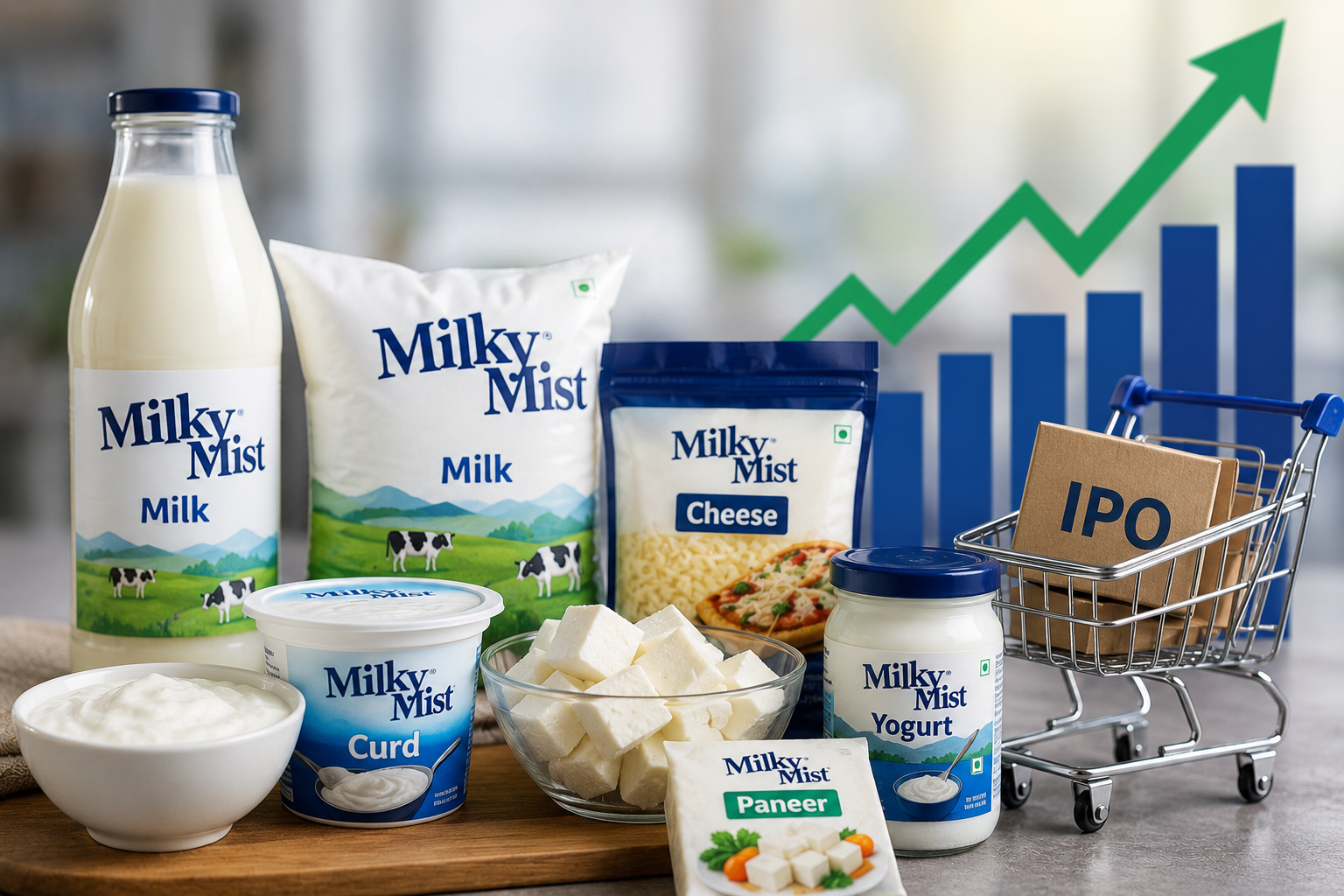
₹1,553 crore IPO opens on August 11; value-added dairy focus, strong financial growth, debt reduction and expansion plans support the long-term investment case
Milky Mist IPO review: Milky Mist Dairy Food Ltd is set to enter the primary market with its ₹1,553 crore initial public offering, with subscription opening on August 11 and closing on August 13.
The company has fixed the IPO price band at ₹133-140 per share. At the upper end of the price band, Milky Mist is expected to command a post-issue market capitalisation of approximately ₹10,778 crore, while the valuation at the lower end would be around ₹10,310 crore.
Brokerages have taken a constructive view of the issue and recommended a ‘Subscribe’ rating, citing the company's focus on value-added dairy products, strong historical growth, expanding distribution network, integrated operations and opportunities to increase capacity.
However, the IPO also comes with a premium valuation, making sustained earnings growth and successful execution critical for investors.
Milky Mist IPO at a Glance
| Particular | Details |
|---|---|
| Company | Milky Mist Dairy Food Ltd |
| IPO Size | ₹1,553 crore |
| Price Band | ₹133-140 per share |
| IPO Opens | August 11, 2026 |
| IPO Closes | August 13, 2026 |
| Fresh Issue | Up to ₹1,428 crore |
| Offer for Sale | Up to ₹125 crore |
| Upper-End Post-Issue Valuation | Around ₹10,778 crore |
| Key IPO Objective | Debt repayment and business expansion |
The issue comprises a combination of fresh equity and an Offer for Sale (OFS).
The fresh issue accounts for the majority of the IPO, meaning substantial capital will be raised directly by the company to strengthen its balance sheet and support its growth plans.
Majority of IPO Proceeds Will Go to the Company
Milky Mist's ₹1,428 crore fresh issue is the key component of the public offering.
One of the major planned uses of the proceeds is repayment of approximately ₹497 crore of debt.
This could be an important financial benefit for the company because lower debt can reduce interest costs and improve the balance sheet.
The company can potentially redirect the savings from lower finance costs towards business expansion, distribution and capacity development.
Debt Repayment Could Improve Profitability
SBI Securities has highlighted debt reduction as one of the important positives of the IPO.
Milky Mist's ability to reduce borrowings could lower its interest burden over the coming periods.
The benefit could become more visible if the company simultaneously increases capacity utilisation.
A combination of lower interest costs and higher operating leverage could support earnings growth.
This is particularly relevant because the company is already operating in a business where increasing scale can improve manufacturing efficiency.
Value-Added Dairy Is the Core Investment Theme
The biggest differentiator in Milky Mist's business model is its focus on value-added dairy products (VADP).
Instead of relying primarily on low-margin liquid milk, the company has built its business around products such as:
-
Paneer
-
Cheese
-
Curd
-
Yogurt
-
Other processed dairy products
Value-added products can offer better margins because they involve processing, branding and product differentiation.
This gives Milky Mist a business profile that is closer to a branded FMCG company than a conventional commodity-oriented dairy business.
Strong Growth Across Financial Metrics
Milky Mist has delivered significant growth over the FY24-FY26 period.
According to SBI Securities, the company recorded:
-
31.3% CAGR in revenue
-
40.5% CAGR in EBITDA
-
155.6% CAGR in PAT
The company also reported an FY26 EBITDA margin of 13.7%.
The margin increased by approximately 70 basis points year-on-year and around 180 basis points compared with FY24.
The combination of strong revenue growth and improving margins has been one of the key factors behind the positive brokerage view.
Profit Growth Has Outpaced Revenue
One of the most notable aspects of the company's recent financial performance is the faster growth in profitability compared with revenue.
While revenue grew at a strong pace, EBITDA increased faster, indicating operating leverage and margin improvement.
PAT growth was significantly higher than both revenue and EBITDA growth.
Such operating leverage can become particularly valuable when a company enters a phase of capacity expansion.
If additional facilities are utilised efficiently, fixed costs can be distributed across a larger production base, potentially supporting margins.
Milky Mist Has a Strong Position in Packaged Paneer
The company has built a significant position in the packaged paneer segment.
According to the brokerage analysis, Milky Mist has approximately 19% market share in packaged paneer.
It also holds strong positions in cheese, curd and yogurt.
This multi-category presence provides diversification and reduces dependence on a single dairy product.
The company can potentially cross-sell products through the same distribution network, improving the productivity of its retail and distribution infrastructure.
Premium Positioning Supports Pricing Power
Milky Mist's focus on branded value-added products allows it to compete on factors beyond price.
Product quality, packaging, brand recognition and convenience can help companies command premium pricing in the packaged-food market.
The company's positioning has also resulted in what analysts describe as strong milk realisation compared with listed dairy peers.
Higher realisation from each unit of milk processed can contribute to better margins.
Direct Procurement Network Is a Competitive Advantage
Milky Mist has developed a direct milk procurement network covering more than 74,000 farmers.
This extensive network provides the company with access to a large raw-material base.
A strong procurement system is particularly important in dairy because milk availability, quality and procurement costs directly influence profitability.
Direct sourcing can also help the company build stronger relationships with farmers and improve supply-chain control.
Integrated Dairy Operations Strengthen the Business
Milky Mist's operations cover multiple stages of the dairy value chain.
An integrated business model can provide greater control over:
-
Raw-material procurement
-
Processing
-
Manufacturing
-
Product development
-
Packaging
-
Distribution
Such integration can potentially improve operational efficiency and product consistency.
It can also help the company respond more quickly to changing consumer preferences.
Capacity Expansion Is a Major Growth Driver
Milky Mist plans to expand its production capacity as it seeks to capture a larger share of India's growing value-added dairy market.
Higher capacity will be important because the company's future growth will depend not only on demand but also on its ability to supply products across new markets.
Increasing utilisation of existing capacity and adding new capacity could create operating leverage.
Brokerages expect this expansion to contribute to earnings growth over the medium term.
66,000 Additional Cooling Assets Planned
The company also plans to deploy approximately 66,000 additional branded cooling assets.
This is an important part of its distribution strategy.
Dairy products require controlled storage and transportation conditions, making refrigeration infrastructure essential for expanding into new markets.
Additional cooling assets can help improve product availability and strengthen the company's presence at retail outlets.
It can also support the company's efforts to build a larger national distribution footprint.
Geographic Expansion Offers Significant Headroom
Milky Mist has significant room to expand beyond its existing markets.
India's dairy market remains highly fragmented, with regional brands holding strong positions in individual states and regions.
A company with an established product portfolio and strong manufacturing capabilities can potentially expand by entering new geographic markets.
This provides Milky Mist with a second major growth engine alongside category expansion.
Large Addressable Market
Brokerage estimates cited in the IPO analysis suggest that Milky Mist is targeting an addressable market of approximately ₹11.9 trillion by FY31.
The large market opportunity reflects the broader growth potential of India's dairy and packaged-food industries.
Rising urbanisation, changing lifestyles, higher disposable incomes and increasing preference for packaged and branded products can support demand for value-added dairy.
The opportunity is substantial, but capturing it will depend on execution.
India's Dairy Consumption Is Changing
India remains one of the world's largest dairy markets, but consumption patterns are evolving.
Traditional loose milk continues to dominate several parts of the market, while packaged and processed products are gaining popularity.
Urban consumers are increasingly looking for convenience and longer shelf life.
Products such as paneer, cheese, yogurt and packaged curd fit directly into this changing consumption pattern.
This shift creates a favourable long-term environment for organised dairy companies.
Value-Added Dairy Could Grow Faster Than Liquid Milk
Traditional liquid milk is generally a lower-margin business because products can be less differentiated.
Value-added dairy products allow companies to create brands and charge for processing, convenience and quality.
As a result, the shift from commodity milk towards processed dairy could potentially improve the profitability profile of the overall dairy industry.
Milky Mist is positioned directly in this transition.
Brokerages Maintain a Positive View
SBI Securities has recommended Subscribe, pointing to the company's differentiated product mix and focus on higher-margin value-added dairy products.
The brokerage believes debt repayment and increasing capacity utilisation could help support high double-digit earnings growth.
SIMFS has also recommended Subscribe for long-term investment, highlighting Milky Mist's market share, product portfolio, farmer network, integrated operations and expansion potential.
The positive brokerage view is therefore based primarily on the company's long-term business prospects rather than only the possibility of listing gains.
IPO Valuation Remains a Key Concern
The biggest issue investors need to consider is valuation.
At the upper price band of ₹140, Milky Mist is valued at approximately 84.9 times FY26 earnings, according to SBI Securities.
This is a demanding valuation.
The market is effectively pricing in a significant amount of future growth.
Therefore, the company's ability to sustain high revenue and earnings growth will be crucial after listing.
Premium Valuation Requires Strong Execution
A high valuation can be justified if a company delivers rapid and consistent earnings growth.
Milky Mist's historical performance provides support for the growth argument.
However, past growth does not automatically guarantee future performance.
The company will need to successfully manage:
-
Capacity expansion
-
Distribution costs
-
Milk procurement expenses
-
Working capital
-
Brand investments
-
Geographic expansion
-
Competitive pricing
Any significant slowdown could lead to pressure on the valuation.
Grey Market Premium Indicates Positive Sentiment
Milky Mist shares have been trading at a premium in the grey market.
The latest indicated grey market price was around ₹165, implying a premium of approximately ₹25 per share, or around 18% over the upper IPO price of ₹140.
The grey market premium indicates positive pre-listing sentiment, but it can change significantly before listing.
For long-term investors, the company's earnings and business performance remain more important than short-term grey market movements.
Comparison With Listed Dairy Companies
Milky Mist will enter a listed dairy peer group that includes companies such as Parag Milk Foods, Hatsun Agro Product and Dodla Dairy.
However, the company's business mix provides an important distinction.
Its greater focus on value-added dairy products gives it exposure to a potentially higher-margin segment of the industry.
This means investors may increasingly evaluate Milky Mist against both dairy companies and broader branded FMCG businesses.
Key Strengths of Milky Mist IPO
Strong Historical Financial Growth
Revenue, EBITDA and PAT have grown rapidly during FY24-FY26.
Value-Added Product Portfolio
The company is focused on categories that can provide better margins than traditional liquid milk.
Strong Market Position
Its approximately 19% share in packaged paneer and presence across cheese, curd and yogurt provide scale.
Debt Reduction
Around ₹497 crore of IPO proceeds are expected to be used for debt repayment.
Large Procurement Network
The company works with more than 74,000 farmers through its direct procurement network.
Distribution Expansion
The planned addition of 66,000 cooling assets can strengthen retail penetration.
Large Market Opportunity
The projected ₹11.9 trillion addressable market by FY31 provides significant long-term room for expansion.
Key Risks Investors Should Monitor
Expensive Valuation
The upper-band valuation of approximately 84.9x FY26 earnings is high and leaves limited room for execution disappointments.
Raw Material Costs
Milk procurement prices can have a significant impact on dairy-company margins.
Competition
Milky Mist faces competition from established national, regional and private dairy brands.
Expansion Risk
Rapid geographic and capacity expansion requires substantial execution capabilities.
Margin Pressure
Higher advertising, distribution, labour or procurement costs could limit margin expansion.
Working Capital Requirements
Fast-growing FMCG and dairy businesses require significant investment in inventory, distribution and receivables.
Milk Procurement Costs Will Remain Important
Dairy businesses are highly sensitive to raw milk prices.
Any sharp increase in procurement costs can put pressure on gross margins.
Companies with strong brands may have some ability to pass higher costs to consumers, but aggressive price increases can also affect demand.
Milky Mist's ability to manage procurement, product pricing and operational efficiency will therefore remain important for profitability.
Distribution Will Determine National Expansion
The company's future growth will depend heavily on its ability to establish a wider distribution network.
Adding cooling assets is a step towards strengthening this network, but successful expansion also requires:
-
Distributor relationships
-
Retail penetration
-
Cold-chain infrastructure
-
Brand awareness
-
Marketing investment
-
Consistent product availability
The speed and efficiency of this expansion will influence the company's ability to capture market share.
Can Milky Mist Maintain High Growth?
This is likely to be the most important question for investors after the IPO.
The company's FY24-FY26 growth numbers are strong, particularly its PAT growth.
However, maintaining very high growth becomes more difficult as the revenue base expands.
The company's ability to sustain growth through new products, geographic expansion, capacity addition and stronger distribution will therefore be closely watched.
What Investors Should Track After Listing
Investors should monitor several key indicators following the IPO.
Revenue growth: Whether new geographies and product categories are contributing meaningfully to sales.
EBITDA margin: Whether the company can preserve its improving profitability despite input-cost pressures.
Capacity utilisation: Whether newly added manufacturing capacity is being absorbed efficiently.
Debt reduction: Whether the company delivers the expected reduction in interest costs.
Market share: Whether Milky Mist continues gaining share in paneer, cheese, curd and yogurt.
Distribution expansion: Whether the planned cooling infrastructure translates into stronger retail penetration.
Cash flow: Whether strong accounting earnings are translating into healthy operating cash generation.
Why the IPO Could Attract Long-Term Investors
The company's investment story combines several structural themes in India's consumption economy.
The first is the shift towards branded packaged food.
The second is the increasing penetration of value-added dairy products.
The third is premiumisation, with consumers willing to pay more for convenience and branded quality.
The fourth is geographic expansion as organised players penetrate smaller cities and new regions.
Milky Mist has exposure to all four trends.
Listing Gains vs Long-Term Investment Case
The IPO may attract two different categories of investors.
Short-term investors may focus on subscription demand and the grey market premium to assess potential listing performance.
Long-term investors are likely to focus more on earnings growth, valuation, margins and market-share expansion.
At a premium valuation, the long-term investment case is more dependent on successful execution than on short-term sentiment.
The company's ability to compound earnings at a strong pace will ultimately determine whether the IPO valuation proves sustainable.
Market Outlook
The Milky Mist IPO presents a constructive long-term growth opportunity, supported by India's expanding value-added dairy market, the company's strong product portfolio and its established position in packaged paneer, cheese, curd and yogurt.
The company's 31.3% revenue CAGR, 40.5% EBITDA CAGR and 155.6% PAT CAGR during FY24-FY26 demonstrate strong historical operating momentum. Debt repayment of approximately ₹497 crore from IPO proceeds could further strengthen the balance sheet and reduce interest costs.
The company's integrated procurement network covering more than 74,000 farmers, planned deployment of 66,000 additional cooling assets and geographic expansion strategy provide multiple avenues for future growth.
However, the 84.9x FY26 P/E valuation at the upper price band is the key factor that investors need to evaluate carefully. The premium valuation already reflects strong expectations for future growth, making execution, margin sustainability and earnings delivery particularly important.
The near-term sentiment could remain favourable if IPO subscription demand and the grey market premium remain strong. Over the longer term, however, the key drivers will be market-share gains, capacity utilisation, distribution expansion, debt reduction, product premiumisation and sustained profitability.
Overall, the brokerage recommendation of ‘Subscribe’ is supported by Milky Mist's differentiated value-added dairy model and strong growth prospects. The IPO appears better suited to investors who are comfortable with a premium valuation and are willing to take a long-term view on India's organised dairy and packaged-food consumption story.