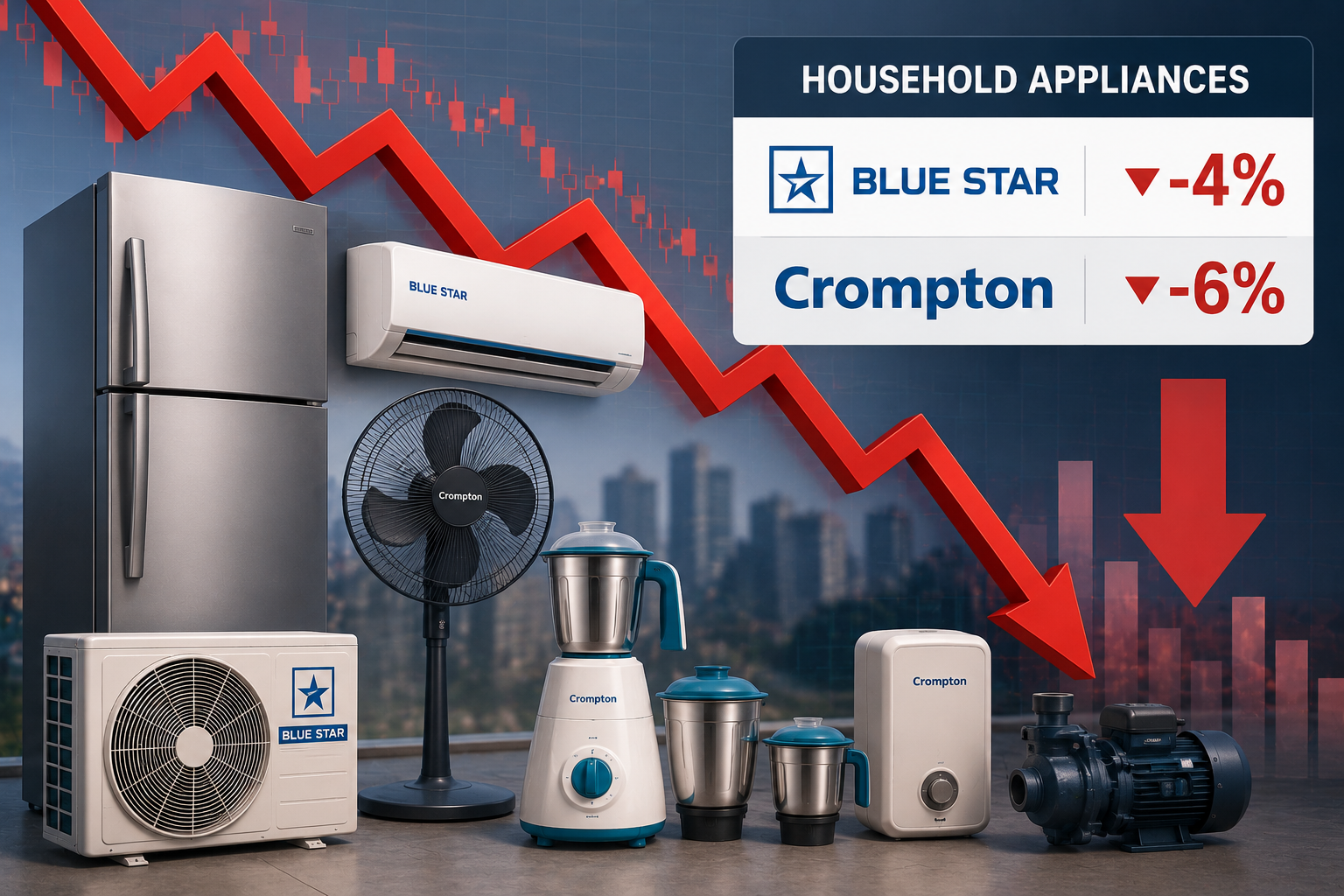
Blue Star and Crompton Greaves Shares Fall Up to 6% as Rising Input Costs, Delayed Summer Demand and Inventory Challenges Hit Profitability
Shares of leading consumer appliance manufacturers Blue Star Ltd. and Crompton Greaves Consumer Electricals Ltd. came under heavy selling pressure after both companies reported weaker-than-expected financial performance for the first quarter of FY27. The disappointing earnings, coupled with rising commodity prices, subdued seasonal demand, and pressure on operating margins, triggered sharp declines in their share prices, dragging the broader household appliance segment lower.
While the long-term outlook for India's consumer durables industry remains positive, analysts believe the June quarter highlighted several short-term challenges facing manufacturers, including inflation in raw material costs, changing weather patterns, inventory build-up, and cautious consumer spending. Despite these headwinds, brokerage firms continue to remain constructive on both companies, expecting profitability to improve as demand normalizes and cost pressures ease.
Stocks React Sharply to Earnings Disappointment
Following the quarterly results, Crompton Greaves Consumer Electricals declined nearly 6% during intraday trading, while Blue Star slipped around 4%, extending its recent correction.
The market reaction reflected investor concerns over:
-
Lower-than-expected earnings
-
Margin contraction
-
Weak seasonal demand
-
Commodity price inflation
-
Supply chain disruptions
-
Soft pricing environment
Although revenue growth remained positive for both companies, profitability failed to meet market expectations, leading to significant profit booking.
Blue Star Faces Multiple Operational Headwinds
Blue Star reported a mixed set of quarterly numbers for Q1 FY27.
The company posted:
-
13.3% year-on-year revenue growth
-
Decline in operating margins
-
Lower EBITDA
-
Reduction in net profit
Management attributed the weaker profitability to several simultaneous challenges affecting the air-conditioning business.
Among the key issues were:
-
Sharp increase in commodity prices
-
Delayed onset of summer
-
Early end to the cooling season
-
High dealer inventory
-
Competitive pricing pressure
-
Increased promotional spending
These factors significantly reduced operating leverage despite healthy revenue growth.
Commodity Inflation Hits Margins
One of the biggest concerns highlighted during the quarter was the sharp increase in raw material prices.
Manufacturers continue to face higher costs for:
-
Copper
-
Aluminium
-
Steel
-
Plastics
-
Electronic components
Although companies implemented selective price increases, they were unable to pass the entire cost burden to consumers due to intense market competition.
As a result, gross margins and operating profitability came under pressure.
Analysts believe margin recovery will largely depend on easing commodity prices and improved pricing discipline across the industry.
Delayed Summer Hurts Air Conditioner Sales
Weather played an unusually significant role in the June quarter.
The delayed arrival of summer, followed by an early onset of monsoon conditions, shortened the peak selling season for room air conditioners.
For companies like Blue Star, whose earnings are heavily dependent on summer demand, the shorter cooling season affected:
-
Sales volumes
-
Dealer replenishment
-
Inventory turnover
-
Product pricing
The company also reported higher inventory levels within dealer channels, forcing liquidation efforts that impacted profitability.
Data Centre Business Provides Support
Despite weakness in consumer cooling products, Blue Star's commercial business delivered encouraging performance.
The company's Electro-Mechanical Projects and Commercial Air Conditioning divisions benefited from:
-
Strong data centre investments
-
Healthy demand for commercial HVAC systems
-
Infrastructure-related project execution
Growing investments in digital infrastructure and hyperscale data centres continue to create long-term opportunities for industrial cooling solutions.
Management expects this business segment to remain an important growth driver in coming quarters.
Crompton Reports Supply Constraints
Crompton Greaves Consumer Electricals also reported weaker-than-expected profitability during the quarter.
However, management indicated that operational challenges rather than demand weakness were primarily responsible.
According to the company, supply constraints resulted in approximately ₹200 crore of lost revenue, particularly in:
-
Fans
-
Business-to-business lighting
Management stated that excluding these supply disruptions, overall revenue growth would have exceeded 20%, suggesting underlying consumer demand remains healthy.
Core Consumer Businesses Continue to Grow
Despite near-term challenges, several of Crompton's product categories continued to perform well.
Growth remained healthy across:
-
BLDC energy-efficient fans
-
Water pumps
-
Kitchen appliances
-
Domestic appliances
-
Consumer lighting products
These businesses continue to benefit from:
-
Urban housing demand
-
Energy efficiency trends
-
Premium product adoption
-
Brand strength
-
Distribution expansion
Analysts believe these structural drivers remain intact despite temporary supply issues.
Input Costs Continue to Pressure Margins
Like Blue Star, Crompton also experienced higher raw material costs during the quarter.
Input inflation affected profitability across multiple product categories.
Management responded by implementing selective price hikes to partially offset rising costs.
Brokerages expect margins to gradually recover over the coming quarters as:
-
Commodity prices stabilize
-
Supply chains normalize
-
Pricing actions take effect
-
Operational efficiencies improve
These factors are expected to support earnings recovery during the second half of the financial year.
Brokerages Maintain Positive Long-Term View
Despite the weak quarterly performance, several brokerage firms continue to maintain positive recommendations on both companies.
Analysts highlighted that the current challenges are largely cyclical rather than structural.
Blue Star continues to benefit from:
-
Strong commercial air-conditioning business
-
Data centre opportunities
-
Healthy project pipeline
-
Established brand
-
Expanding product portfolio
Similarly, Crompton remains well positioned due to:
-
Market leadership in fans
-
Strong distribution network
-
Brand recognition
-
Premium product mix
-
Diversified consumer appliance portfolio
Brokerages believe earnings could improve significantly once seasonal demand normalizes.
Consumer Durable Sector Faces Short-Term Challenges
The June quarter reflects broader challenges affecting India's consumer durable industry.
Manufacturers are currently dealing with:
-
Elevated commodity prices
-
Weather-related demand disruptions
-
Supply chain bottlenecks
-
Intense competitive pricing
-
Cautious discretionary spending
-
Inventory adjustments
However, most analysts believe these pressures are temporary and are unlikely to derail the sector's long-term growth trajectory.
Long-Term Growth Drivers Remain Intact
India's household appliance market continues to offer significant long-term opportunities.
Growth is expected to be supported by:
-
Rising disposable incomes
-
Urbanization
-
Premiumization
-
Increasing electrification
-
Housing expansion
-
Energy-efficient appliances
-
Higher replacement demand
Categories such as air conditioners, premium fans, kitchen appliances, and water pumps continue to enjoy strong structural demand.
Companies with strong brands, extensive distribution, and innovation capabilities remain well positioned to capitalize on these trends.
Key Risks Going Forward
Investors should continue monitoring several factors that could influence future performance.
These include:
-
Commodity price movements
-
Summer weather conditions
-
Consumer demand recovery
-
Supply chain normalization
-
Pricing power
-
Inventory management
-
Geopolitical developments affecting raw materials
Improvement across these variables could support earnings recovery in subsequent quarters.
Outlook
The sharp correction in Blue Star and Crompton Greaves Consumer Electricals shares reflects investor disappointment with near-term earnings rather than concerns over their long-term business models. Rising raw material costs, delayed summer demand, inventory adjustments, and supply chain disruptions weighed on profitability during the June quarter, but most analysts believe these challenges are temporary.
India's consumer appliance industry continues to benefit from favourable structural trends including rising household incomes, rapid urbanization, premium product adoption, and increasing demand for energy-efficient appliances. As commodity prices stabilize, seasonal demand improves, and supply chain conditions normalize, both companies are expected to witness gradual recovery in margins and earnings. For long-term investors, the recent correction may offer an opportunity to accumulate fundamentally strong businesses that continue to hold leadership positions in India's expanding consumer durables market.