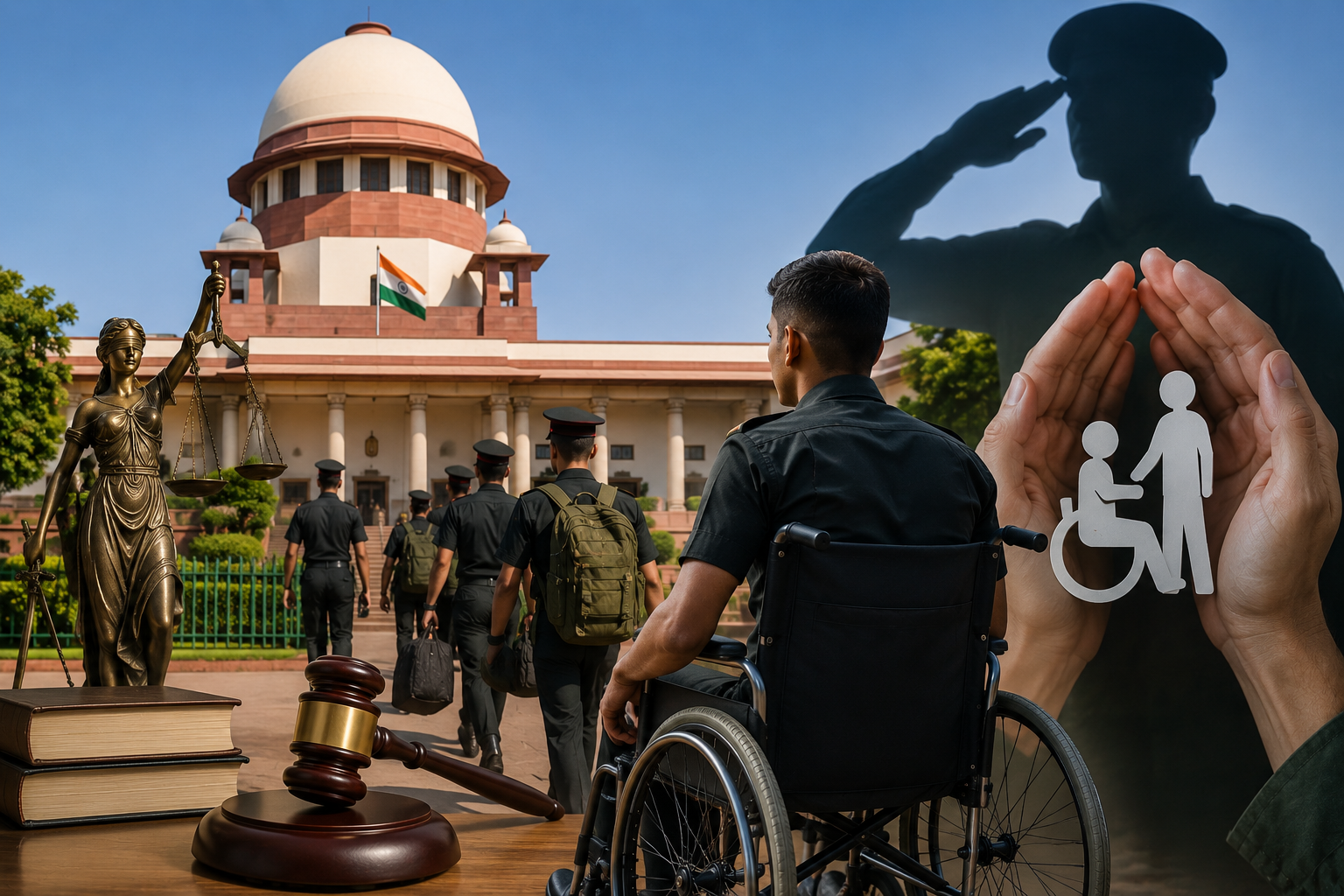
States Asked to Consider Ex-Servicemen Reservation for Out-Boarded Cadets; Centre Directed to Explore Welfare Scheme for Those with Disabilities Below 40%
In a landmark decision aimed at strengthening the rehabilitation and future employment prospects of injured military trainees, the Supreme Court of India has directed all States and Union Territories to examine the possibility of extending ex-servicemen reservation benefits to military cadets who are discharged from training after suffering disabilities. The Court also ruled that cadets who sustain benchmark disabilities of 40% or more are entitled to reservation in government employment under the Rights of Persons with Disabilities (RPwD) Act, 2016.
The judgment marks a significant step towards recognising the sacrifices made by young men and women who are forced to leave military training due to injuries sustained while preparing to serve the nation. While these cadets do not officially become members of the armed forces, the Court observed that they should not be deprived of rehabilitation and employment opportunities merely because their service ended before formal commissioning.
The ruling is expected to have far-reaching implications for defence training institutions, state governments, and policymakers responsible for veteran welfare.
Supreme Court Recognises the Need for Fair Rehabilitation
The order was passed by a Bench comprising Justice B.V. Nagarathna and Justice Manmohan while hearing a suo motu petition relating to the welfare of out-boarded military cadets.
These cadets are trainees who are medically discharged from military academies after suffering injuries or disabilities during rigorous physical training.
The Court observed that such individuals dedicate themselves to serving the country and often lose promising military careers due to circumstances beyond their control. Therefore, providing them with meaningful rehabilitation and employment opportunities is both fair and necessary.
The Bench stressed that governments must adopt a compassionate approach toward those who suffer disabilities while preparing to join India's defence forces.
Reservation Under Disability Law Confirmed
One of the most significant aspects of the judgment is the Supreme Court's clarification regarding the applicability of the Rights of Persons with Disabilities Act, 2016.
The Court held that military cadets discharged after acquiring benchmark disabilities of at least 40% are eligible to seek reservation under Section 34 of the RPwD Act, which mandates a minimum 4% reservation in government jobs for persons with benchmark disabilities.
The Bench clarified that these cadets should be permitted to apply for public employment under the reserved category available for persons with disabilities.
The decision ensures that military trainees injured during training are not excluded from statutory employment protections available under disability law.
States Encouraged to Extend Ex-Servicemen Benefits
Beyond disability reservation, the Supreme Court also urged all State Governments and Union Territories to consider extending the ex-servicemen reservation quota to out-boarded military cadets.
At present, these cadets do not fall within the Central Government's official definition of "ex-servicemen" because they are discharged before completing active military service.
However, the Court observed that states have the flexibility to formulate broader policies aimed at improving employment opportunities for these individuals.
According to the Bench, extending similar reservation benefits would acknowledge the sacrifices made by injured cadets and help them secure stable government employment after leaving military training.
Registry Directed to Communicate Order Nationwide
To ensure wider implementation of the judgment, the Supreme Court directed its Registry to send copies of the order to the Chief Secretaries of all States and Union Territories.
The Court asked state governments to independently examine the issue without restricting themselves to the existing definition of "ex-servicemen" prescribed by the Department of Personnel and Training (DoPT).
This move is expected to encourage individual states to develop policies suited to their own recruitment and reservation frameworks while promoting greater inclusiveness for disabled defence trainees.
Welfare Scheme Sought for Cadets Below 40% Disability
The Supreme Court also addressed the concerns of military cadets who suffer disabilities below the 40% benchmark required under the RPwD Act.
Since these individuals are not eligible for statutory disability reservation, they often face significant challenges in securing employment and rehabilitation assistance.
Recognising this gap, the Court directed the Central Government to examine the feasibility of introducing a special welfare and rehabilitation scheme for such cadets.
The proposed scheme could provide support through employment assistance, vocational training, financial aid, skill development, counselling, or other rehabilitation measures.
The Centre has been asked to consider appropriate policy options and submit its response.
Understanding the Challenges Faced by Out-Boarded Cadets
Military training is physically demanding and exposes cadets to rigorous exercises designed to prepare them for operational service.
Unfortunately, some trainees suffer permanent injuries or medical conditions that make it impossible for them to continue training.
Once discharged, these individuals often face multiple challenges, including:
-
Loss of their intended military career.
-
Difficulty securing alternative employment.
-
Financial uncertainty.
-
Long-term medical treatment.
-
Emotional and psychological stress.
Unlike commissioned defence personnel, out-boarded cadets have historically received limited institutional support despite suffering injuries while training for national service.
The Court's observations seek to address this long-standing policy gap.
RPwD Act Provides Important Employment Safeguards
The Rights of Persons with Disabilities Act, 2016 represents India's principal legislation protecting the rights of persons with disabilities.
The Act guarantees:
-
Reservation in government employment.
-
Reservation in educational institutions.
-
Equal opportunity.
-
Protection against discrimination.
-
Accessibility and inclusion.
By extending these protections to eligible out-boarded military cadets, the Supreme Court has reinforced the objective of ensuring equal employment opportunities for persons who acquire disabilities while pursuing public service careers.
Individual Legal Remedies Remain Open
The Court also clarified that its ongoing proceedings will not prevent affected cadets from pursuing independent legal remedies before various High Courts.
Cadets whose cases were earlier disposed of due to the pending Supreme Court proceedings have also been granted liberty to seek restoration of their petitions.
This ensures that individual grievances can continue to receive judicial attention while broader policy reforms are considered by governments.
Wider Implications for Defence Welfare Policy
Legal experts believe the judgment could influence future reforms in India's defence welfare framework.
If adopted by states and supported by the Centre, the recommendations could provide disabled military trainees with:
-
Improved employment opportunities.
-
Reservation benefits.
-
Better rehabilitation support.
-
Greater financial security.
-
Enhanced social recognition.
The ruling also reinforces the principle that national service begins during military training itself and that individuals injured during this period deserve meaningful institutional support.
Outlook
The Supreme Court's directions represent an important milestone in recognising the sacrifices made by military cadets who are forced to leave training after sustaining disabilities. By affirming reservation benefits under the RPwD Act and encouraging states to extend ex-servicemen quota benefits, the Court has attempted to bridge a long-standing gap in India's defence welfare system.
The Centre's proposed welfare scheme for cadets with disabilities below the statutory benchmark could further strengthen rehabilitation efforts and ensure that no injured trainee is left without support. As states evaluate the Court's recommendations and policymakers examine possible reforms, the judgment has the potential to reshape employment and rehabilitation opportunities for hundreds of aspiring defence personnel across the country while reinforcing India's commitment to inclusive governance and social justice.