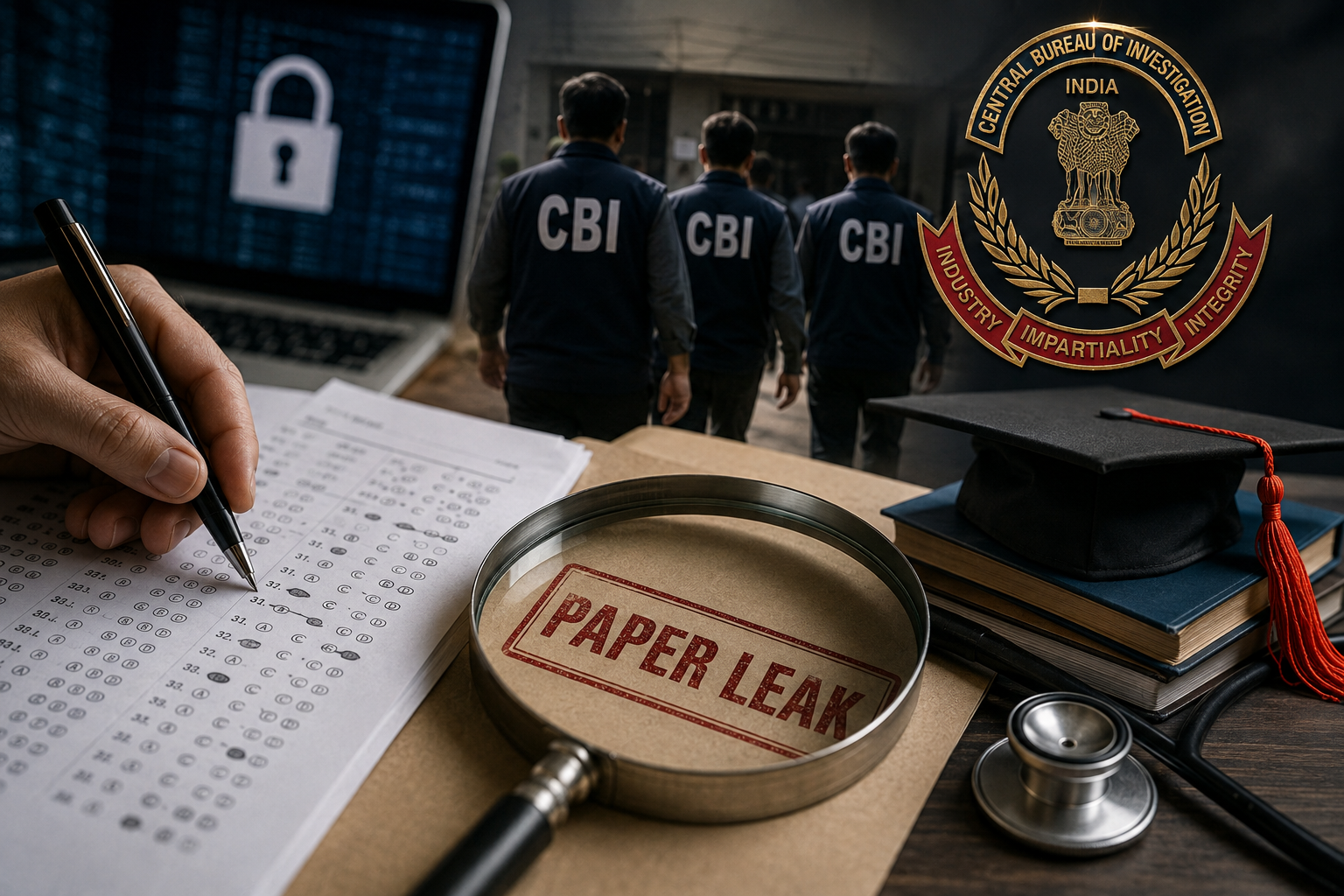
Investigation Points to Organized Network of Subject Experts, Coaching Operators, Middlemen and Candidates; Digital Evidence Forms Core of Prosecution Case
The Central Bureau of Investigation (CBI) has intensified its investigation into the alleged NEET-UG 2026 paper leak by filing a detailed chargesheet before the Special CBI Court in Delhi, alleging that the breach of one of India's most important entrance examinations was the result of a carefully orchestrated conspiracy rather than an isolated security lapse.
According to the investigating agency, the alleged operation was planned months before the examination and involved multiple stakeholders, including National Testing Agency (NTA)-appointed subject experts, coaching institute operators, intermediaries, and candidates. The CBI claims that confidential examination material was allegedly accessed through misuse of official positions and subsequently distributed through a structured network in exchange for financial gains.
The chargesheet marks a significant development in one of the country's most closely watched examination fraud investigations and raises fresh concerns regarding the security, transparency, and credibility of India's competitive examination system.
CBI Alleges Months of Planning Behind Paper Leak
According to the chargesheet, the alleged conspiracy did not emerge shortly before the examination but was planned well in advance.
Investigators claim that coaching operators and intermediaries established contact with individuals associated with the examination process several months before the conduct of the NEET-UG examination.
The agency alleges that these contacts were gradually developed through repeated communication, meetings, and financial arrangements, ultimately enabling unauthorized access to confidential question papers.
The investigation suggests that the operation involved extensive coordination rather than a single act of examination malpractice.
NTA Subject Experts Named in Chargesheet
One of the most significant aspects of the investigation is the alleged involvement of three NTA-appointed subject experts.
According to the CBI, these individuals allegedly misused their official responsibilities connected with the preparation and handling of confidential examination material.
The agency claims that sensitive question papers were unlawfully accessed before the examination and subsequently shared with members of the alleged conspiracy.
The allegations have raised serious questions regarding internal examination security protocols and the safeguards governing confidential examination material.
It is important to note that these allegations are part of an ongoing judicial process, and the accused remain entitled to the presumption of innocence until proven guilty by a competent court.
Coaching Institutes and Private Individuals Under Scanner
The chargesheet further alleges that several coaching operators and private individuals played an important role in coordinating the operation.
According to investigators, these individuals allegedly:
-
Established contact with subject experts
-
Arranged meetings
-
Facilitated financial transactions
-
Coordinated communication between different members of the network
The agency believes these intermediaries acted as the operational backbone of the alleged conspiracy, ensuring that confidential examination material moved securely through various stages before reaching intended recipients.
Investigators also claim that the operation functioned with clearly defined roles assigned to different participants.
Multi-Layer Distribution Network Allegedly Used
Rather than directly supplying confidential papers to candidates, investigators allege that the leaked material passed through several intermediaries.
The CBI believes the multi-layer distribution mechanism was intentionally designed to:
-
Conceal the identities of key conspirators
-
Reduce direct links between sources and candidates
-
Minimize the risk of detection
-
Facilitate financial transactions
According to the chargesheet, multiple individuals allegedly acted as links between the original source of the question papers and candidates seeking advance access.
Such compartmentalization is often associated with organized criminal operations involving confidential information.
Digital Evidence Plays a Crucial Role
The investigation relies heavily on electronic and digital evidence recovered during searches conducted at multiple locations.
According to the CBI, investigators recovered:
-
WhatsApp conversations
-
Telegram chats
-
PDF documents
-
Images of confidential question papers
-
Mobile phone data
-
Computer records
-
Digital forensic reports
The agency claims that forensic analysis of electronic devices enabled investigators to reconstruct the movement of confidential examination material across the alleged network.
Digital communication records are expected to form a substantial part of the prosecution's evidence during court proceedings.
Financial Transactions Also Under Investigation
Apart from digital evidence, investigators have also examined the alleged financial arrangements connected to the paper leak.
According to the chargesheet, payments were allegedly made in exchange for confidential examination material.
The agency further claims that one accused reportedly handed over original educational certificates along with a signed blank cheque as security after receiving the leaked papers.
Investigators believe these transactions demonstrate that the alleged paper leak operated as a commercial enterprise involving substantial financial consideration.
Authorities continue to examine financial records, banking transactions, and other documentary evidence linked to the accused.
Charges Filed Under Multiple Criminal Laws
The CBI has invoked several legal provisions while filing the chargesheet.
The alleged offences include provisions relating to:
-
Criminal conspiracy
-
Cheating
-
Destruction of evidence
-
Prevention of Corruption Act
-
Public Examinations (Prevention of Unfair Means) Act, 2024
The Public Examinations Act was enacted to strengthen legal action against organized examination fraud and introduce stricter punishment for offences such as paper leaks, impersonation, and organized cheating.
According to the investigating agency, 13 accused named in the chargesheet are currently in judicial custody.
NEET's Importance Makes Security Critical
NEET-UG is among India's largest and most competitive entrance examinations.
Every year, millions of students compete for admission to undergraduate medical, dental, AYUSH, veterinary, and other healthcare courses across the country.
Because of the examination's significance, maintaining complete confidentiality and fairness is essential to preserving public trust.
Any compromise in examination security can have far-reaching consequences for deserving students, educational institutions, and the overall credibility of India's admission process.
Calls for Stronger Examination Reforms
The latest developments have renewed calls for strengthening examination security across the country.
Education experts have suggested several reforms, including:
-
Advanced encrypted digital paper transmission
-
Artificial intelligence-based monitoring systems
-
Multi-layer authentication for examination personnel
-
Enhanced background verification of confidential staff
-
Real-time cyber surveillance
-
Stricter audit mechanisms
-
Faster investigation and prosecution of examination-related offences
Many experts believe technology must play a greater role in protecting high-stakes public examinations from organized fraud.
Public Confidence Remains a Key Priority
Incidents involving examination malpractice often create anxiety among students and parents who invest years preparing for competitive examinations.
Maintaining transparency, conducting impartial investigations, and ensuring timely judicial proceedings are considered essential for restoring confidence in the examination system.
Authorities have reiterated their commitment to safeguarding the integrity of national-level entrance examinations through stronger institutional safeguards and improved monitoring mechanisms.
Outlook
The CBI's chargesheet presents serious allegations that the NEET-UG 2026 paper leak was the result of a structured and financially motivated conspiracy involving individuals from multiple levels of the examination ecosystem. The investigation suggests that the alleged operation relied on coordinated planning, confidential access, digital communication networks, and financial arrangements to compromise one of India's most important entrance examinations.
However, the investigation remains subject to judicial scrutiny, and all allegations will ultimately be tested before the court. As legal proceedings continue, the case is expected to play an important role in shaping future reforms aimed at strengthening examination security, improving institutional accountability, and restoring confidence in India's public examination system.