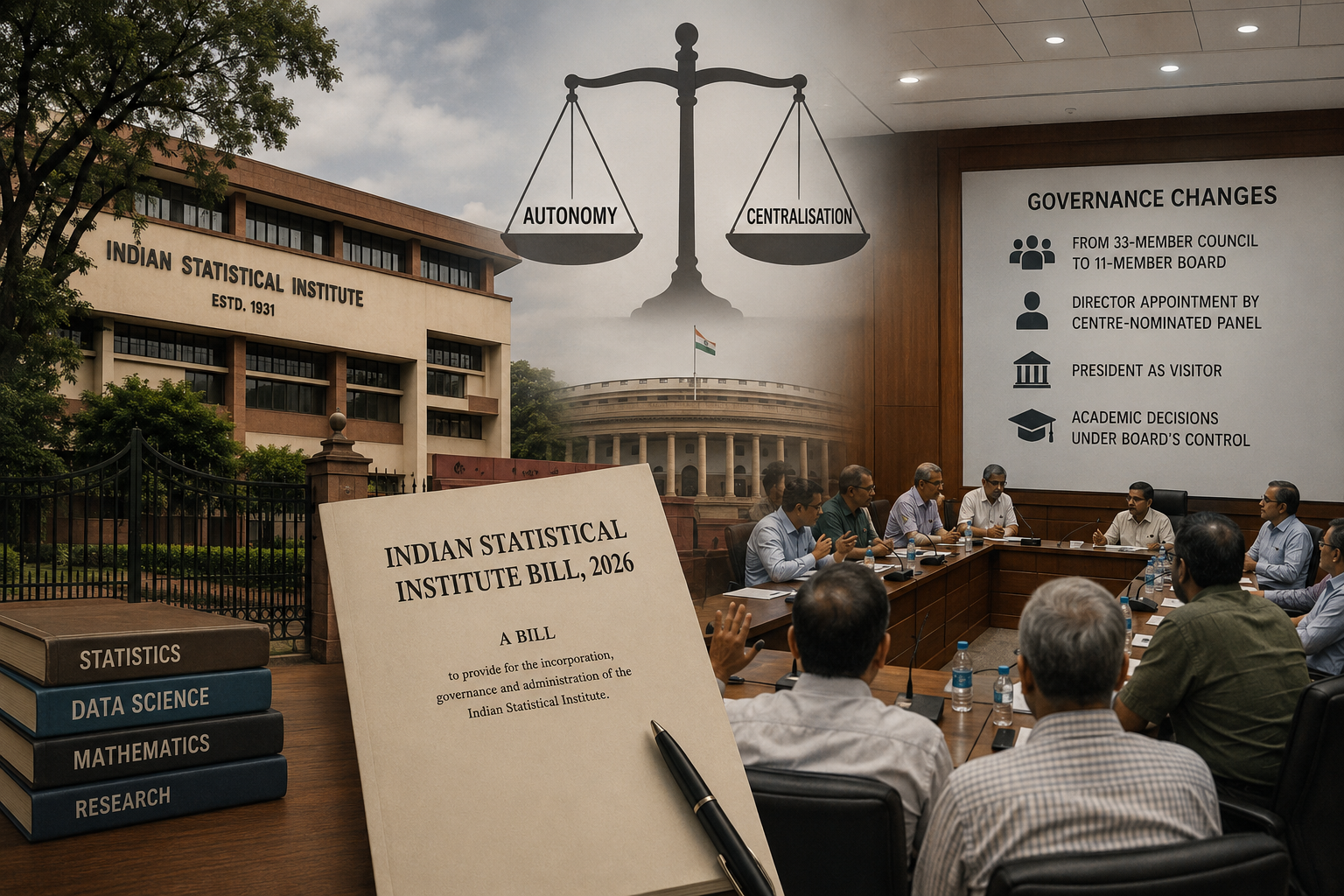
Proposed legislation seeks to modernise ISI's administration, but researchers warn it could centralise decision-making and weaken institutional independence
The introduction of the Indian Statistical Institute (ISI) Bill, 2026 in the Lok Sabha has triggered widespread debate across India's academic and research community. The proposed legislation aims to replace the existing Indian Statistical Institute Act, 1959, introducing a new governance framework intended to modernise one of the country's most prestigious research institutions.
While the Union Government maintains that the Bill will improve administrative efficiency and strengthen institutional governance, faculty members, researchers and several Opposition leaders argue that it could significantly reduce the institute's autonomy by concentrating greater authority with the Central Government.
A Legacy Institution at the Heart of India's Statistical Research
Founded in 1931 by renowned statistician Prasanta Chandra Mahalanobis, the Indian Statistical Institute has played a pivotal role in advancing statistical sciences, mathematics, economics, computer science and interdisciplinary research in India. Headquartered in Kolkata, the institute also operates centres in New Delhi, Bengaluru, Chennai and Tezpur.
Recognised as an Institution of National Importance in 1959, ISI has earned a global reputation for academic excellence, research innovation and contributions to national policy-making. It continues to attract talented students and researchers from India and abroad.
Major Governance Changes Proposed
The Bill proposes converting ISI from a registered society into a statutory body created through an Act of Parliament. One of the most significant reforms is the replacement of the existing 33-member ISI Council with a much smaller 11-member Board of Governance.
According to the Ministry of Statistics and Programme Implementation (MoSPI), the present governance structure has become too large and administratively cumbersome. The ministry believes a leaner governing body will enable quicker decision-making, improve accountability and bring the institute's administration in line with evolving educational and research requirements.
Under the proposed framework:
-
The President of India will serve as the Visitor of the institute.
-
The Board of Governance will oversee administration, appointments, regulations and financial decisions.
-
The Board will have authority to appoint faculty, confer degrees and frame institutional policies.
-
An Academic Council headed by the Director will advise the Board on academic matters.
The legislation also expands ISI's academic mandate by formally including emerging disciplines such as Data Science, Artificial Intelligence, Computer Science, Cryptology, Biostatistics and other allied fields, allowing the institute to introduce programmes aligned with modern technological developments.
Faculty Raise Concerns Over Institutional Independence
Despite the government's assurances, senior faculty members have expressed strong reservations regarding the proposed governance model.
Their principal concern is that the new Board of Governance would contain a higher proportion of government nominees while reducing representation from elected faculty members and the wider scientific community. According to faculty representatives, this could dilute the institute's long-standing tradition of academic self-governance.
Researchers also argue that reducing the role of internally elected representatives may weaken transparency in institutional decision-making and limit academic participation in matters affecting teaching, research and strategic planning.
Appointment of Director Under Scrutiny
Another contentious provision relates to the appointment of the Director.
The Bill proposes that the Director be selected from a panel prepared by a search-cum-selection committee constituted by the Central Government. The Visitor would also have the authority to remove the Director under specified circumstances.
Faculty members believe this framework could make the institute's leadership more accountable to the government than to the academic community, potentially affecting independent decision-making in research and academic administration.
Academic Council's Role May Be Reduced
Several academicians have also questioned the proposed balance of power between the Academic Council and the Board of Governance.
While the Academic Council would continue advising on academic matters, final authority over several important decisions—including regulations, academic policies and institutional administration—would rest with the Board.
Critics argue that major academic institutions function best when academic experts retain substantial influence over curriculum design, research priorities and educational policies.
Government Defends the Reform Agenda
The Central Government has rejected suggestions that the Bill undermines ISI's autonomy.
Officials state that the objective is to strengthen governance by creating a more efficient administrative structure while preserving academic excellence. They argue that the current society-based model often results in delayed decisions due to its large membership and complex governance process.
According to the government, stakeholder consultations were conducted for over a year, during which hundreds of suggestions were received and several recommendations incorporated into the final draft.
The Centre has also clarified that the institute's headquarters will continue to remain in Kolkata, addressing concerns regarding any possible relocation.
Broader Debate on Institutional Autonomy
The controversy surrounding the ISI Bill reflects a wider national discussion on balancing administrative reforms with academic independence.
Supporters believe modern governance structures are necessary for globally competitive institutions, especially as higher education increasingly focuses on interdisciplinary research, digital technologies and international collaboration.
Opponents, however, caution that excessive centralisation could reduce institutional flexibility, discourage academic participation in governance and affect the independence that has historically contributed to ISI's global reputation.
The legislation is expected to receive further scrutiny during parliamentary discussions, where lawmakers may debate whether additional safeguards are needed to protect institutional autonomy while enabling administrative reforms.
What Lies Ahead
If enacted in its current form, the ISI Bill, 2026 would represent one of the most significant structural reforms in the institute's history. The final outcome will likely depend on parliamentary deliberations and whether amendments are introduced in response to concerns raised by faculty members and academic organisations.
The debate highlights the continuing challenge of modernising India's premier educational institutions while preserving the academic freedom and governance principles that underpin research excellence.
Market Outlook
The Indian Statistical Institute Bill, 2026 is primarily an education and governance reform and is unlikely to have any immediate impact on the Indian stock market. The proposed legislation does not directly affect listed companies, corporate earnings or sector-specific businesses. Investors are expected to remain focused on macroeconomic indicators, corporate earnings, monetary policy and global market developments rather than this academic governance reform. However, in the long term, stronger research institutions and expanded focus on data science and artificial intelligence could contribute positively to India's innovation ecosystem and human capital development.