R.C. Bhargava Says Proposed Vehicle-to-Vehicle Communication Mandate Could Increase Costs and Slow Industry Growth; Calls for India-Specific Automotive Policies
Maruti Suzuki Chairman R.C. Bhargava has raised concerns over the government's proposal to make Vehicle-to-Vehicle (V2V) communication technology mandatory in all new passenger vehicles from October 2028, arguing that such regulations should be tailored to India's unique driving conditions rather than mirroring standards followed in developed countries.
Speaking on the evolving regulatory landscape of the Indian automobile industry, Bhargava questioned whether advanced connectivity technologies designed primarily for high-speed highway driving in Western economies would deliver meaningful benefits for Indian consumers, where road conditions, traffic patterns and driving speeds differ significantly.
His remarks come at a time when the Indian automotive industry is simultaneously adapting to stricter emission norms, higher safety standards, ethanol-blended fuel adoption and the transition toward electric and connected mobility.
Government Proposes Mandatory V2V Communication from 2028
The Ministry of Road Transport and Highways is considering making Vehicle-to-Vehicle (V2V) communication systems compulsory for all newly manufactured vehicles beginning October 2028.
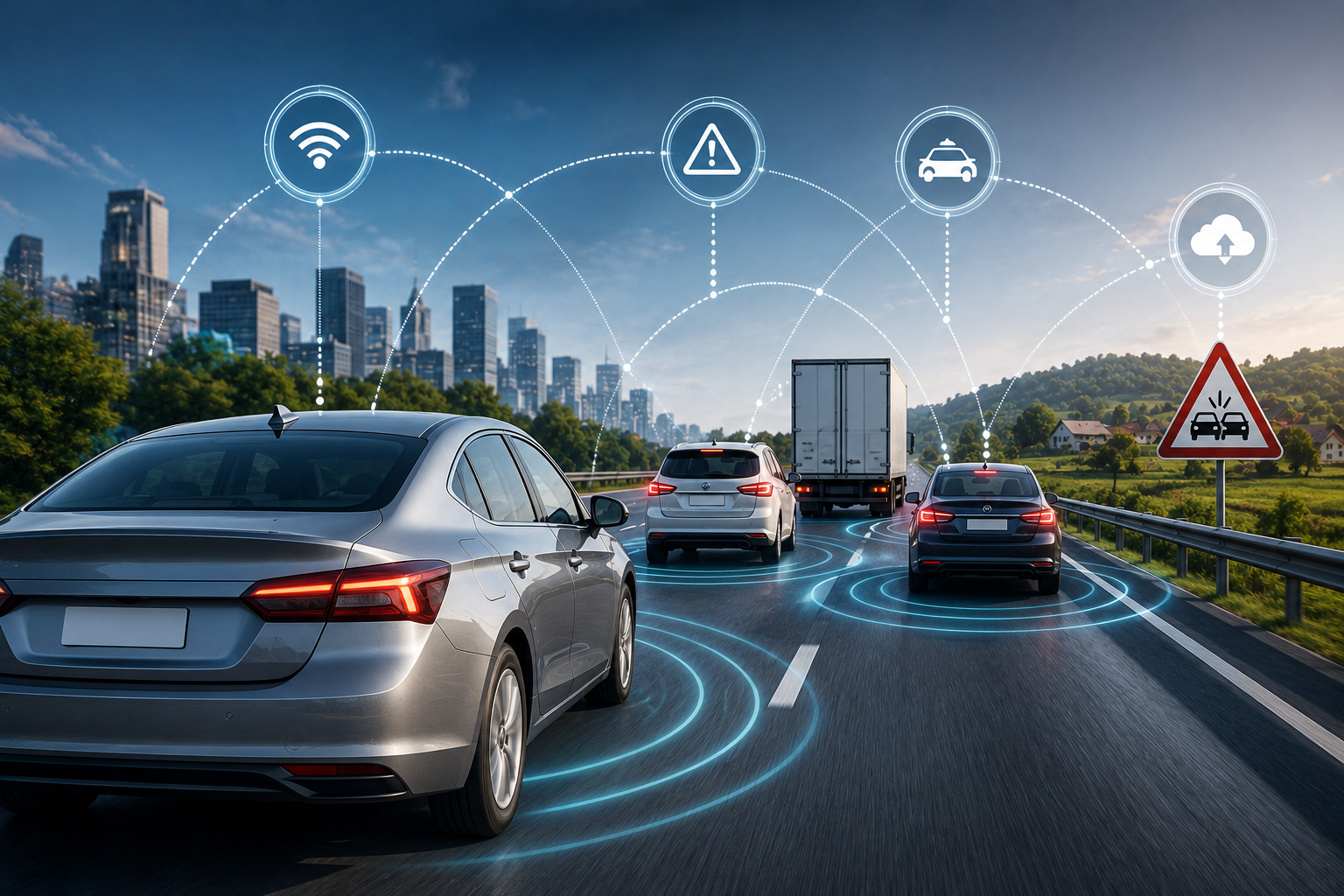
V2V technology enables automobiles to exchange real-time information such as:
-
Vehicle speed
-
Direction of movement
-
Sudden braking alerts
-
Lane positioning
-
Collision warnings
-
Road hazards
-
Traffic conditions
The objective is to improve road safety by allowing connected vehicles to communicate with each other and warn drivers about potential dangers before they become visible.
Globally, V2V communication is regarded as one of the foundational technologies supporting connected and autonomous mobility.
Bhargava Questions Its Relevance for Indian Roads
While acknowledging technological progress, Bhargava questioned whether mandatory implementation is appropriate across all vehicle categories and driving environments in India.
He argued that a large proportion of Indian motorists operate their vehicles:
-
In congested urban areas
-
On mixed-traffic roads
-
At average speeds of only 30–40 kmph
-
In rural regions with different infrastructure challenges
Under such circumstances, the real-world benefits of advanced vehicle communication systems may be significantly lower than those observed in developed economies.
According to Bhargava, automotive regulations should reflect India's unique transportation ecosystem rather than adopting international standards without adequate localisation.
India's Mobility Landscape Is Fundamentally Different
Bhargava emphasised that India cannot be viewed as a homogeneous automobile market.
Unlike developed nations where vehicles primarily travel on controlled-access highways, Indian roads accommodate an extremely diverse mix of road users, including:
-
Passenger cars
-
Two-wheelers
-
Auto-rickshaws
-
Buses
-
Trucks
-
Tractors
-
Animal-drawn vehicles
-
Cyclists
-
Pedestrians
Road infrastructure, traffic density and driving behaviour vary significantly between metropolitan cities, smaller towns and rural regions.
Given these differences, he believes regulatory frameworks should be designed specifically for Indian operating conditions.
Higher Technology Could Increase Vehicle Prices
One of the industry's principal concerns is the additional cost associated with mandatory connected vehicle technology.
Implementing V2V systems would require manufacturers to install:
-
Dedicated communication modules
-
Vehicle connectivity hardware
-
Advanced sensors
-
Software platforms
-
Cybersecurity systems
-
Regular software maintenance and updates
These additions are expected to increase manufacturing costs, particularly for entry-level and compact vehicles where pricing remains highly competitive.
Industry experts warn that additional regulatory requirements could make affordable passenger vehicles more expensive, potentially affecting consumer demand in India's price-sensitive automobile market.
Affordability Remains Critical in India's Auto Market
India continues to be one of the world's most cost-conscious automobile markets.
A significant portion of passenger vehicle sales comes from:
-
Entry-level hatchbacks
-
Compact sedans
-
Small SUVs
-
First-time car buyers
For these customers, even modest increases in vehicle prices can influence purchasing decisions.
Automakers therefore argue that regulatory interventions should carefully balance technological advancement with affordability.
Maintaining accessible pricing remains essential for sustaining long-term growth in domestic vehicle sales.
Safety Benefits Are Undisputed, But Timing Is Important
Supporters of V2V technology argue that connected vehicle systems have the potential to significantly improve road safety.
The technology can help drivers by providing advance warnings regarding:
-
Sudden braking by nearby vehicles
-
Blind-spot hazards
-
Collision risks
-
Dangerous intersections
-
Adverse road conditions
-
Emergency vehicle movement
As connected mobility evolves globally, V2V communication is expected to become a key component of intelligent transportation systems.
However, Bhargava believes India should prioritise practical implementation based on domestic infrastructure readiness rather than imposing uniform mandates across all vehicle categories.
Industry Already Managing Multiple Regulatory Transitions
The Indian automobile sector is currently undergoing one of its most significant transformation phases.
Manufacturers are simultaneously investing in compliance with:
-
Bharat Stage emission standards
-
Corporate Average Fuel Efficiency (CAFE) norms
-
Electric vehicle development
-
Flex-fuel technologies
-
Advanced safety regulations
-
Connected mobility solutions
-
Digital vehicle architecture
Each new regulatory requirement demands substantial investments in research, development, manufacturing and supply chains.
Industry leaders argue that introducing multiple compliance requirements within a short period may increase costs and slow the pace of industry growth.
Bhargava Highlights Challenges in E20 Fuel Adoption
Apart from connected vehicle technology, Bhargava also commented on India's transition toward E20 ethanol-blended fuel.
He stated that automobile manufacturers have already developed engines capable of operating on E20 fuel.
However, he believes the primary challenge now lies in:
-
Consistent fuel quality
-
Nationwide availability
-
Efficient fuel distribution
-
Infrastructure readiness
According to him, successful adoption depends less on engine technology and more on ensuring consumers have reliable access to high-quality E20 fuel across the country.
Connected Mobility Will Shape the Future of Transportation
Globally, connected vehicle technologies are expected to transform transportation over the coming decade.
Vehicle-to-Vehicle communication is likely to support:
-
Autonomous driving systems
-
Intelligent traffic management
-
Smart city infrastructure
-
Connected highways
-
Accident prevention
-
Reduced traffic congestion
Countries including the United States, Japan, South Korea and several European nations continue investing heavily in connected mobility infrastructure.
India is also gradually moving toward this ecosystem, although widespread deployment will require supporting digital infrastructure and standardised communication networks.
Industry Seeks India-Centric Policy Framework
Bhargava's comments reflect a broader view within the automobile industry that regulations should account for India's unique economic and infrastructural realities.
Manufacturers have consistently advocated for:
-
Phased implementation of new technologies
-
Cost-effective compliance mechanisms
-
India-specific safety standards
-
Extensive consultation with industry stakeholders
-
Infrastructure readiness before mandatory adoption
Industry representatives believe such an approach would encourage innovation while protecting affordability and sustaining long-term sector growth.
What This Means for Consumers
If implemented, mandatory V2V communication could eventually provide several benefits to Indian consumers, including:
-
Enhanced road safety
-
Improved collision avoidance
-
Smarter navigation support
-
Better traffic management
-
Increased vehicle connectivity
However, consumers may also face:
-
Higher vehicle prices
-
Increased maintenance complexity
-
Software update requirements
-
Additional technology-related costs
Balancing these benefits against affordability will remain one of the key considerations for policymakers.
Outlook
The debate surrounding mandatory Vehicle-to-Vehicle communication highlights the broader challenge of modernising India's automobile sector while preserving affordability and supporting industry growth. As connected mobility becomes an integral part of the global automotive ecosystem, India is expected to gradually adopt advanced vehicle technologies. However, industry leaders such as Maruti Suzuki Chairman R.C. Bhargava argue that implementation should be carefully aligned with the country's unique driving conditions, infrastructure and consumer needs.
Going forward, continued dialogue between the government and automobile manufacturers will be crucial in shaping regulations that enhance safety and technological innovation without imposing excessive costs on consumers or slowing the momentum of one of India's most important manufacturing industries.