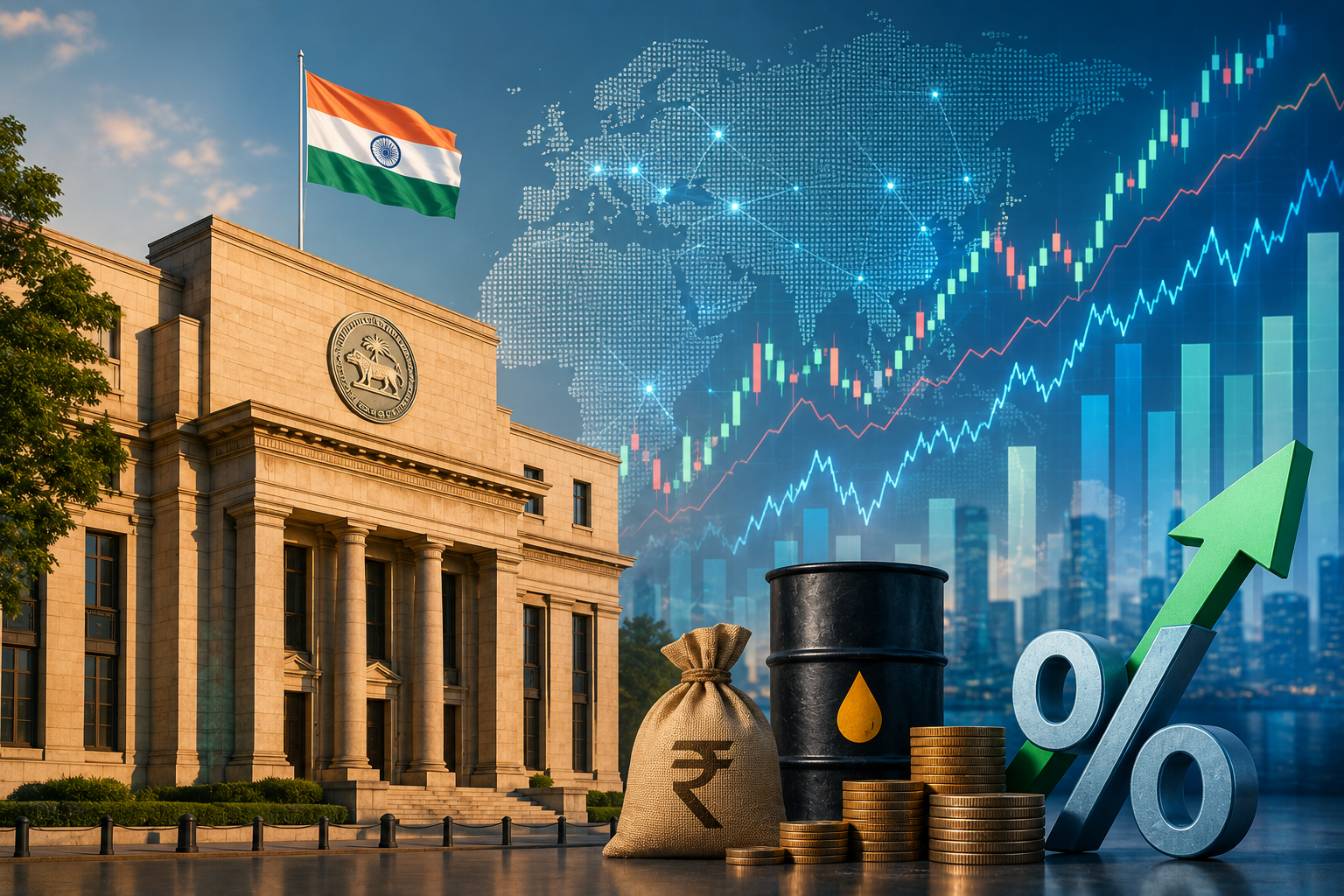
Strong Economic Growth, Controlled Inflation and a Resilient Rupee Allow the Central Bank to Prioritise Stability as Global Uncertainty Persists
The Reserve Bank of India (RBI) has once again reinforced its confidence in the Indian economy by maintaining the benchmark repo rate at 5.25%, despite rising geopolitical tensions in the Middle East and recent volatility in global crude oil prices. While several central banks across Asia have adopted a more cautious stance amid concerns that higher energy prices could fuel inflation, the RBI has chosen to remain patient, signalling that India's economic fundamentals remain strong enough to withstand external shocks.
The latest monetary policy decision positions the RBI as one of Asia's most accommodative major central banks, highlighting its belief that temporary supply-side pressures are unlikely to derail India's growth trajectory or push inflation beyond its comfort zone.
Governor Sanjay Malhotra reiterated that the central bank will continue to follow a data-dependent approach, with future policy decisions being guided by domestic inflation, growth dynamics and evolving global developments rather than reacting to short-term market volatility.
RBI Stands Apart from Regional Central Banks
Over the past few months, central banks across the Asia-Pacific region have become increasingly cautious due to geopolitical tensions, volatile commodity prices and uncertainty surrounding global monetary policy.
Countries including Indonesia and Australia have remained vigilant about the inflationary impact of higher crude oil prices, while several policymakers have signalled the possibility of tighter monetary conditions if inflation accelerates further.
In contrast, the RBI has maintained a relatively calm stance, arguing that India's inflation dynamics remain fundamentally different from many other emerging economies.
The central bank believes that domestic demand remains healthy, inflation expectations are well anchored and external risks, although important, have not yet translated into broad-based inflationary pressures.
Why the RBI Is Comfortable Holding Interest Rates
The RBI's confidence is rooted in the strength of India's macroeconomic fundamentals.
Unlike many economies where inflation has remained stubbornly high, India continues to enjoy:
-
Stable economic growth
-
Moderating retail inflation
-
Improving agricultural output
-
Healthy domestic consumption
-
Strong government capital expenditure
-
A relatively stable external sector
The central bank believes these factors provide sufficient policy flexibility to maintain interest rates while closely monitoring incoming data.
Governor Malhotra emphasized that recent increases in inflation are largely the result of temporary supply disruptions rather than excessive domestic demand.
Inflation Remains Well Within RBI's Target Band
One of the strongest arguments supporting the RBI's policy pause is the country's inflation trajectory.
Retail inflation continues to remain comfortably within the RBI's mandated 2%–6% target range, reducing the urgency for immediate monetary tightening.
Although global crude oil prices have witnessed periodic spikes due to geopolitical tensions, policymakers have observed limited transmission into broader consumer prices.
The RBI has consistently maintained that monetary policy should respond to sustained inflationary trends rather than temporary supply-side shocks.
As long as inflation remains contained and medium-term expectations stay anchored, the central bank is expected to prioritise economic growth over premature policy tightening.
Governor Malhotra Signals Data-Driven Policy Approach
Following the monetary policy announcement, RBI Governor Sanjay Malhotra reiterated that future policy decisions would remain entirely data dependent.
Rather than committing to a fixed interest-rate trajectory, the central bank will evaluate:
-
Inflation trends
-
Economic growth
-
Employment indicators
-
Global commodity prices
-
Currency movements
-
Financial market conditions
This flexible approach enables policymakers to respond quickly if inflationary pressures become persistent while avoiding unnecessary tightening during temporary disruptions.
The Governor also highlighted that India's economy continues to display remarkable resilience despite an uncertain global backdrop.
Global Brokerages Push Back Rate Hike Expectations
The RBI's policy commentary prompted several global financial institutions to revise their interest-rate forecasts.
Goldman Sachs observed that Governor Malhotra adopted a distinctly dovish tone by emphasizing the temporary nature of current inflationary pressures.
Following the policy announcement, the investment bank postponed its expectation for the first RBI rate hike from October 2026 to December 2026.
It further noted that if core inflation remains weaker than expected over the coming months, the beginning of the tightening cycle could potentially shift to February 2027.
The revised outlook reflects growing confidence that India's inflation risks remain manageable despite global uncertainties.
Bond Markets Respond with Lower Rate Expectations
Financial markets also adjusted their expectations following the RBI's policy decision.
India's interest-rate swap curve shifted lower, particularly in shorter-duration contracts, as traders reduced expectations of near-term monetary tightening.
Markets now expect approximately:
-
50 basis points of cumulative rate hikes over the next year,
compared with roughly:
-
75 basis points expected before the RBI's latest policy announcement.
The decline indicates that investors increasingly believe the central bank has room to remain on hold for an extended period if inflation remains under control.
Economic Growth Continues to Surprise on the Upside
Another factor strengthening the RBI's confidence is India's resilient economic performance.
The central bank recently upgraded its FY27 GDP growth projection to 6.7%, reflecting optimism regarding domestic demand and investment activity.
Several high-frequency indicators continue to point toward robust economic momentum, including:
-
Strong automobile sales
-
Healthy manufacturing activity
-
Expansion in the services sector
-
Stable bank credit growth
-
Rising infrastructure spending
-
Improving corporate earnings
The resilience of these indicators suggests that the Indian economy remains among the fastest-growing major economies globally.
Core Inflation Remains Under Control
Economists believe that the RBI is paying closer attention to core inflation, which excludes volatile food and fuel prices.
Historically, the RBI has increased interest rates only when core inflation remains persistently elevated and becomes broad-based across the economy.
Several economists believe that policy tightening would become necessary only if core inflation consistently moves above 4.5%.
Current projections, however, suggest that such conditions are unlikely to emerge during 2026.
This provides additional justification for maintaining the current policy stance.
Festive Demand Will Be the Next Major Test
The upcoming festive season, beginning in September and extending through Diwali, will provide an important assessment of India's inflation dynamics.
Traditionally, household spending increases significantly during this period across categories such as:
-
Consumer electronics
-
Automobiles
-
Gold and jewellery
-
Apparel
-
Home improvement
-
Travel and leisure
If stronger consumer demand does not lead to widespread inflation, it would further validate the RBI's assessment that current price pressures remain temporary.
Stronger Rupee Supports Inflation Management
The appreciation of the Indian rupee has also strengthened the central bank's policy flexibility.
Since June, the rupee has recovered nearly 2% from its record low against the US dollar.
The recovery has been supported by:
-
Softer global crude oil prices
-
RBI measures to attract foreign capital
-
Improved capital inflows
-
Better market sentiment
-
Easing geopolitical concerns
A stronger domestic currency helps reduce imported inflation by lowering the cost of crude oil, industrial raw materials and other imported goods.
This provides another cushion against inflationary pressures.
Foreign Capital Inflows Improve External Stability
The RBI's foreign exchange management initiatives have significantly strengthened India's external position.
According to market estimates, the central bank has attracted nearly $41 billion through its swap programme, improving foreign exchange liquidity and supporting the rupee.
A stronger external sector gives policymakers greater flexibility to maintain accommodative monetary conditions without risking excessive currency volatility.
Analysts believe these measures have enhanced India's resilience against external financial shocks.
Consumer Confidence Suggests Limited Inflation Risk
Recent RBI surveys reveal that household confidence has moderated across both urban and rural India.
Consumers remain relatively cautious regarding:
-
Employment prospects
-
Income expectations
-
Overall economic outlook
However, importantly, households continue to expect inflation to remain broadly stable over the coming months.
Anchored inflation expectations reduce the likelihood of self-reinforcing price increases and support the RBI's decision to avoid premature interest-rate hikes.
Implications for Borrowers, Businesses and Investors
The RBI's decision to maintain policy stability carries several implications across the economy.
Borrowers
-
Home loan EMIs are likely to remain unchanged.
-
Business financing costs should remain relatively stable.
-
Credit demand may continue improving.
Businesses
-
Lower borrowing costs support capital expenditure.
-
Infrastructure investment remains attractive.
-
Corporate profitability could benefit from stable financing conditions.
Investors
-
Equity markets generally favour stable interest-rate environments.
-
Bond yields may remain supported.
-
Banking stocks could experience moderate margin pressure but benefit from sustained credit growth.
Risks That Could Change the RBI's Outlook
Despite the favourable domestic outlook, several risks continue to warrant close monitoring:
-
Sharp increase in crude oil prices.
-
Escalation of geopolitical tensions.
-
Persistent rise in core inflation.
-
Significant depreciation of the rupee.
-
Adverse monsoon impacting food inflation.
-
Faster-than-expected tightening by major global central banks.
Should any of these risks intensify, the RBI may need to reassess its policy stance.
Outlook
The Reserve Bank of India's latest policy decision underscores its confidence in the resilience of the Indian economy. Strong GDP growth, inflation within the target range, improving external sector stability and a recovering rupee have provided policymakers with the flexibility to maintain interest rates despite global uncertainties and rising geopolitical risks.
By adopting a patient, data-driven approach, the RBI has differentiated itself from many regional central banks that remain concerned about inflationary pressures. If domestic inflation continues to stay under control and economic growth remains robust, India could continue benefiting from stable monetary conditions that support investment, consumption and long-term economic expansion. However, policymakers will remain vigilant as global geopolitical developments, commodity prices and capital flows continue to shape the macroeconomic landscape in the months ahead.