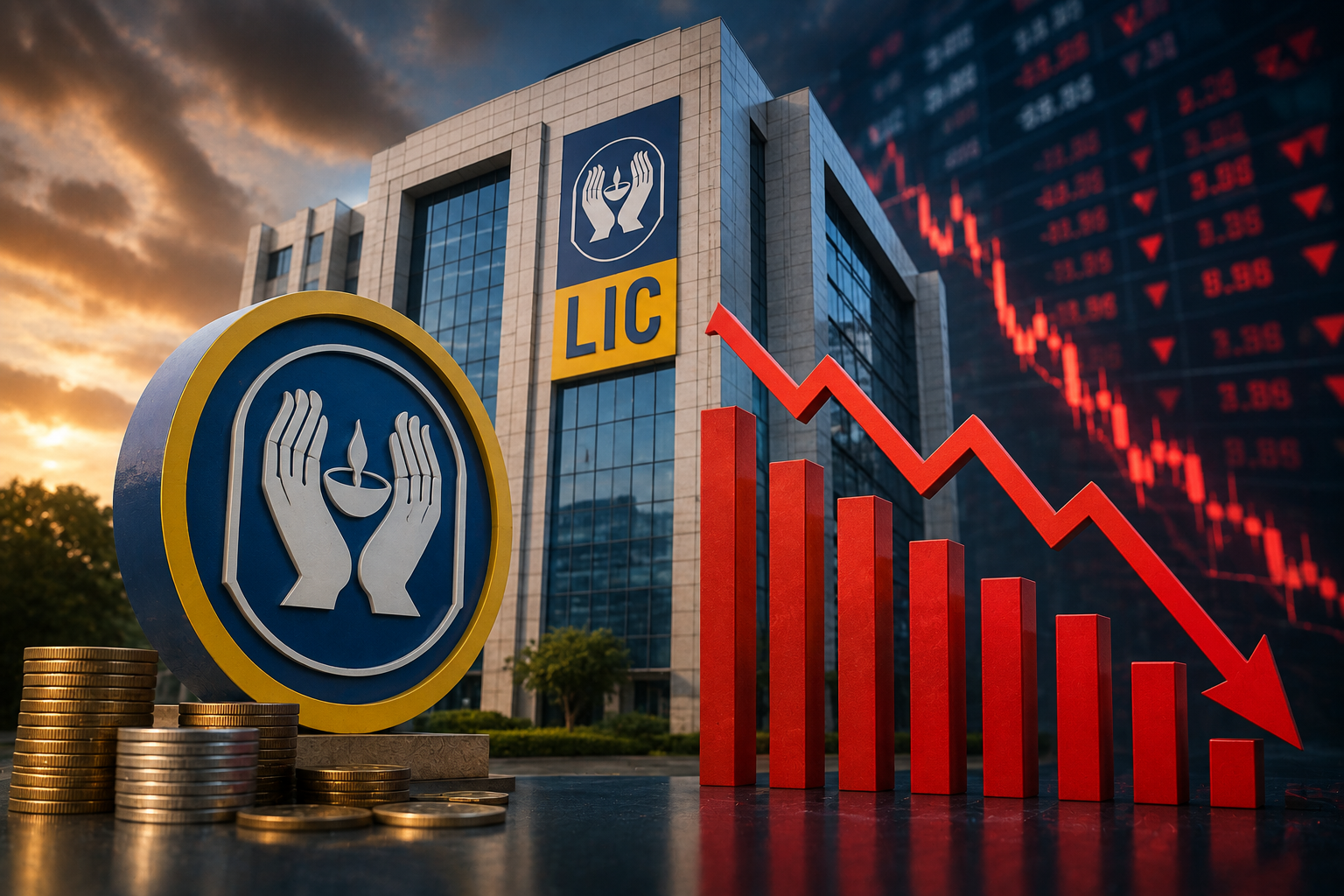
₹382 Floor Price Triggers Sharp Selling Pressure; Disinvestment Aims to Raise Public Shareholding While India's Insurance Growth Story Remains Intact
Shares of Life Insurance Corporation of India (LIC) fell sharply in Tuesday's trading session after the Government of India launched a two-day Offer for Sale (OFS) to divest up to 6.5% of its stake in the country's largest life insurer. The announcement triggered heavy selling as investors reacted to the discounted floor price and the possibility of a significant increase in the stock's free float.
The government has fixed the floor price at ₹382 per share, nearly 10% below the previous closing price, making the OFS attractive for institutional and retail investors but putting immediate pressure on LIC's market price.
The divestment marks one of the largest secondary share sales undertaken by the government since LIC's historic IPO in 2022 and represents another major step in India's ongoing public sector disinvestment programme.
LIC Shares Witness Heavy Selling
LIC shares opened significantly lower and extended losses during the morning session.
The stock declined as much as 8% to an intraday low of ₹390.70 before recovering marginally. Around late morning, the shares were trading near ₹395.85, down more than 7.5% from the previous close.
Trading activity increased sharply, with combined volumes on the NSE and BSE crossing 10 million shares, nearly four times the average daily volume.
The sharp increase in trading volumes indicates active participation by institutional investors as well as traders responding to the government's stake sale announcement.
Government to Sell Up to 6.5% Stake
Under the Offer for Sale, the government has structured the transaction into two parts.
Structure of the OFS
| Particulars | Details |
|---|---|
| Base Offer | 2.5% Equity Stake |
| Greenshoe Option | Additional 4% |
| Maximum Stake Sale | 6.5% |
| Floor Price | ₹382 per share |
| Duration | Two Trading Days |
The government currently owns approximately 96.5% of LIC.
If the entire 6.5% stake is sold, the Centre's holding will reduce to around 90%, enabling the insurer to comply with SEBI's Minimum Public Shareholding (MPS) requirements well before the regulatory deadline.
Why Is the Government Selling LIC Shares?
The stake sale forms part of the government's broader disinvestment strategy and regulatory compliance roadmap.
The objectives include:
-
Increasing public shareholding.
-
Improving liquidity in LIC shares.
-
Enhancing institutional participation.
-
Meeting SEBI's minimum public shareholding norms.
-
Mobilising funds for the government's disinvestment programme.
Under current regulations, listed companies are generally required to maintain at least 25% public shareholding.
Considering LIC's enormous size and market capitalisation, SEBI had earlier granted the insurer a phased timeline requiring the government to reduce its ownership to 90% by May 2027.
The current OFS is expected to substantially complete that requirement ahead of schedule.
Discounted Floor Price Creates Short-Term Pressure
The floor price of ₹382 represents a discount of roughly 10% to LIC's prevailing market price before the announcement.
Such discounts are common in large government stake sales because they encourage strong institutional participation and improve the likelihood of successful subscription.
However, discounted offerings also tend to create short-term selling pressure as existing shareholders adjust their positions ahead of the additional supply entering the market.
Analysts believe Tuesday's decline primarily reflects this technical adjustment rather than any deterioration in LIC's underlying business fundamentals.
LIC Continues to Dominate India's Life Insurance Market
Despite the temporary weakness in its share price, LIC remains India's largest life insurer with an unparalleled distribution network and one of the strongest brands in the country's financial services industry.
The company continues to hold a dominant position across:
-
Individual life insurance.
-
Group insurance.
-
Pension products.
-
Rural insurance.
-
Government-backed insurance schemes.
LIC also remains one of India's largest institutional investors, with significant holdings across equity markets, government securities and infrastructure projects.
Its investment portfolio plays a crucial role in supporting India's capital markets and long-term infrastructure financing.
Insurance Industry Entering High-Growth Phase
The long-term outlook for India's insurance sector remains highly encouraging.
According to a recent Swiss Re study, India is expected to become the fastest-growing major insurance market globally during 2026–2030.
The report forecasts annual premium growth of approximately 6.9%, driven by:
-
Rising disposable incomes.
-
Increasing insurance awareness.
-
Digital distribution.
-
Financial inclusion.
-
Regulatory reforms.
-
Expanding middle class.
-
Growing retirement planning.
These structural drivers are expected to support sustained growth across both public and private insurers.
Life Insurance Demand Expected to Accelerate
India already ranks among the world's largest emerging life insurance markets, yet insurance penetration remains below many developed economies.
Several demographic and economic trends are expected to support long-term growth.
These include:
Rising Life Expectancy
Longer life spans are increasing demand for retirement and pension products.
Expanding Middle Class
Higher incomes are driving greater demand for financial protection and wealth planning solutions.
Credit Growth
Increasing housing and personal loans are boosting demand for protection-linked insurance products.
Regulatory Support
IRDAI reforms aimed at improving transparency and market efficiency are expected to accelerate industry growth.
What Investors Should Watch
Following the OFS announcement, investors will closely monitor several developments.
OFS Subscription Response
Strong participation from institutional and retail investors would indicate continued confidence in LIC despite short-term price weakness.
Greenshoe Option
If investor demand remains strong, the government may fully exercise the additional 4% greenshoe option, increasing the total stake sale to 6.5%.
Post-OFS Price Behaviour
Historically, many stocks stabilize after large OFS transactions are completed as uncertainty surrounding additional supply gradually fades.
Quarterly Performance
Investors will continue monitoring LIC's premium growth, embedded value, profitability, solvency position and investment income over the coming quarters.
Key Risks
While LIC's long-term outlook remains positive, investors should keep an eye on several potential challenges.
These include:
-
Increased competition from private insurers.
-
Equity market volatility affecting investment income.
-
Regulatory changes.
-
Interest rate movements.
-
Slower-than-expected premium growth.
-
Margin pressure in certain product categories.
Nevertheless, LIC's scale, brand strength and extensive distribution network continue to provide significant competitive advantages.
Market Outlook
The sharp decline in LIC shares reflects the market's immediate reaction to the government's discounted stake sale rather than any deterioration in the company's business fundamentals. Large OFS transactions typically create temporary supply overhangs, leading to near-term price pressure until the additional shares are absorbed by the market.
From a broader perspective, the Indian insurance sector remains one of the country's strongest long-term structural growth stories, supported by favourable demographics, rising financial awareness, regulatory reforms and increasing insurance penetration.
Market Outlook
The government's OFS is an important milestone in LIC's post-listing journey and should enhance liquidity while helping the insurer meet regulatory public shareholding requirements. Although the stock may remain volatile during and immediately after the offer period, long-term fundamentals remain supported by India's expanding insurance market and LIC's leadership position.
For investors, the completion of the OFS could remove a key overhang and shift focus back to business performance. Monitoring subscription levels, institutional participation and management's future growth strategy will be crucial in assessing LIC's medium- to long-term investment potential.