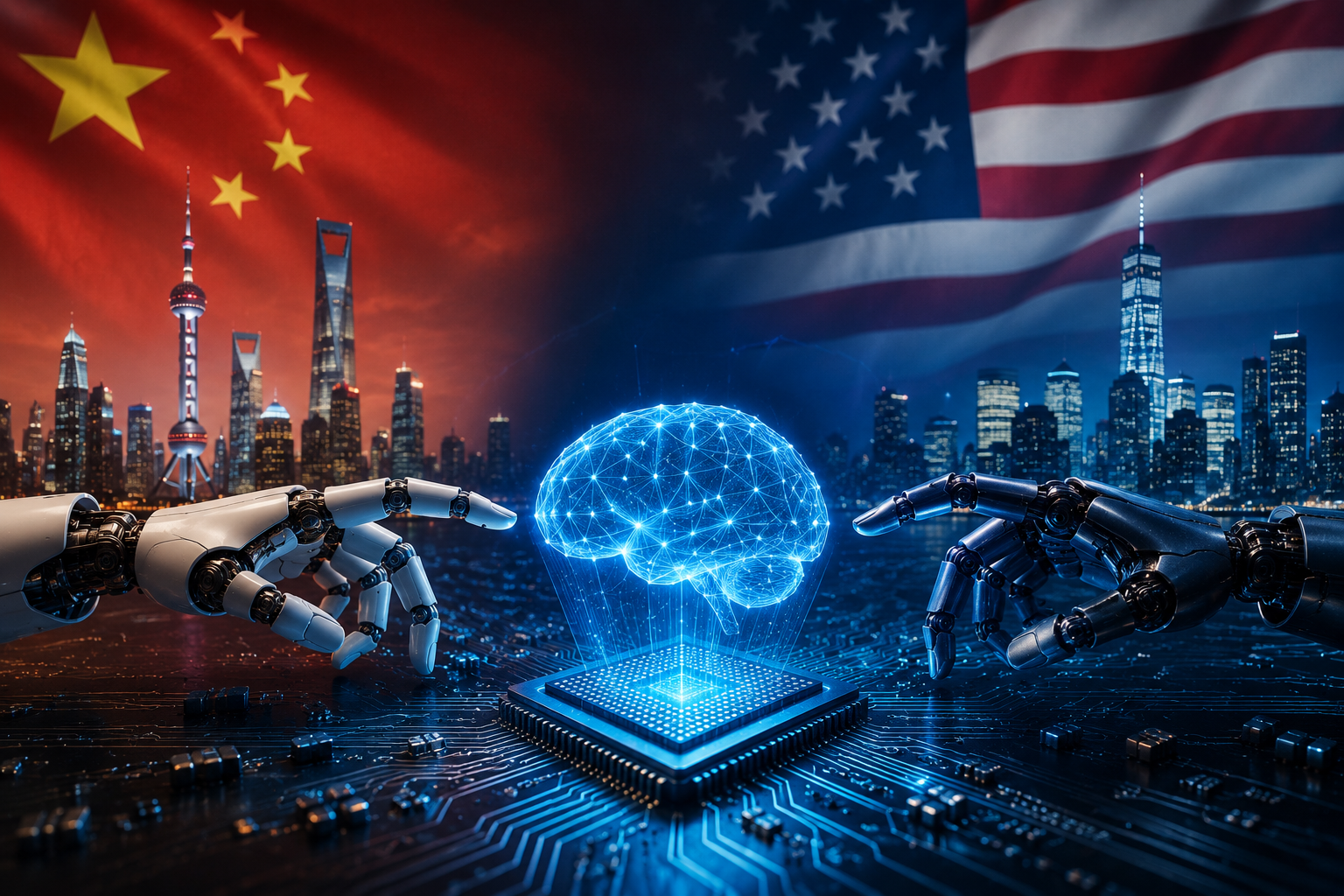
Alibaba, Moonshot AI, DeepSeek, ByteDance and Z.ai Are Narrowing the AI Gap, Triggering a Global Price War and Forcing Silicon Valley to Rethink Its Strategy
The global artificial intelligence (AI) industry is witnessing a dramatic shift as Chinese technology companies rapidly close the technology gap with their American counterparts. What began with the emergence of DeepSeek earlier this year has now evolved into a broader industry-wide transformation, with companies such as Alibaba, Moonshot AI, ByteDance, and Z.ai launching advanced AI models that rival some of the world's best-performing systems.
These developments are reshaping the economics of artificial intelligence by combining frontier-level performance with significantly lower operating costs. As a result, industry analysts believe the AI market has entered a new competitive phase where innovation alone is no longer enough—companies must also deliver exceptional efficiency and aggressive pricing.
The rapid progress of Chinese AI developers is intensifying the technology rivalry between China and the United States while creating fresh opportunities and challenges for businesses, investors and governments worldwide.
China's AI Ecosystem Has Reached a New Level
Just a year ago, China's AI progress was viewed largely through the success of a handful of companies. Today, however, multiple Chinese developers are consistently introducing frontier AI models capable of competing with the world's leading platforms.
Within the past two months alone, China has witnessed the launch of several advanced AI systems:
-
Alibaba – Qwen3.8-Max
-
Moonshot AI – Kimi K3
-
DeepSeek – V4 Flash
-
ByteDance – Seedance 2.5
-
Z.ai – GLM-5.2
The frequency of these launches demonstrates that China's AI ecosystem has evolved beyond isolated breakthroughs into a sustainable innovation engine supported by strong research capabilities, aggressive investment and intense domestic competition.
Technology analysts now believe China's AI industry is no longer simply following Silicon Valley—it is increasingly setting new benchmarks in several application areas.
Alibaba's Qwen3.8-Max Raises the Competitive Bar
Alibaba's latest AI model, Qwen3.8-Max, has emerged as one of the most significant releases of the year.
Independent benchmark evaluations suggest that the model performs at levels comparable to some of the most advanced large language models developed in the United States. In several reasoning, coding and enterprise tasks, it has reportedly matched or exceeded leading global competitors.
The launch strengthens Alibaba Cloud's ambition to become a major global AI infrastructure provider while expanding its enterprise AI ecosystem across Asia, the Middle East and other international markets.
For Alibaba, artificial intelligence has become a central pillar of its long-term cloud computing strategy.
Moonshot AI and DeepSeek Challenge Conventional Thinking
Perhaps the biggest surprise for the AI industry has been the rise of Moonshot AI and DeepSeek.
Moonshot AI's Kimi K3 demonstrated that world-class AI capabilities can be achieved with comparatively modest computing resources, raising fresh questions about whether massive investments in computing power remain the only path to AI leadership.
Meanwhile, DeepSeek V4 Flash continues to disrupt global pricing models.
Its ability to deliver advanced reasoning and coding capabilities at exceptionally low operating costs has forced competitors to reconsider their pricing strategies.
Many analysts believe DeepSeek has fundamentally changed expectations regarding the cost of deploying enterprise AI applications.
The Emergence of the 'DeepSeek Death Zone'
One of the most discussed concepts within the AI industry today is the so-called "DeepSeek Death Zone."
The term refers to the increasingly difficult competitive environment faced by AI developers.
Companies now face two choices:
-
Deliver significantly better AI performance than DeepSeek.
-
Match or beat DeepSeek's extremely low pricing.
Businesses unable to achieve either objective risk losing customers and developer adoption.
This shift has dramatically altered the economics of artificial intelligence.
Instead of competing solely on model intelligence, AI companies are now competing simultaneously on:
-
Performance
-
Cost efficiency
-
Scalability
-
Response speed
-
Enterprise deployment capabilities
This represents one of the biggest structural changes the AI software industry has experienced since the launch of ChatGPT.
ByteDance Leads the AI Video Revolution
While language models have attracted most public attention, China's dominance is becoming even more visible in AI-powered video generation.
ByteDance's Seedance 2.5 has rapidly established itself as one of the highest-performing AI video generation platforms globally.
The platform delivers high-quality video creation with improved realism, consistency and motion generation, making it attractive for content creators, advertisers and businesses.
The opportunity has expanded further after OpenAI delayed the broader rollout of its highly anticipated Sora video platform.
China's growing leadership in generative video highlights the country's ability to innovate beyond traditional language models.
Open-Source Strategy Accelerates Adoption
A major reason behind China's rapid AI adoption is its strong commitment to open-source development.
Several Chinese AI companies have made their models openly available, allowing developers worldwide to:
-
Build customised applications.
-
Reduce AI deployment costs.
-
Improve transparency.
-
Accelerate innovation.
-
Integrate AI into enterprise software.
This open-source strategy has enabled Chinese AI models to gain popularity across startups, research institutions and software developers far more quickly than many proprietary systems.
It also creates a larger ecosystem that continuously improves models through community contributions.
US AI Giants Face Increasing Pricing Pressure
The rapid advancement of Chinese AI models is placing growing pressure on leading US technology companies, including OpenAI and Anthropic.
These firms have invested billions of dollars in developing cutting-edge AI systems and continue to lead in frontier research. However, China's ability to deliver competitive performance at significantly lower costs is beginning to reshape customer expectations.
Enterprises are increasingly evaluating AI platforms based not only on intelligence but also on:
-
Cost per inference.
-
Scalability.
-
Ease of deployment.
-
Integration capabilities.
-
Total cost of ownership.
As a result, pricing power for premium AI providers could gradually come under pressure.
This challenge becomes even more significant as several American AI companies prepare for future public listings that depend heavily on sustained revenue growth and high operating margins.
AI Becomes the New Geopolitical Battleground
Artificial intelligence has evolved far beyond a commercial technology.
Today, it has become a strategic asset influencing:
-
Economic competitiveness.
-
National security.
-
Defence capabilities.
-
Industrial productivity.
-
Global diplomatic influence.
Both the United States and China have declared AI leadership a national priority, with governments actively supporting research, semiconductor development and AI infrastructure.
The growing technological competition is expected to influence future policy decisions involving:
-
Semiconductor export controls.
-
Cross-border AI collaboration.
-
Intellectual property protection.
-
Data governance.
-
International AI regulations.
The AI race is increasingly becoming one of the defining geopolitical themes of the decade.
Businesses Stand to Benefit from Greater Competition
For enterprises adopting artificial intelligence, increasing competition among AI providers is creating several advantages.
Companies can now expect:
-
Lower implementation costs.
-
More advanced AI capabilities.
-
Faster innovation cycles.
-
Greater model choice.
-
Improved enterprise support.
-
Reduced vendor dependence.
Lower AI costs could accelerate adoption across industries including banking, healthcare, manufacturing, logistics, education and financial services.
Small and medium-sized businesses may also gain access to enterprise-grade AI capabilities that were previously too expensive to deploy.
What Investors Should Watch
The intensifying AI race is expected to generate significant investment opportunities across multiple sectors.
Key industries likely to benefit include:
-
Semiconductor manufacturing.
-
Data centre infrastructure.
-
Cloud computing.
-
Enterprise software.
-
Cybersecurity.
-
AI hardware.
-
Networking equipment.
-
Digital infrastructure.
At the same time, investors should closely monitor how pricing pressure affects profitability among leading AI software providers, particularly those relying on premium subscription models.
Companies capable of balancing innovation with operational efficiency are likely to emerge as long-term winners.
Market Outlook
China's accelerating progress in artificial intelligence marks one of the most important shifts in the global technology industry since the rise of cloud computing. Rather than merely competing on cost, Chinese AI companies are increasingly demonstrating world-class capabilities while maintaining significant pricing advantages.
For investors, the AI industry is entering a new phase where valuation will depend not only on technological leadership but also on efficiency, scalability, commercial adoption and ecosystem strength. As competition intensifies, businesses and consumers are expected to benefit from lower costs, faster innovation and wider AI accessibility.
Over the next several years, the AI investment landscape is likely to be shaped not by a single dominant player but by a highly competitive ecosystem where both US and Chinese companies continue pushing the boundaries of artificial intelligence.