Company Chooses ₹1,000 Crore Pre-IPO Funding Over Public Issue as Blinkit Retains Leadership and Competition Intensifies Across the Sector
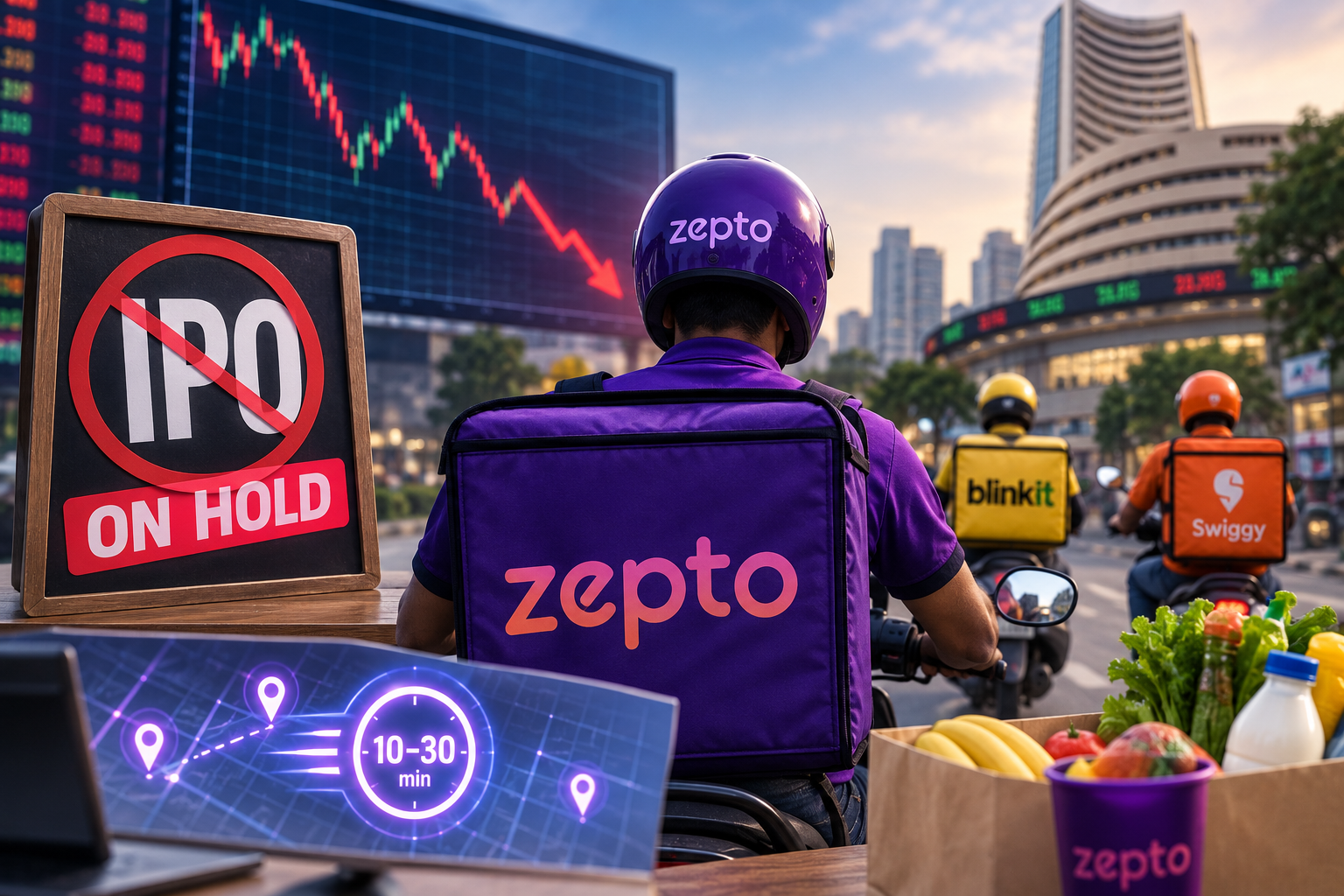
India's fast-growing quick commerce industry will have to wait longer for its first standalone listed player after Zepto decided to postpone its much-anticipated Initial Public Offering (IPO). Instead of entering the public markets, the company plans to raise ₹1,000 crore through a pre-IPO funding round at an estimated valuation of $4.5 billion, significantly lower than the $7 billion valuation it achieved in late 2025.
The decision postpones what was expected to be a landmark event for India's quick commerce ecosystem. A public listing by Zepto was widely anticipated to provide investors with the first direct valuation benchmark for the sector and potentially influence the market valuation of listed rivals Eternal's Blinkit and Swiggy's Instamart.
While the IPO delay may disappoint investors awaiting greater transparency into Zepto's business, analysts believe the company's long-term expansion strategy remains firmly on track.
Why Zepto Chose to Delay Its IPO
Rather than entering the stock market immediately, Zepto has opted to strengthen its balance sheet through private funding.
The planned ₹1,000 crore pre-IPO fundraise is expected to provide additional capital for expanding its delivery network, investing in technology and improving operational efficiency before approaching public market investors.
The revised valuation of approximately $4.5 billion reflects a more cautious funding environment compared to the higher private market valuations witnessed during the technology boom.
Market participants believe postponing the IPO also gives the company additional time to improve profitability—one of the biggest concerns for investors evaluating quick commerce businesses.
A Missed Valuation Benchmark for the Industry
Zepto's listing was expected to become a major milestone for India's quick commerce sector.
Unlike Blinkit and Instamart, which operate under larger listed companies, Zepto would have become the country's first pure-play quick commerce company listed on Indian stock exchanges.
Its IPO could have helped investors answer several important questions:
-
How should quick commerce businesses be valued?
-
What premium should investors assign to rapid delivery platforms?
-
How quickly can high-growth companies become profitable?
-
Is the current pace of expansion financially sustainable?
Without a listed Zepto, investors will continue relying on financial disclosures from parent companies and private funding rounds to assess the sector.
India's Quick Commerce Market Continues to Expand
Despite the IPO delay, the growth story for India's quick commerce industry remains intact.
The sector has expanded at an extraordinary pace over the past three years.
Estimated Gross Merchandise Value (GMV)
| Financial Year | GMV |
|---|---|
| FY23 | $1.6 billion |
| FY26 | $11.3 billion |
| FY31 (Projected) | $60 billion |
The rapid increase reflects growing consumer preference for deliveries within 10–30 minutes, expansion into new product categories and increasing adoption across urban India.
Industry experts expect the sector to remain one of the fastest-growing segments of India's digital economy.
Blinkit Continues to Lead the Market
Industry data indicates that Blinkit remains India's largest quick commerce platform.
Estimated Market Share
| Company | Market Share |
|---|---|
| Blinkit | 52% |
| Zepto | 27% |
| Instamart | 21% |
Blinkit has maintained its leadership through an aggressive expansion strategy and a significantly larger dark store network.
The company also remains the largest player by revenue.
Blinkit's Operational Advantage
One of Blinkit's biggest competitive strengths lies in the scale of its infrastructure.
As of FY26:
-
Revenue stood at approximately ₹37,779 crore.
-
The company operated 2,243 dark stores, nearly double that of its nearest competitors.
Its larger fulfilment network enables wider geographical coverage, faster deliveries and higher operational efficiency.
These advantages have helped Blinkit improve profitability faster than the rest of the industry.
Profitability Remains the Biggest Differentiator
Although all major players continue investing heavily in expansion, profitability remains a key point of differentiation.
Adjusted EBITDA Performance (FY26)
| Company | Adjusted EBITDA Loss |
|---|---|
| Blinkit | ₹277 crore |
| Zepto | ₹5,042 crore |
| Instamart | ₹3,507 crore |
Estimated Loss Per Order
-
Blinkit: ₹3
-
Zepto: ₹79
-
Instamart: ₹85
The numbers highlight Blinkit's progress toward operational break-even, while Zepto and Instamart continue prioritising growth over near-term profitability.
Zepto's Scale Continues to Improve
Despite posting significant losses, Zepto has emerged as one of the fastest-growing players in the industry.
According to market observers, the company currently records the highest number of daily orders per dark store, demonstrating strong customer demand and efficient utilisation of its existing network.
However, rapid expansion has also resulted in higher operating costs.
Zepto reported a net loss of approximately ₹5,905 crore in FY26, underlining the substantial investments required to build a nationwide quick commerce platform.
Swiggy Faces Increasing Competitive Pressure
Analysts believe Swiggy's Instamart could face the greatest competitive challenge if Zepto accelerates its expansion.
Current estimates suggest:
-
Blinkit: Around 1,417 daily orders per dark store
-
Instamart: Around 1,044 daily orders per dark store
The productivity gap reflects Blinkit's stronger infrastructure and broader market presence.
A better-capitalised Zepto could intensify competition further by expanding aggressively in key metropolitan markets.
Zepto's Expansion Plans Remain Unchanged
Although the IPO has been postponed, Zepto's growth ambitions remain intact.
The company reportedly plans to add nearly 1,900 additional dark stores, significantly expanding its delivery network across major Indian cities.
The fresh capital raised through private funding is expected to support:
-
Expansion of fulfilment centres.
-
Technology upgrades.
-
Supply chain optimisation.
-
Customer acquisition.
-
Existing lease commitments.
This strategy is expected to strengthen Zepto's competitive position ahead of any future IPO.
New Entrants Raise Competitive Stakes
Competition in India's quick commerce market is expected to intensify further with new entrants increasing investments.
Companies including:
-
Flipkart Minutes
-
Amazon Now
are expanding their presence in rapid delivery services.
As more players compete on delivery speed, pricing, assortment and customer experience, sustained investment across the industry is expected to continue.
While this benefits consumers, it also increases pressure on companies to improve efficiency and reduce losses.
Investors Waiting for Sustainable Profitability
While growth remains impressive, analysts continue to emphasise that long-term success in public markets will depend on sustainable earnings rather than revenue growth alone.
Institutional investors are increasingly focusing on:
-
Cash flow generation.
-
EBITDA improvement.
-
Margin expansion.
-
Capital efficiency.
-
Return on invested capital.
Companies capable of combining rapid growth with improving profitability are likely to command premium valuations once the sector matures.
Market Outlook
Zepto's decision to postpone its IPO delays what could have been a defining moment for India's quick commerce industry, but it does not diminish the sector's long-term growth potential. Consumer demand for ultra-fast delivery continues to expand, supported by rising digital adoption, improving logistics infrastructure and increasing urban consumption.
Over the coming years, competition is expected to become even more intense as existing players expand their dark store networks and new entrants strengthen their presence. While Blinkit currently enjoys a leadership position backed by improving profitability, Zepto's aggressive expansion strategy and Swiggy's continued investments in Instamart suggest the battle for market share is far from over. Ultimately, the companies that successfully balance rapid growth with sustainable profitability are likely to emerge as long-term winners in India's evolving quick commerce landscape.