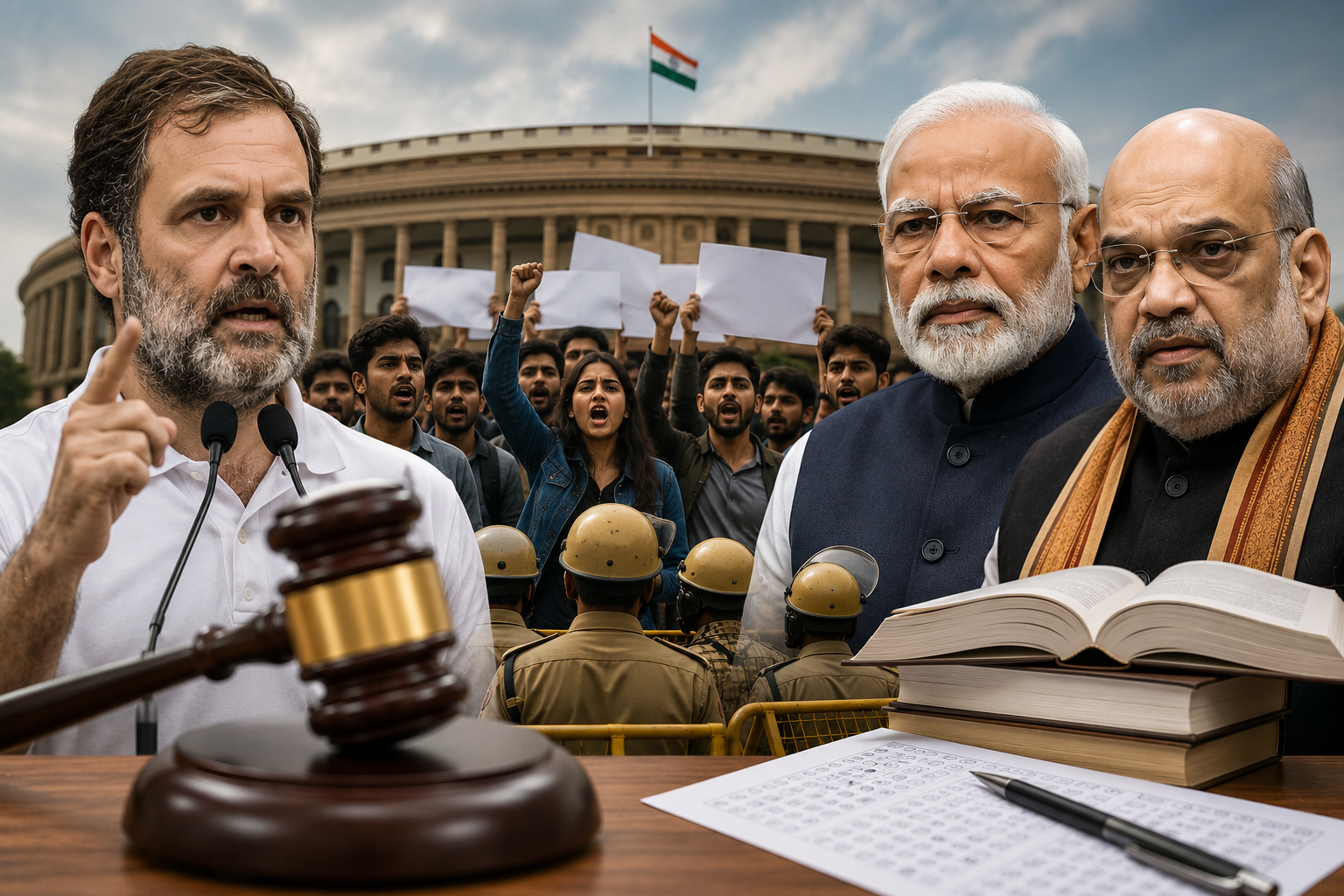
Congress Leader Alleges FIRs and Social Media Action Against Student Protesters as Centre Defends Tougher Anti-Paper Leak Reforms
A fresh political confrontation erupted on Friday after Congress leader and Leader of Opposition in the Lok Sabha Rahul Gandhi accused Prime Minister Narendra Modi and Union Home Minister Amit Shah of attempting to suppress the voices of India's younger generation. The remarks came amid an ongoing debate over examination reforms and the recently passed amendments to the country's anti-paper leak law.
In a strongly worded post on social media platform X, Rahul Gandhi alleged that the government was intimidating student protesters through police action and restrictions on their social media accounts. The Congress leader claimed that India's youth could not be silenced through legal action and warned the government against undermining the aspirations of the country's younger generation.
The comments come a day after Parliament approved stricter provisions to combat paper leaks in public examinations, with the Centre reiterating its commitment to protecting students from organised examination fraud.
Rahul Gandhi's Sharp Attack on the Centre
Rahul Gandhi accused the Prime Minister and the Home Minister of using state machinery against students raising their voices over issues related to competitive examinations.
In his social media post, Gandhi alleged that authorities were registering First Information Reports (FIRs) against protesting students while simultaneously taking down their social media accounts.
Addressing the country's leadership directly, he stated that India's younger generation could not be threatened into silence and described Gen Z as the nation's future.
The Congress leader further remarked that the current political leadership represented "India's past" and should exercise caution in its treatment of the country's youth.
The government has not issued any official response specifically addressing these allegations.
Remarks Follow Parliament's Approval of Anti-Paper Leak Bill
The political exchange follows Parliament's passage of The Public Examination (Prevention of Unfair Means) Amendment Bill, 2026, which strengthens the legal framework against examination-related fraud.
The amended legislation introduces tougher penalties for individuals and organised groups involved in paper leaks, unfair examination practices and related offences.
The Bill was approved by the Lok Sabha on Wednesday and passed by the Rajya Sabha on Thursday through a voice vote.
Several opposition parties belonging to the INDIA bloc staged a walkout during the Upper House proceedings before the legislation was passed.
PM Modi Calls for Comprehensive Education Reforms
Earlier on Thursday, Prime Minister Narendra Modi described paper leaks as one of the most serious challenges facing India's education system and stressed the need for comprehensive reforms across both the Centre and the states.
In a video message released after Parliament passed the amendment Bill, the Prime Minister said repeated examination leaks had endangered the future of millions of students preparing for competitive examinations.
He emphasised that the problem had persisted for several years and required stronger legal provisions along with administrative reforms to restore public confidence in the examination process.
Government Promises Zero Tolerance Against Paper Leak Mafia
Reaffirming the government's position, Prime Minister Modi stated that there would be no leniency towards individuals or organised syndicates involved in leaking examination papers.
According to the Prime Minister, the Centre has adopted a multi-pronged strategy to tackle examination fraud, including:
-
Formation of a dedicated task force.
-
Establishment of fast-track courts for speedy disposal of cases.
-
Consultation with state governments to strengthen examination systems.
-
Enhanced coordination between investigative agencies.
-
Measures to improve security and transparency in public examinations.
The government believes these initiatives will help safeguard merit-based recruitment and ensure fair opportunities for students.
Growing Political Debate Over Student Protests
The issue has added another dimension to the political discourse surrounding education reforms and youth concerns.
While the ruling government argues that stronger laws are essential to dismantle organised paper leak networks, opposition leaders have questioned the handling of student protests and alleged excessive use of administrative and legal measures.
The debate has gained wider attention as competitive examinations continue to play a crucial role in government recruitment, higher education admissions and public sector employment across the country.
Examination Integrity Remains a National Priority
Paper leaks have affected several recruitment and entrance examinations in recent years, leading to cancellations, delays and widespread protests by candidates demanding accountability.
Successive governments have faced criticism over recurring examination irregularities, prompting calls for stronger legal safeguards and technological improvements to secure the examination process.
The amended anti-paper leak legislation is intended to create a stronger deterrent against organised fraud while enhancing the credibility of public examinations.
Student Community Closely Watching Developments
With millions of students preparing for competitive examinations each year, the implementation of the amended law is expected to remain under close public scrutiny.
Candidates, educational institutions and recruitment agencies will be watching how effectively the new legal framework is enforced and whether it succeeds in reducing examination-related irregularities.
At the same time, the debate over students' democratic rights, freedom of expression and the handling of protests is likely to remain an important political issue in the coming months.
Market and Policy Outlook
Although the controversy is primarily political, reforms aimed at strengthening the integrity of India's examination system carry broader economic and institutional significance. A transparent recruitment framework is considered essential for improving governance, strengthening public institutions and enhancing investor confidence in administrative systems.
Going forward, attention will remain focused on the implementation of the amended anti-paper leak law, the government's engagement with students, and the evolving political narrative around education reforms, youth participation and institutional accountability.