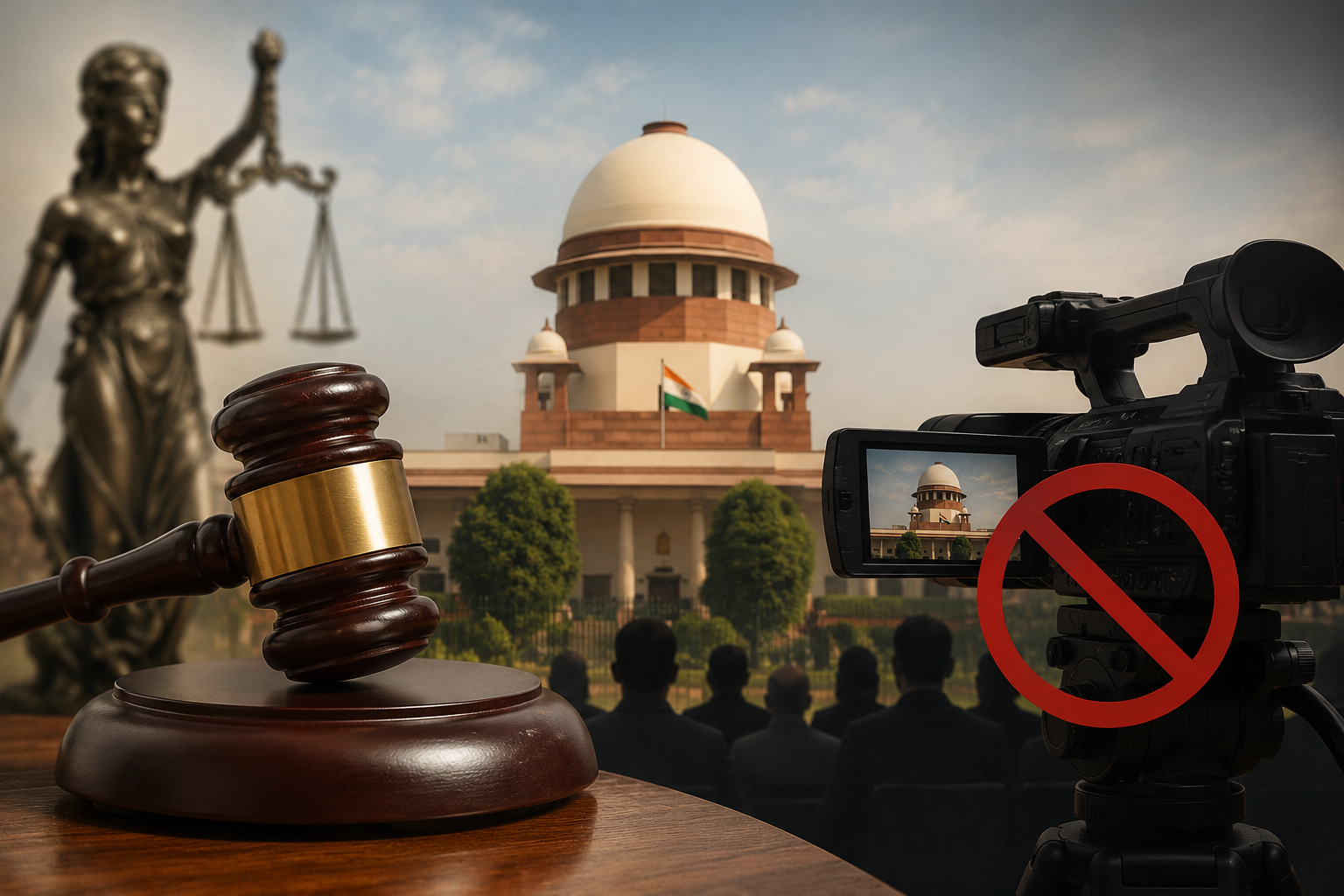
Petition Says Blanket Restrictions on Official Court Recordings Threaten Transparency, Free Speech and Public Access to Judicial Proceedings
A fresh legal challenge has emerged over the Supreme Court's recent restrictions on sharing recordings of court proceedings, with two prominent Right to Information (RTI) activists urging the apex court to reconsider its interim order that bars the dissemination of courtroom audio and video clips without prior permission.
The intervention application argues that while preventing the misuse of edited or misleading courtroom videos is a legitimate objective, imposing a blanket ban on sharing official recordings is disproportionate and risks undermining constitutional principles of transparency, accountability and open justice.
The petition has been filed by National Campaign for People's Right to Information (NCPRI) co-convenor Anjali Bhardwaj and transparency activist Amrita Johri in the ongoing matter relating to the regulation of live-streaming and dissemination of judicial proceedings.
The activists have called for a more balanced framework that targets manipulated content rather than restricting the lawful sharing of authentic court proceedings.
Petition Questions Blanket Restrictions
The applicants have challenged the Supreme Court's July 24 interim order, which prohibits individuals and organisations from extracting, uploading, reposting, transmitting or hosting audio and video recordings of judicial proceedings on digital platforms without obtaining prior approval from either the Supreme Court or the concerned High Court.
According to the petition, the order extends beyond addressing the specific problem of manipulated videos and instead imposes a broad restriction on the dissemination of official judicial records.
The activists argue that such sweeping limitations may have unintended consequences for journalists, legal researchers, civil society organisations and citizens who rely on official court proceedings to understand important legal developments.
Open Courts Strengthen Democracy
The intervention application places significant emphasis on the constitutional doctrine of open courts, describing it as an essential safeguard for judicial accountability.
According to the petition, public access to court proceedings ensures that the judicial process remains transparent and answerable to citizens, thereby strengthening confidence in the justice delivery system.
The applicants contend that openness in judicial proceedings is closely linked to Article 21 of the Constitution, which guarantees a fair, just and reasonable legal process.
By enabling citizens to observe how justice is delivered, open courts help prevent arbitrariness while reinforcing democratic values and institutional credibility.
Distinguishing Genuine Sharing from Misuse
A key argument advanced in the application is that the judiciary should differentiate between deliberately manipulated courtroom videos and the legitimate sharing of official recordings.
The petition states that maliciously edited clips designed to spread misinformation or distort judicial observations deserve strict legal action.
However, it argues that citizens, media organisations and legal commentators sharing authentic, unaltered recordings should not face the same restrictions.
The activists believe that treating both situations alike creates an unnecessary barrier to public access and informed discussion of judicial proceedings.
Prior Permission Raises Constitutional Concerns
The applicants have also questioned the requirement that individuals obtain prior permission from the Supreme Court Secretary General or the respective High Court Registrars before sharing courtroom recordings.
According to the petition, making the dissemination of official judicial content dependent on administrative approval effectively places a constitutional right under discretionary control without clearly defined legal standards.
The activists argue that such uncertainty could discourage legitimate reporting and public engagement with important judicial matters.
Stronger Digital Infrastructure Suggested
Rather than imposing broad restrictions, the petition proposes strengthening the judiciary's own digital ecosystem to address concerns surrounding manipulated content.
Among the recommendations are:
-
Expanding official live-streaming of court proceedings.
-
Establishing a permanent digital audio-visual archive.
-
Making original recordings easily accessible for verification.
-
Taking action against morphed or selectively edited videos using existing legal provisions.
According to the applicants, maintaining an official archive would allow any disputed video circulating online to be verified against the original recording, reducing the risk of misinformation while preserving public access.
Background of the Supreme Court's Interim Order
On July 24, the Supreme Court passed an interim order prohibiting the extraction, uploading, posting, reposting or hosting of audio and video recordings of judicial proceedings on social media or other digital platforms without prior authorisation.
The order came after the Court expressed concern that edited courtroom clips were being circulated online with selective commentary capable of misleading viewers and distorting judicial observations.
The matter remains under consideration as the Court examines a broader regulatory framework governing the live-streaming and dissemination of judicial proceedings.
Live-Streaming Has Expanded Judicial Transparency
India's judiciary has significantly increased public access to court proceedings over the past few years through live-streaming initiatives.
The Supreme Court first live-streamed proceedings on August 26, 2022, during the ceremonial Bench marking the retirement of then Chief Justice N. V. Ramana.
From September 27, 2022, Constitution Bench hearings began to be regularly broadcast through the Court's official webcast platform, allowing citizens across the country to watch important constitutional cases in real time.
The initiative traces its legal foundation to the landmark Swapnil Tripathi judgment, where the Supreme Court recognised that live-streaming promotes transparency, improves access to justice and strengthens public confidence in the judiciary.
Balancing Transparency and Digital Misuse
The latest intervention highlights the growing challenge of balancing judicial openness with the risks posed by digital misinformation.
As court proceedings increasingly become accessible through online platforms, authorities must ensure that technological advancements do not become tools for spreading misleading narratives.
At the same time, transparency advocates argue that restrictions should remain narrowly tailored so that public access to authentic judicial records is not unnecessarily curtailed.
Finding the right balance between protecting the integrity of judicial proceedings and preserving constitutional freedoms is expected to remain central to the Court's deliberations.
Outlook
The Supreme Court's decision on the intervention application is likely to shape the future framework governing the sharing of court proceedings in India. A ruling that clarifies the scope of permissible dissemination could have far-reaching implications for journalists, legal professionals, researchers and citizens seeking access to judicial information. As digital transparency becomes increasingly important, the case may establish new standards for balancing freedom of expression, open justice and safeguards against the misuse of official court recordings.