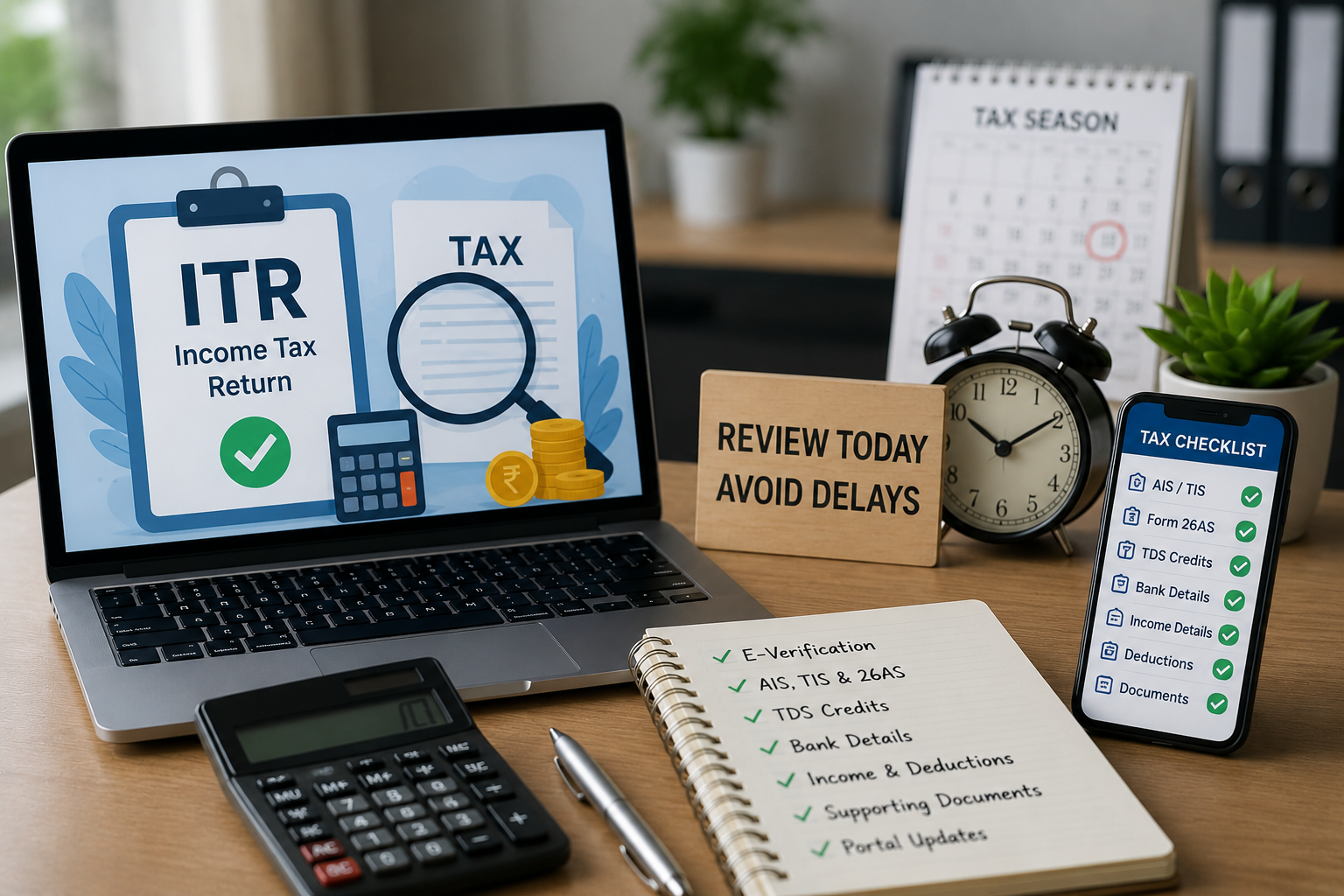
Experts Recommend Rechecking AIS, Form 26AS, TDS Credits and Bank Details as Fresh Data Updates May Impact Tax Refunds and Return Processing
Filing an Income Tax Return (ITR) before the due date is considered one of the best practices for taxpayers, helping avoid last-minute technical glitches, filing errors and penalties. However, tax experts believe that the compliance process does not end once the return is filed. Financial information submitted by employers, banks, mutual funds, stockbrokers and other reporting institutions continues to be updated on the Income Tax Department's portal even after taxpayers have filed their returns.
These updates can create differences between the information reported in the filed return and the latest records available with the tax department. Such mismatches may lead to refund delays, lower tax credits, additional tax demands or notices seeking clarification.
A brief post-filing review can help taxpayers identify discrepancies early and, if necessary, file a revised return before any issue escalates. With the Income Tax Department relying increasingly on automated data matching and artificial intelligence-driven verification systems, ensuring consistency across all tax records has become more important than ever.
Why Early Filing Does Not Always Mean the Process Is Complete
Many taxpayers assume that filing the return ahead of the deadline guarantees smooth processing.
In reality, information on the Income Tax portal continues to evolve as reporting entities upload revised or delayed financial information.
Data that may change after filing includes:
-
Interest income.
-
Dividend income.
-
Tax deducted at source (TDS).
-
Securities transactions.
-
Mutual fund investments.
-
Salary revisions.
-
High-value financial transactions.
If these updates are not reflected in the filed return, they may trigger automated mismatches during assessment.
Income Tax Portal Is Continuously Updated
Financial institutions report information to the Income Tax Department throughout the year.
Major reporting entities include:
-
Employers.
-
Banks.
-
Mutual fund companies.
-
Stockbrokers.
-
Insurance companies.
-
Registrars and Transfer Agents.
-
Government departments.
As revised statements are submitted, taxpayers may notice changes in their Annual Information Statement (AIS), Taxpayer Information Summary (TIS) and Form 26AS.
First Step: Ensure Your Return Has Been Successfully E-Verified
Submitting an Income Tax Return alone is not sufficient.
A return becomes legally valid only after it has been successfully e-verified.
Things to Confirm
-
Return filing status.
-
Successful e-verification.
-
Acknowledgement number.
-
Date of verification.
-
Processing status.
An unverified return is treated as invalid and may not be processed for refunds.
Compare Your Return with AIS, TIS and Form 26AS
One of the most important post-filing checks involves comparing the filed return with the Income Tax Department's official records.
Important Tax Documents
| Document | Purpose |
|---|---|
| Annual Information Statement (AIS) | Comprehensive financial transactions |
| Taxpayer Information Summary (TIS) | Summarised tax-related information |
| Form 26AS | Tax deducted, tax collected and tax payments |
Any mismatch between these records and the filed return should be examined carefully.
Check Whether New TDS Credits Have Been Added
Employers and other deductors sometimes revise TDS statements after taxpayers have already filed their returns.
As a result:
-
Additional TDS credits may appear.
-
Refund amounts may increase.
-
Tax liability may reduce.
-
Previous mismatches may disappear.
Reviewing Form 26AS before return processing ensures that all eligible tax credits have been claimed.
Verify Your Bank Account Details
Incorrect banking information remains one of the most common reasons for delayed income tax refunds.
Taxpayers should verify that:
-
Bank account is active.
-
Account is pre-validated.
-
IFSC code is correct.
-
Refund account has been selected.
-
PAN linkage requirements have been completed.
Even a successfully processed return cannot result in a timely refund if bank details are inaccurate.
Review Income Disclosure Carefully
Many taxpayers discover after filing that certain income sources were unintentionally omitted.
A fresh review should cover:
-
Salary income.
-
Bank interest.
-
Fixed deposit interest.
-
Rental income.
-
Dividend income.
-
Capital gains.
-
Foreign income (if applicable).
-
Other taxable receipts.
Accurate reporting reduces the likelihood of future notices.
Recheck Eligible Deductions
Similarly, taxpayers should ensure they have claimed all eligible deductions and exemptions.
Common deductions include:
-
Section 80C investments.
-
Health insurance premiums.
-
National Pension System (NPS).
-
Home loan interest.
-
Donations.
-
Education loan interest.
Missing legitimate deductions may result in paying more tax than required.
Capital Market Investors Should Pay Extra Attention
Investors in shares and mutual funds should carefully reconcile transaction details.
Important areas include:
-
Equity sales.
-
Mutual fund redemptions.
-
Dividend income.
-
Securities Transaction Tax (STT).
-
Capital gains calculations.
Broker-reported information in AIS should be compared with personal investment records.
Preserve Supporting Documents
Although supporting documents are generally not submitted while filing the return, taxpayers should retain them safely.
Important records include:
-
Form 16.
-
Form 16A.
-
AIS.
-
TIS.
-
Form 26AS.
-
Bank statements.
-
Investment proofs.
-
Capital gains statements.
-
Home loan certificates.
-
Donation receipts.
These documents may be required if the Income Tax Department seeks clarification.
Monitor Income Tax Portal Regularly
Even after filing the return, taxpayers should periodically check:
-
Email notifications.
-
SMS alerts.
-
Income Tax e-Filing portal.
-
Refund status.
-
Processing updates.
-
Department communications.
Prompt responses to notices help avoid unnecessary litigation or penalties.
Found a Mistake? File a Revised Return
Discovering an error after filing does not automatically result in penalties.
Taxpayers may submit a revised return if they identify genuine mistakes.
Common reasons for revision include:
-
Omitted income.
-
Incorrect deductions.
-
Updated TDS credits.
-
Wrong capital gains calculations.
-
Incorrect bank details.
-
Reporting errors.
Submitting a revised return at the earliest improves compliance and reduces future complications.
Benefits of Reviewing Your Return Again
A simple post-filing review offers several advantages.
These include:
-
Faster refund processing.
-
Accurate tax credits.
-
Lower risk of notices.
-
Better tax compliance.
-
Correct tax liability.
-
Improved financial record-keeping.
Spending a few extra minutes reviewing the return can prevent significant inconvenience later.
Technology Is Transforming Tax Administration
The Income Tax Department has significantly strengthened its digital compliance infrastructure.
Today, sophisticated technology enables automated matching of taxpayer disclosures with information received from:
-
Banks.
-
Employers.
-
Mutual funds.
-
Stock exchanges.
-
Registrars.
-
Government databases.
This automation has substantially improved the department's ability to detect inconsistencies quickly and process returns more efficiently.
Common Post-Filing Mistakes to Avoid
Tax experts recommend avoiding several common mistakes after filing an ITR.
These include:
-
Assuming filing alone completes compliance.
-
Ignoring updates in AIS.
-
Forgetting interest income.
-
Missing dividend income.
-
Overlooking revised TDS credits.
-
Failing to verify bank accounts.
-
Ignoring Income Tax Department communications.
A proactive approach can significantly reduce compliance risks.
Market Outlook
The growing integration of financial institutions with the Income Tax Department's digital ecosystem reflects India's continued progress towards a more transparent and technology-driven tax administration system. Automated reconciliation of data from employers, banks, stockbrokers, mutual funds and other reporting entities has significantly improved compliance monitoring while enabling faster identification of discrepancies. As digital tax processing becomes increasingly sophisticated, taxpayers must recognise that filing an Income Tax Return is no longer the final step but part of an ongoing compliance process.
From a broader financial perspective, enhanced digital governance is expected to improve tax collection efficiency, reduce disputes and accelerate refund processing over the long term. Taxpayers who regularly monitor their Income Tax portal, verify updated information, preserve supporting documents and promptly rectify discrepancies are likely to experience smoother assessments and quicker refunds. Proactive tax management is becoming an essential component of sound financial planning in an increasingly digitised tax environment.