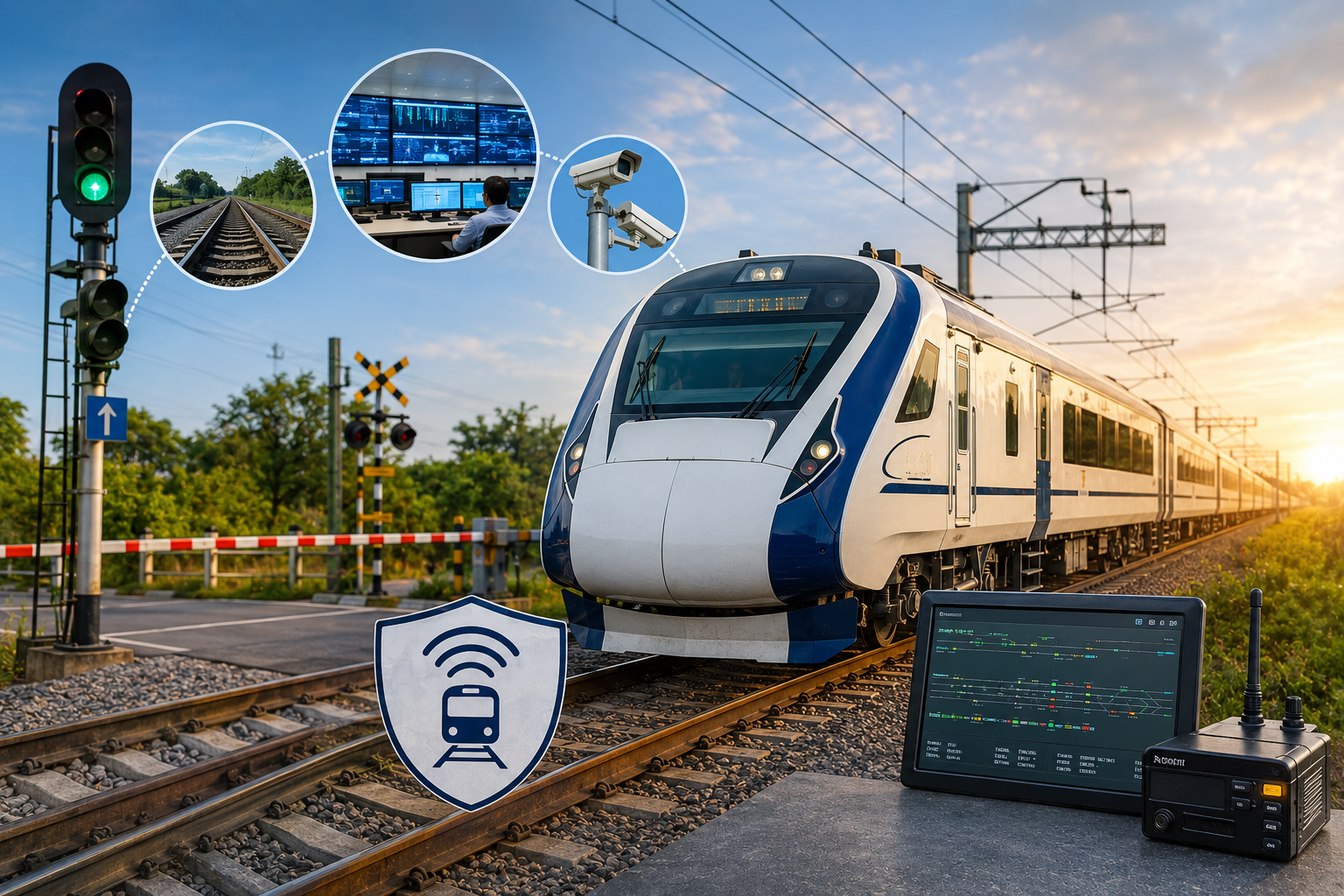
Expansion of Kavach, Modern Signalling Systems, Track Renewal and ₹1.2 Trillion Safety Budget Drive Historic Improvement in India's Railway Safety Standards
Indian Railways has recorded one of the most significant improvements in operational safety in its history, reducing consequential train accidents by 88% over the last 12 years through sustained investments in technology, infrastructure and maintenance. According to data released by the Ministry of Railways, the number of consequential train accidents has declined from 118 in FY2013-14 to 14 in FY2025-26, reflecting the government's continued focus on strengthening the safety and reliability of one of the world's largest railway networks.
The milestone comes alongside the rapid expansion of Kavach, India's indigenous Automatic Train Protection (ATP) system, which has now been commissioned on more than 2,500 route kilometres. Combined with modern signalling, improved track maintenance, elimination of unmanned level crossings and the introduction of safer passenger coaches, these initiatives are transforming the country's railway safety ecosystem.
With passenger and freight traffic continuing to grow, Indian Railways is positioning safety as a key pillar of its long-term infrastructure development strategy.
Train Accidents Decline to Historic Lows
Official data shows a dramatic reduction in serious railway accidents over the past decade.
Consequential Train Accident Trend
| Financial Year | Number of Consequential Train Accidents |
|---|---|
| FY2013-14 | 118 |
| FY2025-26 | 14 |
| FY2026-27 (Till Date) | 2 |
The figures represent an 88% decline, highlighting consistent progress in operational safety despite increasing train movements across the national network.
Consequential train accidents include:
-
Train collisions
-
Derailments
-
Fire-related incidents
-
Level crossing accidents
-
Incidents causing casualties or major damage to railway assets
The improvement demonstrates the effectiveness of multiple safety initiatives implemented over the last decade.
Safety Performance Improves Beyond Accident Numbers
The Railways has also reported significant improvement in its Consequential Accident Index, which measures the number of accidents per million train kilometres.
Operational Safety Index
| Year | Accident Index |
|---|---|
| FY2014-15 | 0.11 |
| FY2025-26 | 0.01 |
This represents nearly a 91% improvement, indicating that trains are operating far more safely even as passenger numbers and freight movement continue to expand.
The improvement reflects higher operational discipline, technological upgrades and better maintenance practices across the railway network.
Railway Safety Spending Reaches Record Levels
A major driver of the safety transformation has been the sharp increase in government investment.
Safety Expenditure Growth
| Financial Year | Safety-Related Expenditure |
|---|---|
| FY2013-14 | Around ₹39,200 crore |
| FY2026-27 | Around ₹1.2 trillion |
The increased capital allocation has enabled Indian Railways to modernise critical infrastructure while accelerating the adoption of advanced safety technologies.
This investment supports the government's long-term objective of building a safer, faster and more efficient railway system.
Kavach Becomes the Backbone of India's Railway Safety Strategy
One of the biggest contributors to improved railway safety has been the rollout of Kavach, India's indigenously developed Automatic Train Protection (ATP) system.
Kavach is designed to:
-
Prevent train collisions.
-
Automatically apply brakes when necessary.
-
Warn locomotive pilots about potential risks.
-
Prevent overspeeding.
-
Improve coordination with signalling systems.
-
Enhance operational reliability.
The technology reduces dependence on manual intervention and significantly lowers the risk of human error.
Kavach Version 4.0 Expands Across High-Density Routes
Indian Railways recently crossed another important milestone in the deployment of Kavach.
Current Deployment
-
2,569 route kilometres commissioned
-
Coverage includes:
-
Delhi–Mumbai Corridor
-
Delhi–Howrah Corridor
-
These routes handle some of the country's busiest passenger and freight operations, making them among the highest priorities for advanced safety systems.
The Railways plans to continue expanding Kavach coverage across the national network over the coming years.
Modern Signalling Systems Strengthen Operational Reliability
Alongside Kavach, Indian Railways has accelerated the modernisation of signalling infrastructure.
Major improvements include:
-
Electronic interlocking.
-
Advanced signalling equipment.
-
Digital communication systems.
-
Automatic monitoring technologies.
-
Centralised traffic management.
These upgrades minimise operational conflicts and improve train movement efficiency while reducing accident risks.
Track Modernisation Enhances Safety
Extensive investment has also been directed towards strengthening railway tracks.
Key initiatives include:
-
Track renewal.
-
Heavier rail installation.
-
Mechanised maintenance.
-
Ultrasonic rail testing.
-
Predictive inspections.
-
Continuous track monitoring.
These measures have substantially reduced derailment risks and improved network reliability.
Safer LHB Coaches Replace Older Rolling Stock
Indian Railways has accelerated the replacement of conventional coaches with Linke Hofmann Busch (LHB) coaches.
Compared with older coach designs, LHB coaches provide:
-
Better crash protection.
-
Reduced telescoping during collisions.
-
Improved passenger safety.
-
Enhanced riding comfort.
-
Better fire resistance.
-
Higher operating speeds.
The transition is considered a major structural improvement in passenger safety.
Level Crossing Safety Improves Significantly
The Railways has also completed major improvements in level crossing safety.
Key achievements include:
-
Elimination of unmanned level crossings on the broad-gauge network.
-
10,395 level crossing gates equipped with interlocking systems.
-
6,671 railway stations provided with complete track circuiting.
Track circuiting enables railway officials to electronically verify whether a section of track is occupied before permitting train movement, reducing the possibility of operational errors.
Technology-Driven Maintenance Reduces Risk
Indian Railways has increasingly embraced technology-based maintenance systems to identify potential issues before they become safety hazards.
Modern inspection methods now include:
-
Artificial intelligence-based monitoring.
-
Drone inspections.
-
Predictive analytics.
-
Sensor-enabled diagnostics.
-
Automated track inspection vehicles.
-
Digital asset management systems.
These technologies improve preventive maintenance while reducing service disruptions.
Supporting India's Expanding Transport Network
India's railway network continues to play a vital role in supporting economic growth, logistics and passenger mobility.
With freight volumes and passenger demand steadily increasing, ongoing investment in railway safety will remain essential to:
-
Improve service reliability.
-
Increase operational efficiency.
-
Reduce accident risks.
-
Support economic development.
-
Strengthen logistics infrastructure.
The government's long-term railway modernisation programme aligns with broader infrastructure development initiatives aimed at improving national connectivity.
Opportunities for the Railway and Infrastructure Industry
The continued emphasis on railway modernisation is expected to create significant opportunities for companies engaged in:
-
Railway signalling systems.
-
Automation technologies.
-
Electrical equipment.
-
Engineering and construction.
-
Rolling stock manufacturing.
-
Digital infrastructure.
-
Railway electronics.
-
Track maintenance equipment.
As capital expenditure on railway infrastructure remains strong, companies participating in these projects may benefit from sustained order inflows over the coming years.
Future Focus Remains on Safety and Modernisation
Indian Railways has indicated that safety will remain a top priority as it continues expanding the network.
Future initiatives are expected to include:
-
Wider deployment of Kavach.
-
Further signalling upgrades.
-
Smart monitoring systems.
-
AI-enabled maintenance.
-
Expansion of dedicated freight corridors.
-
Modernisation of stations and railway assets.
These investments are expected to further improve operational safety while supporting faster, more reliable rail services.
Market Outlook
The sharp reduction in train accidents highlights the success of India's sustained investment in railway safety and infrastructure modernisation. Continued deployment of the Kavach Automatic Train Protection system, modern signalling technologies, track renewal programmes and digital maintenance solutions demonstrates the government's long-term commitment to building a safer and more efficient railway network. These initiatives are expected to improve operational reliability, reduce service disruptions and support growing passenger and freight demand as India's economy expands.
From a market perspective, the railway modernisation programme offers significant long-term opportunities for companies involved in railway engineering, signalling systems, electrical equipment, rolling stock, automation, infrastructure construction and technology solutions. Investors should closely monitor future railway capital expenditure, Kavach expansion, infrastructure tenders and public-sector procurement, as continued government investment in rail infrastructure is likely to remain a key growth driver for India's engineering, capital goods and infrastructure sectors.