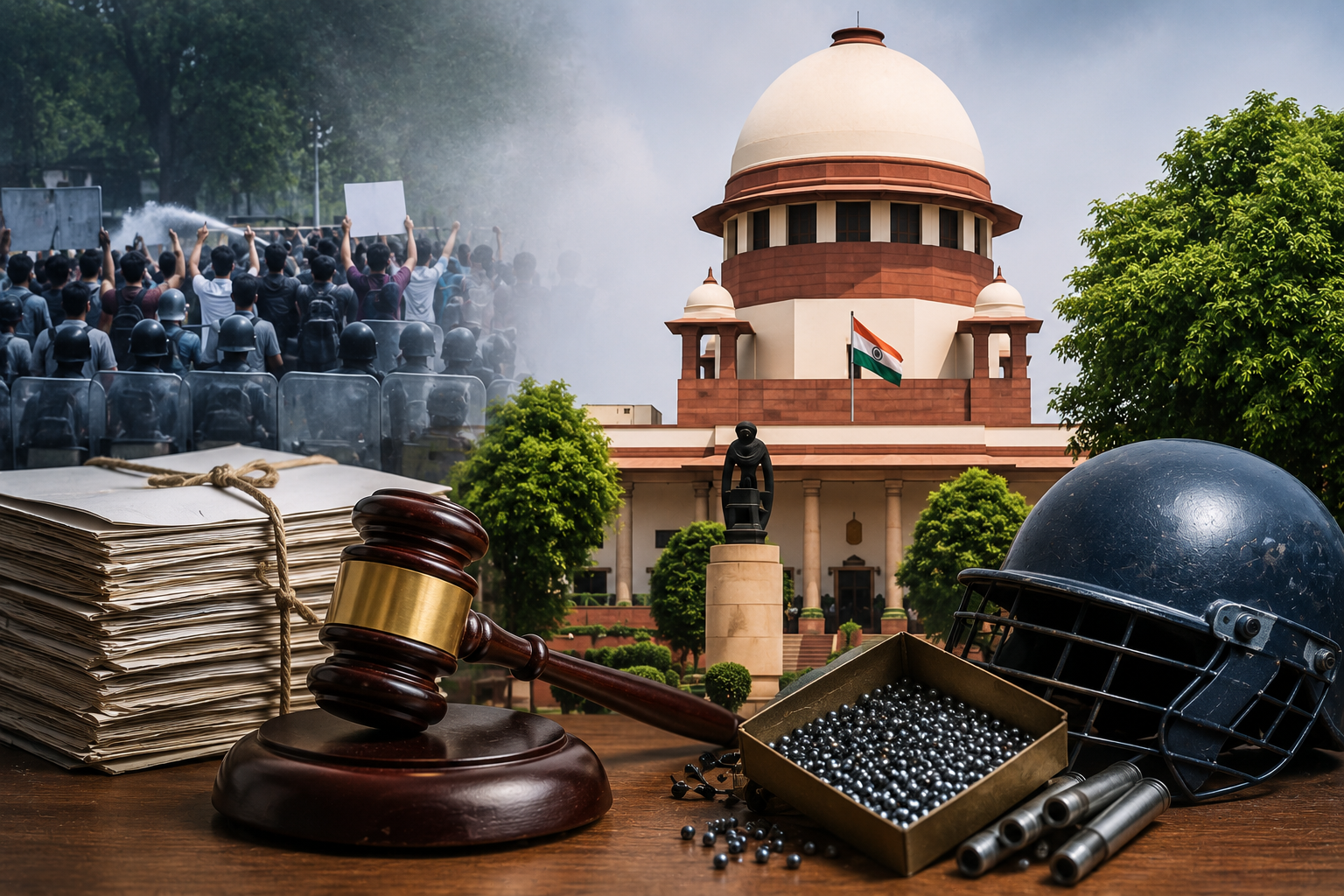
Top Court Begins Examination of Plea Challenging Use of Metallic Pellet Guns During Civilian Protests, Directs Authorities to Safeguard Key Evidence
The Supreme Court has taken up an important public interest litigation (PIL) concerning the use of metallic pellet ammunition during public demonstrations, directing the Central Government to preserve the ammunition log of the Rapid Action Force (RAF) deployed during the July 20 student protest over the alleged NEET paper leak at Jantar Mantar in New Delhi.
The apex court also instructed the Delhi Government to ensure the best possible medical treatment for individuals who reportedly suffered pellet injuries during the protest. The case could have significant implications for policing standards, crowd-control policies and the constitutional limits on the use of force during public assemblies across India.
The matter was heard by a Bench comprising Chief Justice Surya Kant, Justice Joymalya Bagchi and Justice V. Mohana, which indicated that it would closely examine the circumstances surrounding the use of pellet guns during the demonstration.
Supreme Court Directs Preservation of Critical Evidence
During the hearing, the Supreme Court directed the Centre to preserve the ammunition records of the RAF personnel deployed at Jantar Mantar during the July 20 protest.
The court's direction aims to ensure that official records remain available for judicial scrutiny as the case progresses.
The preserved ammunition log may help determine:
-
The quantity of ammunition used.
-
The type of ammunition deployed.
-
Whether operational protocols were followed.
-
The sequence of crowd-control measures adopted.
-
Compliance with existing policing guidelines.
The preservation of these records is expected to play a crucial role if the court later examines whether the force used was proportionate and lawful.
Delhi Government Asked to Ensure Best Medical Treatment
The Bench also directed the Delhi Government to provide comprehensive medical care to those who allegedly sustained pellet injuries during the protest.
The court emphasised that individuals claiming injuries should receive appropriate treatment without delay while legal proceedings continue.
The petition also seeks:
-
Long-term medical assistance.
-
Rehabilitation support.
-
Compensation for victims.
-
Monitoring of treatment where necessary.
These issues are expected to be examined in greater detail during subsequent hearings.
Petition Seeks Nationwide Ban on Metallic Pellet Guns
The PIL has been jointly filed by:
-
Former Central Information Commissioner and retired IPS officer Yashovardhan Azad.
-
Two individuals who claim to have suffered pellet injuries during the protest.
The petition requests a nationwide prohibition on the use of wholly or partially metallic pellet ammunition fired from pump-action or projectile guns for dispersing civilian gatherings.
According to the petitioners, such weapons can cause severe and permanent injuries and are incompatible with constitutional protections governing the use of force by public authorities.
Court Refers to Existing Crowd-Control Guidelines
During the proceedings, the Supreme Court referred to the advisory issued by the Bureau of Police Research and Development (BPRD) regarding the use of pellet guns.
The Bench observed that under existing operational guidelines, police authorities are permitted to use pellet guns only in exceptional situations.
However, the court clarified that it remains open to examining whether the use of such force in the present case complied with constitutional safeguards and established policing standards.
Case Linked to July 20 'Sansad Chalo' Protest
The petition arises from the "Sansad Chalo" protest organised in New Delhi on July 20, where students and civil society groups demonstrated over the alleged irregularities in the NEET examination.
The protest was organised to demand greater transparency and accountability regarding the examination process.
According to the petition, some demonstrators sustained pellet injuries during crowd-control operations carried out by security personnel.
The incident has since sparked debate over the methods employed by law enforcement agencies while handling public protests.
Constitutional Questions Before the Supreme Court
The case raises several important constitutional and legal questions regarding the use of force by law enforcement agencies.
Among the issues likely to be examined are:
-
Whether metallic pellet ammunition constitutes proportionate force.
-
The balance between public order and the right to peaceful protest.
-
Standards governing non-lethal crowd-control weapons.
-
Accountability mechanisms for law enforcement agencies.
-
Protection of fundamental rights under the Constitution.
The outcome could shape future policing practices during public demonstrations across India.
Importance of Preserving Operational Records
The court's direction to preserve the RAF ammunition log highlights the importance of maintaining official records during incidents involving allegations of excessive force.
Such records can assist in:
-
Verifying operational decisions.
-
Establishing accountability.
-
Reviewing compliance with standard operating procedures.
-
Supporting judicial examination of disputed facts.
Evidence preservation is considered an essential aspect of ensuring transparency in legal proceedings.
Petition Seeks Compensation and Rehabilitation
In addition to seeking a nationwide ban on metallic pellet ammunition, the petition requests several forms of relief for individuals allegedly injured during the protest.
The petition seeks:
-
Monetary compensation.
-
Comprehensive medical treatment.
-
Rehabilitation assistance.
-
Long-term healthcare support.
-
Judicial oversight of the investigation.
The court is expected to consider these requests alongside the broader constitutional challenge.
Debate Over Non-Lethal Crowd-Control Measures
The case has reignited discussion over the use of so-called non-lethal weapons during public demonstrations.
Supporters argue that such equipment provides law enforcement agencies with alternatives to more severe force in volatile situations.
Critics contend that metallic pellet ammunition can still cause serious injuries, including permanent vision loss and other long-term physical harm.
The Supreme Court's eventual decision may help establish clearer legal standards governing crowd-control methods in India.
Potential Policy Implications
Legal experts believe the case could influence future policy in several areas.
Possible outcomes include:
-
Revision of crowd-control guidelines.
-
Stronger accountability mechanisms.
-
Enhanced training for security personnel.
-
Greater judicial oversight of public-order operations.
-
Updated protocols for the use of non-lethal weapons.
Such reforms could have long-term implications for policing and civil liberties across the country.
Next Phase of the Proceedings
The Supreme Court is expected to continue hearing arguments from both the petitioners and the Central Government in the coming weeks.
Future hearings may examine:
-
Medical evidence relating to injuries.
-
RAF operational records.
-
Existing legal frameworks.
-
International practices on crowd-control weapons.
-
Constitutional principles governing use of force.
The final judgment is likely to provide important guidance on balancing public safety with the protection of fundamental rights.
Market Outlook
Although the proceedings primarily concern constitutional law and public policy, they underscore the importance of institutional accountability and transparent governance in India. Judicial oversight of law enforcement practices can influence future regulatory frameworks, procurement standards and operational guidelines for security agencies. While the case is unlikely to have any immediate impact on financial markets, it reflects the broader role of the judiciary in strengthening governance and reinforcing the rule of law.
From a market perspective, the direct financial implications are expected to remain limited. However, any future changes to policing protocols or procurement policies could be relevant for companies involved in defence equipment, public safety technologies and security solutions. More broadly, strong legal institutions and predictable regulatory processes continue to support investor confidence by reinforcing India's governance framework and long-term institutional stability.