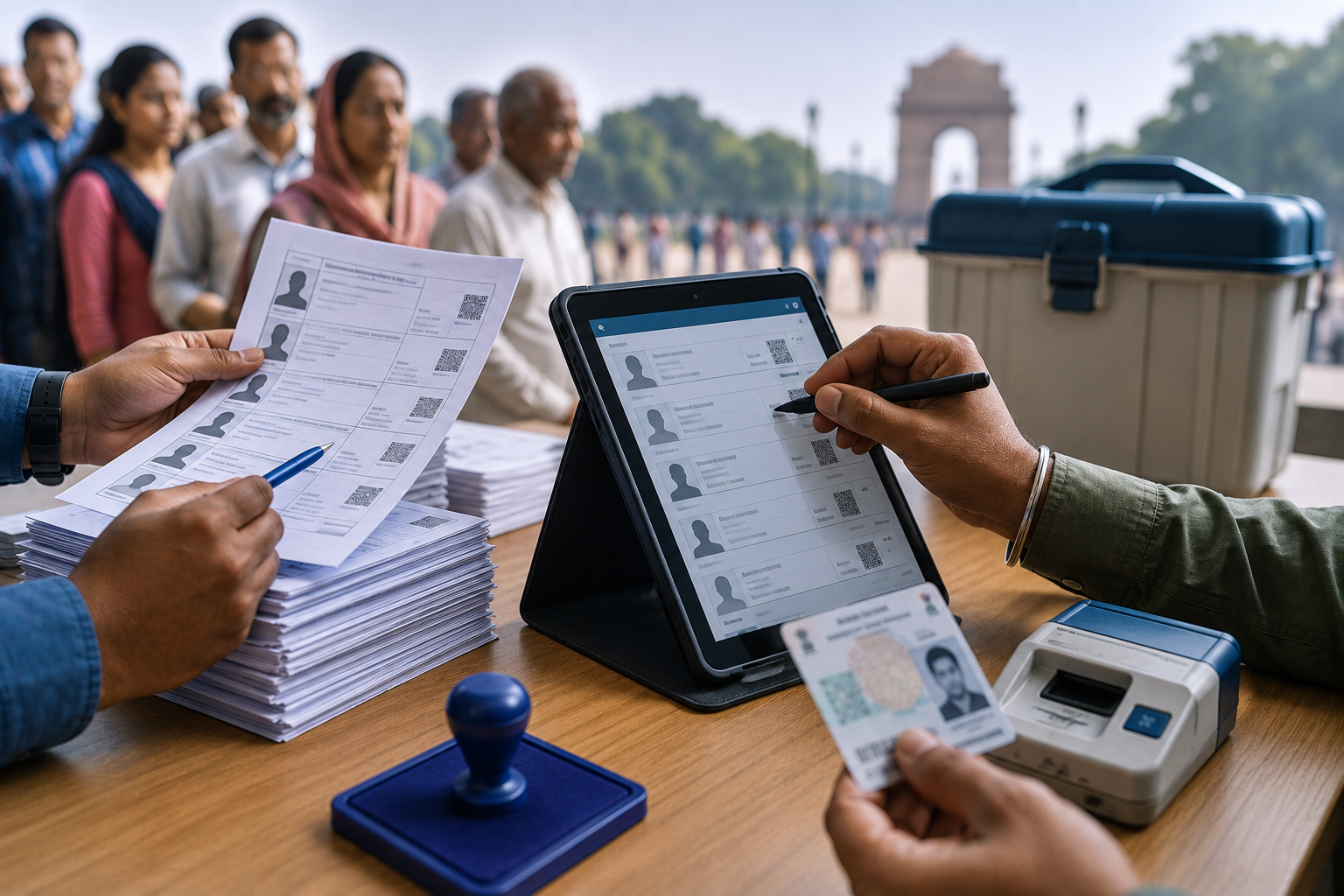
Election Commission Covers More Than Half of Delhi's Electorate, Extends Special Intensive Revision Until August 8 to Ensure Maximum Voter Inclusion
The Election Commission of India (ECI) has achieved a major milestone in Delhi's ongoing Special Intensive Revision (SIR) of electoral rolls, with more than 7.57 million voter enumeration forms digitised, covering 52.19% of the capital's electorate. The large-scale verification exercise is aimed at updating and authenticating voter records to ensure an accurate, transparent and inclusive electoral roll ahead of future elections.
According to the latest status report released by the Commission, enumeration forms have already been distributed to nearly every registered voter in Delhi, while digitisation efforts continue at a rapid pace across all 13 districts. To facilitate the collection of pending forms and improve verification, the Election Commission has extended the house-to-house survey by Booth Level Officers (BLOs) until August 8, providing additional time for eligible voters to complete the process.
The exercise represents one of the largest voter verification campaigns undertaken in the national capital and forms a key component of India's ongoing electoral reforms through technology-enabled governance.
More Than Half of Delhi's Electorate Verified
The latest progress report indicates that the Special Intensive Revision has crossed the halfway mark in terms of digitisation, reflecting significant progress in updating voter records.
Overall Progress of the SIR Exercise
| Particulars | Status |
|---|---|
| Total Registered Electors | 1,45,10,298 |
| Enumeration Forms Distributed | 1,44,92,544 |
| Distribution Coverage | 99.88% |
| Forms Digitised | 75,72,315 |
| Digitisation Coverage | 52.19% |
The near-complete distribution of forms suggests that the Election Commission has successfully reached almost every eligible voter, while digitisation and verification remain the primary focus in the next phase.
What Is the Special Intensive Revision (SIR)?
The Special Intensive Revision is a comprehensive voter verification programme conducted periodically by the Election Commission to ensure that electoral rolls remain updated and free from inaccuracies.
During the exercise:
-
Booth Level Officers visit every household.
-
Enumeration forms are distributed to registered voters.
-
Voters verify their personal details.
-
Corrections, additions or deletions are recorded.
-
Completed forms are digitised and verified.
-
Updated electoral rolls are prepared.
The objective is to improve the accuracy of voter databases while ensuring that every eligible citizen retains the right to vote.
Outer North District Emerges as the Top Performer
Among Delhi's thirteen districts, Outer North has recorded the highest percentage of digitised forms, reflecting efficient coordination between field officers and election authorities.
Top Five Districts by Digitisation Rate
| District | Digitisation |
|---|---|
| Outer North | 64.34% |
| South West | 62.45% |
| West | 59.46% |
| North West | 58.53% |
| Central North | 56.72% |
Officials believe these districts have benefited from effective door-to-door verification and faster document processing.
Some Districts Continue to Lag Behind
Despite overall progress, a few districts remain below the citywide average, highlighting the need for additional verification efforts.
Districts with Lower Digitisation Progress
| District | Digitisation |
|---|---|
| South East | 38.51% |
| East | 43.57% |
| South | 45.11% |
| Central | 48.41% |
| Old Delhi | 48.51% |
Election officials are expected to intensify field operations in these areas before the revised deadline.
North East Leads in Absolute Number of Uploaded Forms
While Outer North leads in percentage terms, North East Delhi has processed the highest number of enumeration forms due to its larger voter base.
Highest Number of Digitised Forms
| District | Forms Uploaded |
|---|---|
| North East | 10,13,554 |
| West | 8,65,773 |
| South West | 8,30,483 |
| South | 6,06,769 |
The figures underline the scale of the exercise being undertaken across densely populated districts.
Distribution Nearly Complete Across the Capital
The distribution phase of the Special Intensive Revision has almost concluded.
Enumeration forms have been fully distributed in ten districts, including:
-
South East
-
Old Delhi
-
North
-
New Delhi
-
Central
-
Outer North
-
North East
-
East
-
South
-
West
Among the remaining districts:
-
South West has reached 99.98% distribution.
-
Central North stands at 99.95%.
-
North West has achieved 98.66%.
The near-universal distribution demonstrates the extensive reach of the Election Commission's field machinery.
Deadline Extended to Ensure Greater Participation
Recognising the magnitude of the exercise, the Election Commission has extended the Special Intensive Revision until August 8.
Earlier, Booth Level Officers were scheduled to complete the process by July 29, but the extension provides additional time for:
-
Collection of pending forms.
-
Door-to-door verification.
-
Digitisation of submitted documents.
-
Inclusion of eligible voters who were unavailable during previous visits.
-
Resolution of discrepancies in voter records.
Officials expect the extension to significantly improve overall digitisation levels before the electoral rolls are finalised.
Special Focus on Voters Affected by Demolitions
The Election Commission has also acknowledged concerns regarding electors whose registered residences have been demolished due to redevelopment or civic projects.
Chief Electoral Officer Ashok Kumar has stated that the Commission is developing an appropriate mechanism to ensure such voters are not excluded from the electoral rolls merely because their recorded addresses no longer exist.
The proposed safeguards aim to protect voting rights while maintaining the integrity of the verification process.
Role of Booth Level Officers in Electoral Verification
Booth Level Officers play a crucial role in implementing the Special Intensive Revision.
Their responsibilities include:
-
Household visits.
-
Distribution of enumeration forms.
-
Assisting voters with corrections.
-
Collecting completed forms.
-
Verifying supporting documents.
-
Uploading verified information into the electoral database.
Delhi currently has 13,033 polling booths, making this one of the largest field verification exercises conducted by the Election Commission.
Technology Driving Electoral Reforms
The increasing use of digital tools has significantly enhanced the efficiency of electoral administration.
Digitisation offers several advantages:
-
Faster verification of voter records.
-
Reduced paperwork.
-
Improved accuracy.
-
Better data security.
-
Quicker identification of duplicate or incorrect entries.
-
Streamlined preparation of electoral rolls.
Technology-driven electoral reforms are expected to improve transparency and reduce administrative errors during elections.
Why Updated Electoral Rolls Matter
Accurate electoral rolls are fundamental to conducting free and fair elections.
An updated voter database helps:
-
Eliminate duplicate registrations.
-
Remove ineligible entries.
-
Include newly eligible voters.
-
Improve polling efficiency.
-
Enhance voter confidence.
-
Strengthen democratic institutions.
Regular revisions ensure that electoral rolls remain reliable and reflective of the latest demographic changes.
Key Highlights
| Particular | Latest Update |
|---|---|
| Total Electors | 1.45 crore |
| Enumeration Forms Distributed | 1.449 crore |
| Distribution Coverage | 99.88% |
| Forms Digitised | 75.72 lakh |
| Digitisation Coverage | 52.19% |
| Best Performing District | Outer North (64.34%) |
| Lowest Digitisation | South East (38.51%) |
| Polling Booths | 13,033 |
| Extended Deadline | August 8 |
Market Outlook
While the Special Intensive Revision is primarily an electoral administration exercise, it reflects India's continued focus on digital governance and technology-enabled public administration. Efficient voter roll management strengthens institutional transparency and administrative efficiency, factors that contribute positively to governance standards. For investors, continued digitisation across government processes supports the broader narrative of improving public infrastructure and digital transformation, which remains an important pillar of India's long-term economic and institutional development.