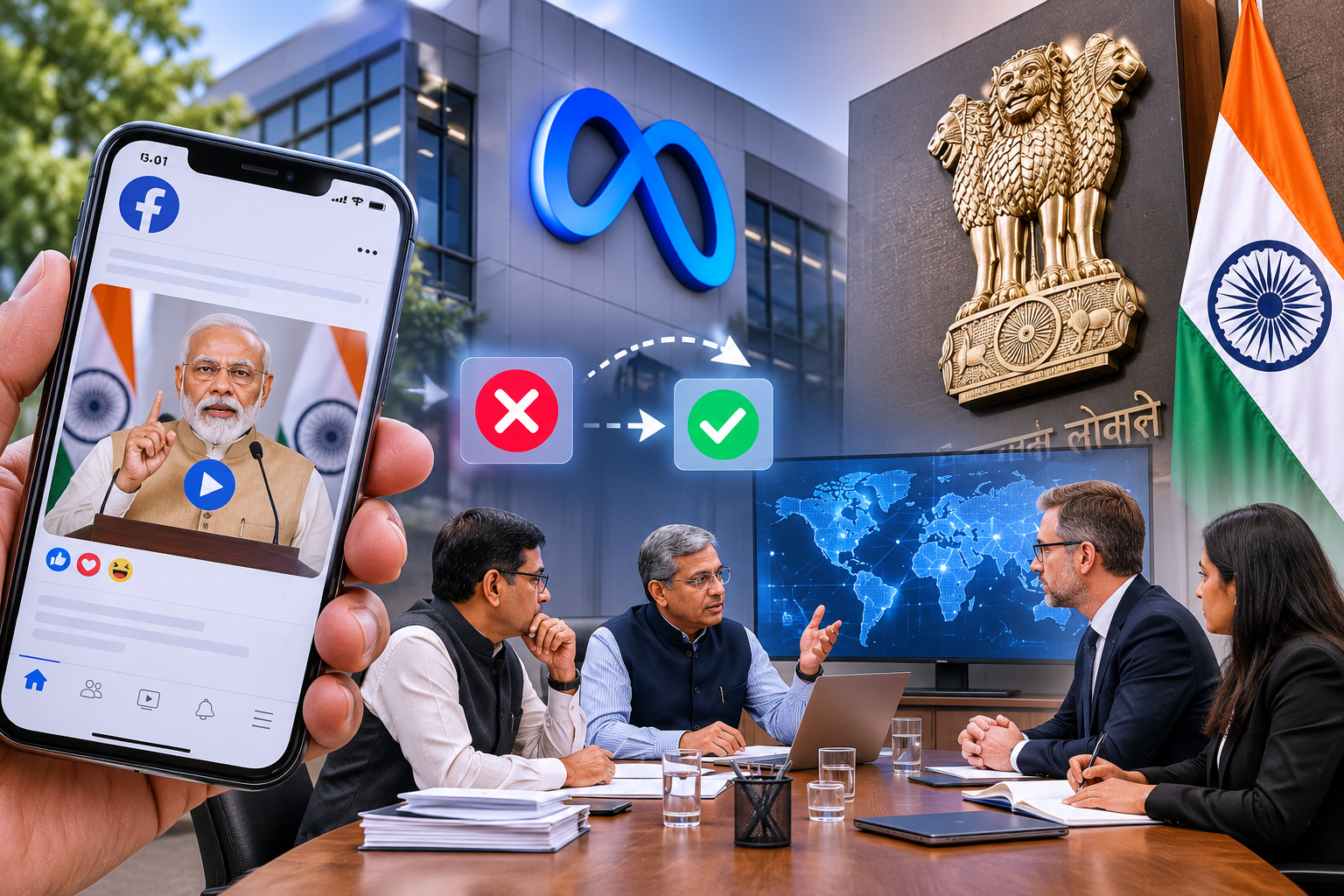
Government Seeks Clarification on Content Moderation Process as Meta Acknowledges Mistaken Takedown of Prime Minister's Youth Outreach Video
The Ministry of Electronics and Information Technology (MeitY) has summoned Meta's Global Head of Public Policy after the temporary removal of Prime Minister Narendra Modi's Facebook post, intensifying scrutiny of how global social media platforms moderate content in India. The incident has sparked fresh debate over the transparency, accountability and reliability of automated content moderation systems used by technology companies.
The post, published on 23 July, featured the Prime Minister addressing India's youth and outlining the government's commitment to taking stringent action against examination paper leaks. It was reportedly shared during ongoing student protests and was later removed from Facebook before being restored by Meta, which admitted that the removal had occurred due to an internal error.
Although the content has since been reinstated, the Indian government has sought a detailed explanation from the company regarding the circumstances that led to the takedown and the safeguards in place to prevent similar incidents in the future.
Government Calls Meta for Explanation
According to official sources, the IT Ministry has asked Meta's senior public policy leadership to explain why an official communication from the Prime Minister's verified account was removed.
The ministry is expected to seek clarity on several aspects, including:
-
The reason behind the removal.
-
Whether the action resulted from automated moderation or manual review.
-
The internal review process followed before restoring the content.
-
Measures being implemented to prevent similar mistakes.
-
Existing protocols for handling verified government accounts.
Officials reportedly view the issue seriously because it concerns communication issued by the country's highest elected office.
Meta Admits Error, Restores the Post
Following the government's intervention, Meta acknowledged that the removal of the Prime Minister's Facebook post was a mistake.
The company restored the video after identifying the error and confirmed that the content had been wrongly removed.
While Meta has not publicly disclosed the exact technical reason behind the incident, industry experts note that mistaken removals often occur because of:
-
Automated content moderation systems.
-
Incorrect policy enforcement.
-
Algorithmic misclassification.
-
Human moderation errors.
-
Technical glitches during content review.
The restoration helped resolve the immediate issue, but questions remain regarding the accuracy and oversight of large-scale content moderation systems.
The Video Focused on Youth and Examination Reforms
The Facebook post reportedly contained Prime Minister Narendra Modi's message directed towards students and young citizens.
The video addressed concerns over examination paper leaks and assured young people that the government would take strict measures against those responsible for compromising the integrity of competitive examinations.
The communication came amid student demonstrations demanding stronger action against examination irregularities, making the post particularly significant from a public policy perspective.
Its temporary removal therefore attracted considerable attention from both government officials and social media users.
Content Moderation Under Fresh Spotlight
The incident has once again highlighted the growing challenges associated with moderating billions of posts across global social media platforms.
Companies such as Meta increasingly rely on sophisticated artificial intelligence systems to identify content that may violate platform policies.
These systems analyse:
-
Images.
-
Videos.
-
Text.
-
Audio.
-
User behaviour.
-
Community reports.
Although automation allows platforms to process enormous volumes of content efficiently, experts acknowledge that false positives and unintended removals remain a persistent challenge.
Balancing Automation and Human Oversight
Modern content moderation generally combines machine learning with human review.
Artificial intelligence helps identify potentially problematic content within seconds, while human moderators assess more complex cases requiring contextual understanding.
However, even advanced systems may occasionally struggle with:
-
Political content.
-
Satire.
-
News reporting.
-
Government communications.
-
Regional languages.
-
Context-sensitive discussions.
This makes quality control and escalation procedures especially important for verified public accounts.
India Continues to Strengthen Digital Platform Oversight
The latest development reflects India's increasing emphasis on digital platform accountability.
Over recent years, the government has introduced several regulatory measures aimed at ensuring:
-
Greater transparency.
-
Faster grievance redressal.
-
Responsible content moderation.
-
Protection of user rights.
-
Compliance with Indian laws.
-
Enhanced accountability of large technology companies.
Officials have consistently maintained that digital platforms operating in India must ensure fairness, transparency and responsible governance while respecting legal requirements.
Why India Is an Important Market for Meta
India remains one of Meta's most strategically important markets.
The country represents one of the world's largest user bases across:
-
Facebook.
-
Instagram.
-
WhatsApp.
Millions of individuals, businesses, government departments and public representatives rely on these platforms for communication, marketing, governance and public outreach.
Consequently, any disruption involving official government communications attracts significant regulatory attention.
Growing Global Debate on Platform Accountability
The issue also reflects a broader international debate surrounding the role of major technology companies.
Governments across multiple jurisdictions are increasingly examining:
-
Algorithm transparency.
-
AI governance.
-
Content moderation policies.
-
Platform accountability.
-
User rights.
-
Digital competition.
Technology companies, meanwhile, continue investing heavily in artificial intelligence, moderation teams and policy enforcement to improve the accuracy of their systems while balancing freedom of expression with user safety.
Potential Regulatory Implications
Although Meta corrected the error quickly, the incident may encourage regulators to examine several operational issues more closely.
Areas likely to receive additional attention include:
-
Handling of verified government accounts.
-
Escalation procedures for public office holders.
-
Transparency in moderation decisions.
-
Human oversight of AI-generated actions.
-
Internal audit mechanisms.
-
Communication with regulatory authorities.
Such discussions could influence future regulatory expectations for large digital platforms operating in India.
Impact on Investor Sentiment
The incident is unlikely to have an immediate financial impact on Meta but serves as another reminder of the growing regulatory scrutiny facing global technology companies.
For investors, increasing oversight in key markets such as India could lead to:
-
Higher compliance costs.
-
Greater investment in moderation technologies.
-
Expanded legal and policy teams.
-
Enhanced AI governance frameworks.
While these measures may increase operating expenses, they could also strengthen long-term trust in digital platforms.
What Comes Next?
The meeting between Meta representatives and the Ministry of Electronics and Information Technology is expected to focus on understanding how the error occurred and identifying improvements to existing moderation systems.
The government is also expected to assess whether current safeguards are adequate to prevent the erroneous removal of official public communications in the future.
The outcome could contribute to broader discussions around platform governance and responsible use of artificial intelligence in content moderation.
Market Outlook
The temporary removal of Prime Minister Narendra Modi's Facebook post has once again highlighted the growing intersection of technology, regulation and public communication. While Meta's prompt restoration of the content and acknowledgment of the error helped defuse the immediate controversy, the incident underscores the challenges global social media platforms face in balancing automated moderation with contextual accuracy.
As India continues strengthening its digital governance framework, technology companies are likely to face increasing expectations around transparency, accountability and responsible AI deployment. For Meta and other major platforms, maintaining robust moderation systems while ensuring uninterrupted access to official public communications will remain critical as regulatory scrutiny intensifies across global markets.