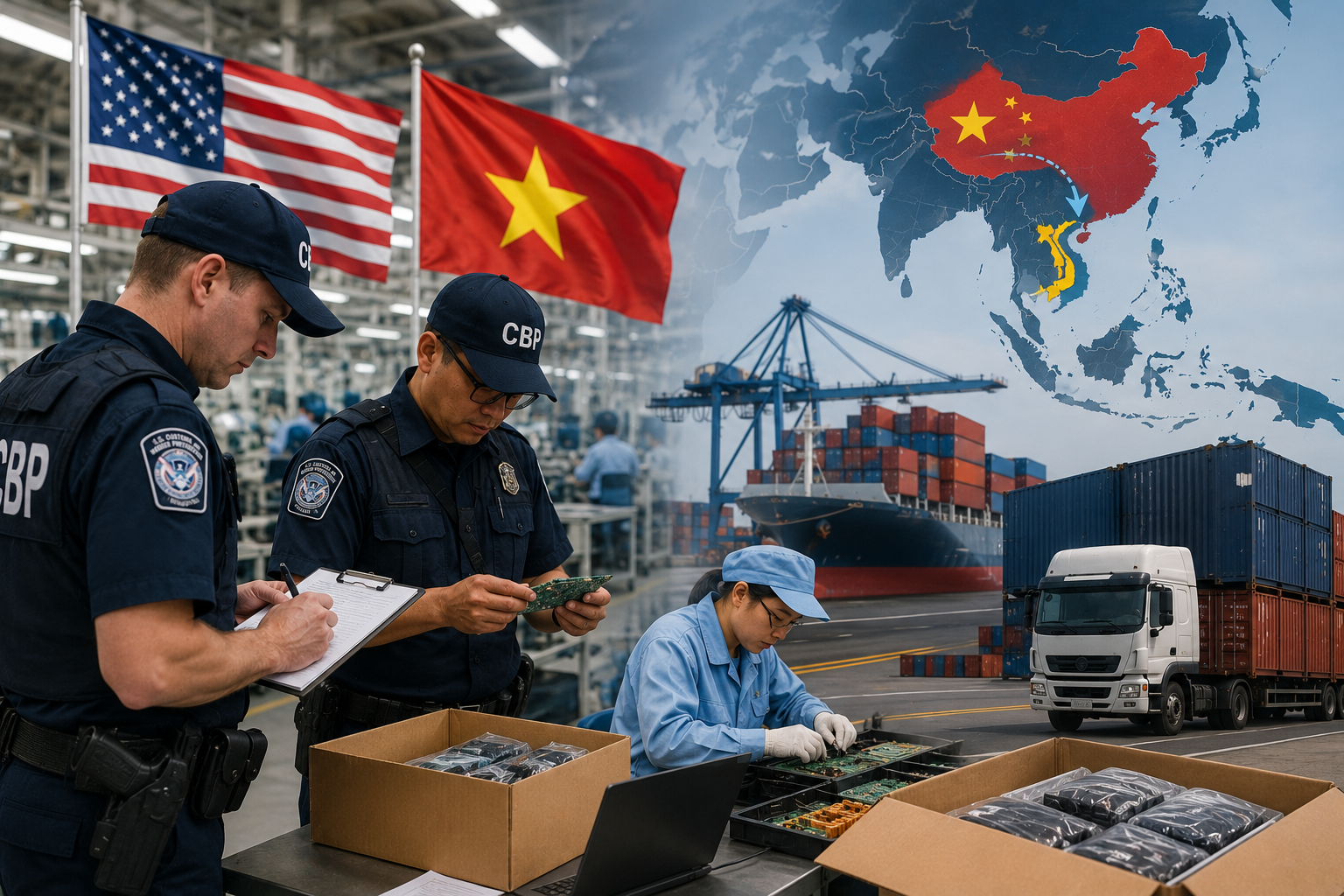
Customs Inspections Focus on Transshipment, Local Value Addition and Intellectual Property Compliance as Washington Tightens Trade Enforcement
The United States has stepped up its trade enforcement efforts by conducting spot inspections at China-linked manufacturing facilities in Vietnam, a move that has reignited concerns about additional tariffs on Vietnamese exports. The inspections, carried out by officials from US Customs and Border Protection (CBP), come at a sensitive time as Washington and Hanoi continue negotiations on a broader trade agreement amid rising geopolitical and economic tensions.
The inspections are aimed at determining whether products exported from Vietnam to the United States genuinely qualify as Vietnamese-made goods or are simply Chinese products rerouted through Vietnam with minimal processing to avoid US tariffs. While investigators have reportedly not uncovered substantial evidence of widespread trade violations so far, the increased scrutiny has raised concerns among manufacturers and global investors that Vietnam could face stricter trade measures in the months ahead.
The development also highlights the growing importance of supply chain transparency as multinational corporations continue shifting production away from China to diversify manufacturing bases.
US Customs Focuses on Manufacturing Processes
According to sources familiar with the inspections, US officials examined multiple aspects of factory operations to determine whether exports complied with American trade regulations.
Investigators reportedly reviewed:
-
Raw material sourcing.
-
Manufacturing records.
-
Production processes.
-
Local value addition.
-
Software licensing and intellectual property compliance.
-
Export documentation.
The objective is to verify whether sufficient manufacturing activities occur in Vietnam before products receive "Made in Vietnam" certification for exports to the United States.
US authorities have long argued that products must undergo meaningful transformation before they qualify as originating from Vietnam under international trade rules.
Transshipment Remains the Core Concern
One of the central issues under investigation is the alleged practice of transshipment.
Transshipment generally refers to goods manufactured in one country being routed through another country before export, often to avoid tariffs or trade restrictions.
US officials believe some Chinese manufacturers may be:
-
Shipping finished goods to Vietnam.
-
Performing limited assembly or packaging.
-
Relabelling products as Vietnamese.
-
Exporting them to the US to bypass tariffs imposed on Chinese goods.
Although officials have not publicly confirmed widespread violations, Washington continues to view transshipment as a major challenge to its trade enforcement efforts.
Trade Negotiations Become Increasingly Difficult
The inspections coincide with ongoing negotiations between the United States and Vietnam over a comprehensive trade framework.
While both countries reached a preliminary understanding last year, converting that framework into a formal agreement has proven challenging.
Key issues under discussion include:
-
Transshipment controls.
-
Intellectual property protection.
-
Market access.
-
Non-tariff barriers.
-
Supply chain security.
-
Economic cooperation.
Sources indicate that negotiations have become increasingly complex as both sides attempt to balance economic interests with strategic priorities.
Vietnam Responds with Stronger Enforcement
Recognising growing US concerns, Vietnam has accelerated efforts to strengthen trade compliance and intellectual property enforcement.
Authorities have recently announced several enforcement actions, including:
-
Confiscation of approximately 50,000 counterfeit Nike shoes.
-
Increased customs inspections.
-
Crackdowns on counterfeit goods.
-
Tighter monitoring of export documentation.
-
Enhanced enforcement against intellectual property violations.
The government has also highlighted its broader efforts to improve transparency and strengthen regulatory oversight across manufacturing industries.
Intellectual Property Protection Under Greater Scrutiny
Apart from transshipment, intellectual property protection has become another major focus of bilateral discussions.
The United States has repeatedly urged Vietnam to strengthen enforcement against:
-
Counterfeit products.
-
Software piracy.
-
Trademark infringement.
-
Patent violations.
-
Copyright misuse.
Vietnam recently submitted an extensive report to US trade authorities detailing nearly 20,000 intellectual property enforcement cases handled between 2021 and 2025, demonstrating efforts to improve compliance with international standards.
Strengthening intellectual property protection is expected to remain an important condition for deeper economic cooperation between the two countries.
Vietnam Faces Multiple US Trade Investigations
Vietnam is currently under heightened scrutiny from Washington on several fronts.
The country is reportedly subject to multiple investigations involving:
-
Alleged forced labour in supply chains.
-
Industrial overcapacity.
-
Trade fraud.
-
Intellectual property enforcement.
-
Section 301 trade investigations.
-
Transshipment practices.
These investigations could significantly influence future tariff decisions and broader trade policy between the two countries.
Why Vietnam Became a Global Manufacturing Hub
Over the past decade, Vietnam has emerged as one of Asia's fastest-growing manufacturing centres.
Several factors have contributed to its rise:
-
Competitive labour costs.
-
Stable political environment.
-
Strategic geographic location.
-
Extensive free trade agreements.
-
Improving infrastructure.
-
Growing skilled workforce.
The country's importance increased significantly after earlier rounds of US-China trade tensions encouraged multinational companies to diversify production away from China.
Global Brands Have Shifted Production to Vietnam
Vietnam now serves as a major manufacturing base for several leading global companies.
Examples include:
Nike
The sportswear giant manufactures more than half of its global footwear production in Vietnam, making the country one of its most important manufacturing locations.
Apple
Apple has steadily expanded production of several products, including:
-
AirPods.
-
MacBooks.
-
iPads.
-
Other consumer electronics.
The diversification reduces dependence on Chinese manufacturing while strengthening supply chain resilience.
Many other electronics, apparel and consumer goods manufacturers have also expanded operations in Vietnam over recent years.
Growing Trade Surplus Adds to US Pressure
Another important issue influencing negotiations is Vietnam's rapidly expanding trade surplus with the United States.
According to recent US trade data, Vietnam recorded one of the largest monthly trade surpluses with America, surpassing several traditional trading partners.
The Trump administration has consistently argued that persistent bilateral trade deficits indicate structural imbalances that require corrective policy measures.
As Vietnam's exports continue growing rapidly, pressure from US policymakers is expected to intensify.
Potential Impact on Global Supply Chains
Any expansion of US tariffs on Vietnamese exports could have significant consequences for global manufacturing networks.
Industries most exposed include:
-
Consumer electronics.
-
Smartphones.
-
Footwear.
-
Apparel.
-
Furniture.
-
Electrical equipment.
-
Industrial machinery.
-
Automotive components.
Multinational corporations may need to reassess supply chain strategies if additional trade restrictions increase manufacturing costs.
Countries such as India, Indonesia and Mexico could emerge as alternative production destinations if companies seek further diversification.
Implications for Investors
For global investors, the inspections highlight the increasing role of geopolitical risk in supply chain planning.
Key developments to monitor include:
-
Progress in US-Vietnam trade negotiations.
-
Findings from customs inspections.
-
Possible expansion of tariff measures.
-
Corporate supply chain relocation strategies.
-
Manufacturing investment flows into Southeast Asia.
-
US trade policy towards China and neighbouring economies.
Companies heavily dependent on Vietnam for exports to the United States could experience increased volatility if trade tensions escalate.
Market Outlook
The latest inspections underscore Washington's determination to strengthen trade enforcement and prevent tariff circumvention as global supply chains continue to evolve. Although US investigators have not yet identified widespread evidence of illegal transshipment, the increased scrutiny signals that Vietnam's growing role in international manufacturing will remain under close observation.
For Vietnam, addressing concerns surrounding transshipment, intellectual property protection and supply chain transparency will be critical to securing a comprehensive trade agreement with the United States and maintaining its status as one of the world's fastest-growing manufacturing hubs. For investors and multinational companies, developments in US-Vietnam trade relations are likely to play an increasingly important role in shaping global supply chains, manufacturing investment decisions and export competitiveness across Asia.