Solidarity Demonstrations in the US, UK and Ireland Highlight Growing Global Attention as Student Protests and Political Tensions Continue in India
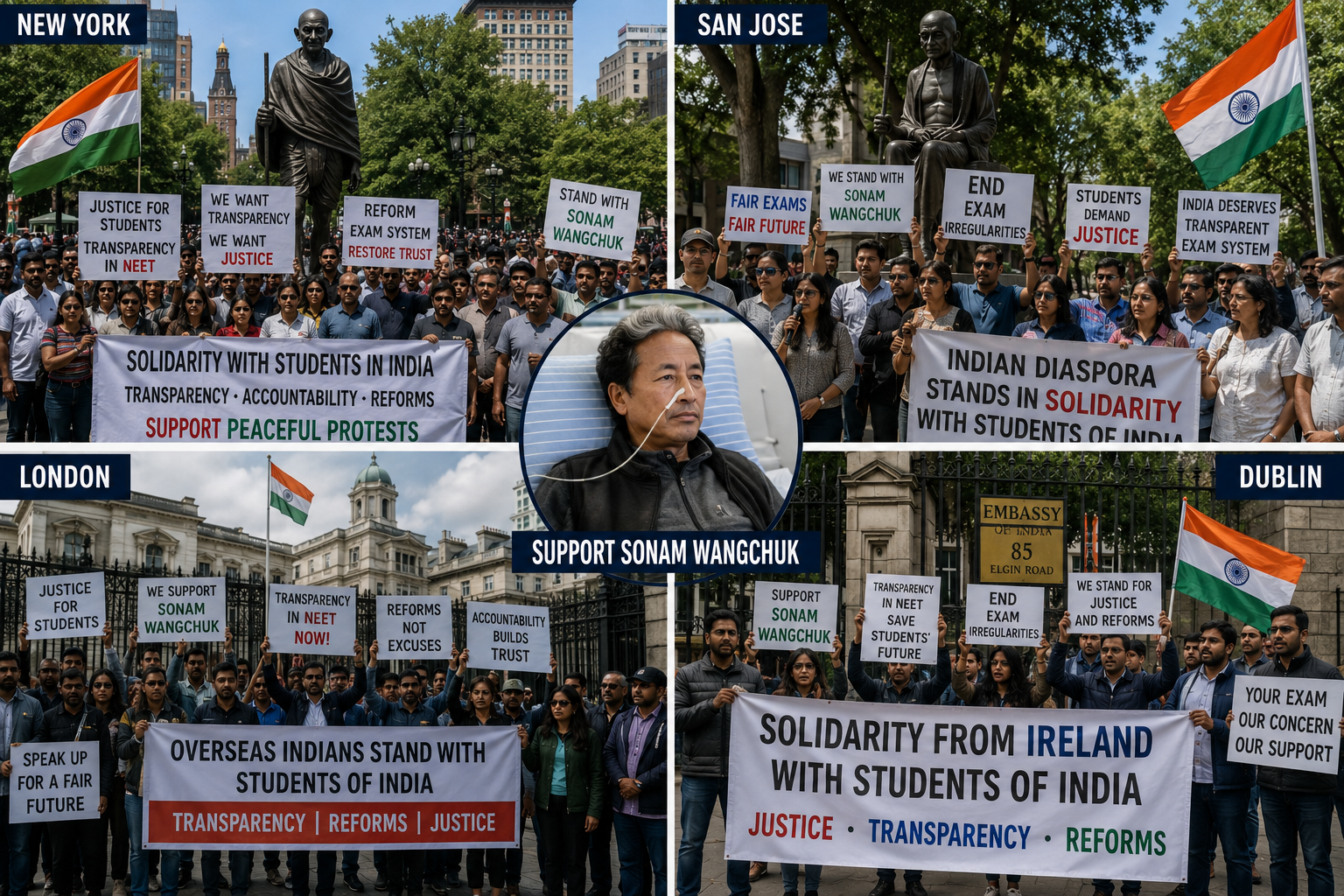
The controversy surrounding the alleged irregularities in the NEET-UG examination has crossed India's borders, with members of the Indian diaspora and advocacy groups organizing solidarity demonstrations in several international cities in support of activist Sonam Wangchuk. The overseas protests, held in New York, San Jose, London, and Dublin, reflect the growing global attention on an issue that has already triggered widespread political debate and student demonstrations across India.
While the protests abroad remain relatively limited in scale, they underscore how developments involving India's education system are increasingly attracting international interest through diaspora networks and social media. The demonstrations come as the Centre faces mounting pressure from opposition parties and student organizations demanding greater transparency, accountability, and reforms in the country's competitive examination system.
The developments also coincide with heightened security arrangements in New Delhi, where protests continue alongside the ongoing Monsoon Session of Parliament.
Diaspora Groups Organize Solidarity Demonstrations
Members of the US-based advocacy group Hindus for Human Rights organized peaceful demonstrations in New York City's Union Square and San Jose, gathering near statues of Mahatma Gandhi to express support for Sonam Wangchuk and students demanding examination reforms.
Participants carried placards calling for transparency, accountability and institutional reforms while urging authorities to engage constructively with protesters.
According to the organizers, the demonstrations were intended to draw attention to concerns surrounding the integrity of India's competitive examination process and to express solidarity with students participating in peaceful protests.
The organization also stated that similar gatherings took place outside the Indian High Commission in London and the Indian Embassy in Dublin, reflecting growing engagement among sections of the Indian diaspora.
Sonam Wangchuk's Hunger Strike Remains the Focal Point
At the center of the movement is environmentalist and education reform advocate Sonam Wangchuk, who has been on an indefinite hunger strike over the alleged irregularities in the NEET examination process.
After his health deteriorated following several weeks of fasting, authorities shifted him from the protest site at Jantar Mantar to Safdarjung Hospital before he was later moved to a private hospital following judicial intervention.
Medical teams continue to monitor his condition while supporters across India and abroad have appealed for dialogue and a peaceful resolution of the issue.
His hunger strike has become a powerful symbol of the broader demand for greater transparency and accountability within India's examination system.
NEET Controversy Evolves Into a National Political Issue
What began as a student-led movement has rapidly transformed into a major political issue.
Several opposition parties have extended support to protesting students and have demanded:
-
Greater transparency in the conduct of competitive examinations.
-
Accountability from concerned authorities.
-
A comprehensive discussion in Parliament.
-
Institutional reforms to strengthen public confidence.
-
Withdrawal of legal action against peaceful protesters.
The issue has dominated political discourse during the Monsoon Session, with opposition leaders accusing the government of failing to adequately address students' concerns.
Government Maintains Commitment to Reforms
The Union Government has reiterated that it remains committed to ensuring fairness and integrity in India's examination system.
Government representatives have maintained that Parliament is the appropriate platform for discussing concerns related to national examinations and have expressed willingness to debate the issue while emphasizing the need to preserve the credibility of public institutions.
Officials have also highlighted ongoing efforts to strengthen examination processes and improve accountability through administrative and technological reforms.
International Demonstrations Reflect India's Global Educational Importance
India conducts some of the world's largest competitive entrance examinations, with millions of students participating each year.
As a result, developments affecting the country's education system often receive close attention from overseas Indian communities, many of whom have personal, academic or professional ties to India's higher education ecosystem.
The recent demonstrations illustrate how domestic policy issues can increasingly resonate internationally through global diaspora communities and digital platforms.
Although the overseas protests are not expected to directly influence government policy, they contribute to broader public awareness and international discussion surrounding India's education governance.
Security Tightened in the National Capital
The international demonstrations come against the backdrop of heightened security arrangements in New Delhi.
Additional security personnel have been deployed across central Delhi to manage ongoing protests while ensuring the smooth functioning of Parliament.
Authorities continue to monitor developments closely, with enhanced surveillance around key government buildings, public gathering areas and designated protest sites.
Officials have appealed for peaceful demonstrations while emphasizing the importance of maintaining public order.
Education Reforms Remain the Central Demand
Beyond the political developments, the protests have renewed focus on long-term reforms within India's examination system.
Education experts believe the current debate presents an opportunity to strengthen:
-
Examination security.
-
Digital monitoring systems.
-
Transparency in evaluation processes.
-
Independent grievance redressal mechanisms.
-
Student communication and information systems.
-
Institutional accountability.
Building greater trust in competitive examinations is expected to remain a key policy priority as India continues expanding access to higher education.
Market and Policy Perspective
While the protests are primarily social and political in nature, prolonged public demonstrations can influence policy discussions surrounding education governance, digital examination infrastructure, cybersecurity and public administration.
For investors, the developments are unlikely to have an immediate impact on financial markets. However, companies involved in educational technology, secure digital testing platforms, identity verification systems, artificial intelligence-enabled examination monitoring and government digital infrastructure could benefit over the long term if examination reforms accelerate.
The broader policy response may also shape future investments in India's rapidly expanding education technology ecosystem.
Outlook
The NEET controversy has evolved beyond a domestic student movement into an issue receiving attention from Indian communities across the world. While overseas demonstrations remain symbolic, they reflect the increasing global engagement of the Indian diaspora with public policy issues affecting education and governance.
The coming weeks will be critical as Parliament continues deliberations, student organizations maintain pressure for reforms, and the government considers further measures to strengthen confidence in India's competitive examination system.
Constructive dialogue, institutional transparency and timely policy action will likely determine how quickly the controversy can be resolved and how effectively public trust can be restored.
Key Takeaways
-
Solidarity demonstrations supporting Sonam Wangchuk were held in New York, San Jose, London and Dublin.
-
The NEET controversy has evolved into an international issue attracting attention from sections of the Indian diaspora.
-
Sonam Wangchuk remains under medical supervision as his hunger strike continues to draw public attention.
-
The issue has become a major political debate during Parliament's Monsoon Session.
-
Education reforms, examination transparency and institutional accountability remain the central demands of protesters.
-
The government's response in the coming days will be closely watched by students, policymakers, educational institutions and global Indian communities.