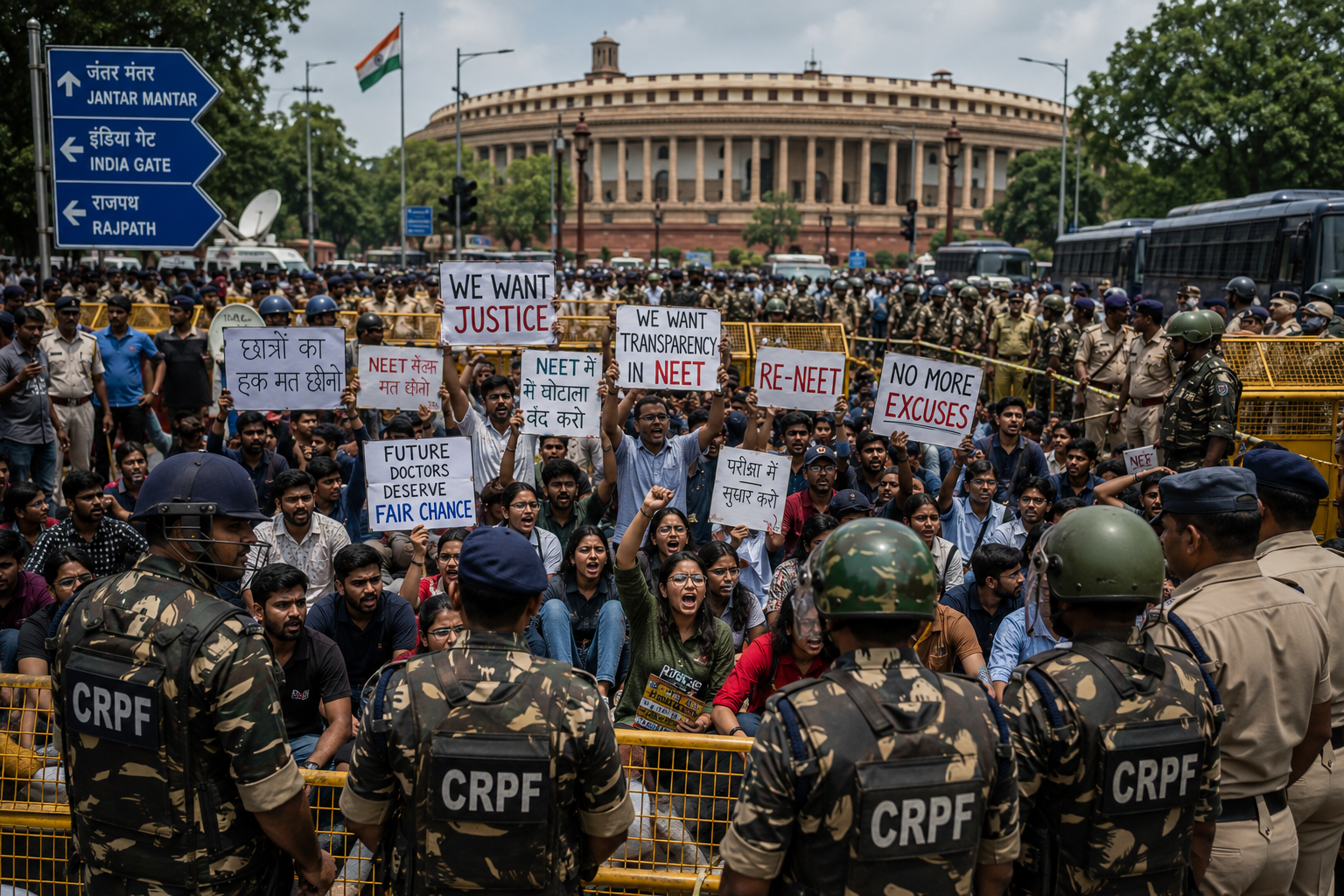
Security Tightened Across the National Capital as Student Agitation, Opposition Protests and International Solidarity Gather Momentum During Parliament's Monsoon Session
Delhi has been placed under heightened security after the Union government ordered the deployment of 20 additional companies of the Central Reserve Police Force (CRPF) amid intensifying protests over alleged irregularities in the NEET-UG examination. The move comes as demonstrations by student groups and Opposition parties continue to spread across the country, coinciding with the ongoing Monsoon Session of Parliament.
The additional paramilitary personnel are being airlifted to the national capital to strengthen law and order arrangements around Parliament, government buildings, protest sites and other sensitive locations. Authorities have also increased surveillance and crowd management measures as thousands of protesters continue to gather in central Delhi.
The issue, which initially began as a movement demanding greater transparency in the medical entrance examination, has now evolved into a nationwide political and social campaign, drawing support from several opposition parties, civil society organisations and members of the Indian diaspora abroad.
Centre Strengthens Security Amid Growing Demonstrations
According to official reports, the Ministry of Home Affairs has directed the deployment of 20 additional CRPF companies to reinforce security across Delhi.
The decision follows continuous demonstrations in the capital and comes as Parliament debates several key legislative and policy issues during the Monsoon Session.
Security has been intensified around:
-
Parliament House
-
North and South Block
-
Jantar Mantar
-
Central Delhi administrative zones
-
Major Metro stations
-
Sensitive government installations
Authorities stated that the deployment is a precautionary measure aimed at ensuring public safety while allowing peaceful democratic protests to continue within the legal framework.
Traffic restrictions, additional barricades and rapid response units have also been placed at strategic locations to prevent any disruption of essential services.
Student Movement Continues to Gain Momentum
Protests over alleged NEET-UG examination irregularities continued throughout the night, with large groups of students assembling at Jantar Mantar and other designated protest locations.
Although organisers withdrew one planned protest outside the Delhi Police headquarters after detainees were released, they reiterated that the broader movement would continue until their demands are addressed.
Student representatives continue to demand:
-
Greater transparency in the examination process
-
Accountability for alleged irregularities
-
Institutional reforms
-
Withdrawal of legal cases filed against protesters
-
Action against those responsible for alleged lapses
Organisers have also urged supporters to maintain peaceful demonstrations while continuing to press for dialogue with the government.
Delhi Police Register Cases Following Earlier Clashes
Delhi Police confirmed that multiple FIRs have been registered following incidents that allegedly involved attacks on security personnel during earlier demonstrations.
Officials said investigations are ongoing and that action would be taken against individuals found responsible for acts of violence or damage to public property.
Police have appealed to protesters to cooperate with law enforcement agencies and conduct demonstrations peacefully.
The administration has emphasized that maintaining public order remains its highest priority while ensuring citizens' constitutional right to peaceful protest.
Opposition Parties Intensify Political Pressure
The issue has rapidly become a major political flashpoint.
Senior Congress leaders, including Rahul Gandhi, Priyanka Gandhi, and Mallikarjun Kharge, participated in demonstrations in Delhi after staging protests near the Prime Minister's residence.
Although several leaders were briefly detained and later released, the incident triggered fresh protests across multiple states.
Congress leaders have demanded:
-
A detailed discussion on the NEET issue in Parliament
-
Accountability from the Education Ministry
-
Protection of students' interests
-
Withdrawal of cases against student protesters
Several other opposition parties have also expressed support for the movement, arguing that students deserve a transparent examination system and prompt resolution of their concerns.
Nationwide Demonstrations Expand Beyond Delhi
Following developments in the national capital, protests have spread to several parts of the country.
Demonstrations have been reported in:
-
Assam
-
Kerala
-
West Bengal
-
Maharashtra
-
Karnataka
-
Haryana
-
Jammu & Kashmir
Youth organisations, student unions and political workers have organised marches, sit-ins and public meetings demanding reforms in the examination system.
The expanding geographic reach of the protests indicates that the issue has resonated with a wider section of students and political groups across India.
Government Reiterates Commitment to Discussion
Union Education Minister Dharmendra Pradhan has defended the government's position, stating that the Centre remains fully prepared to discuss the matter in Parliament.
According to the minister, the government is committed to transparency, reforms and accountability while ensuring that students receive fair opportunities.
Government officials have maintained that Parliament remains the appropriate forum to debate education policy and address concerns related to national examinations.
The administration has also reiterated that reforms to strengthen examination integrity remain an ongoing priority.
Sonam Wangchuk's Hunger Strike Keeps Focus on the Issue
The ongoing hunger strike by activist Sonam Wangchuk has become another focal point of the movement.
Following concerns regarding his deteriorating health, Wangchuk was shifted from the protest site to hospital care under medical supervision.
His fast has received support from student organisations, social activists and several opposition leaders, further increasing public attention on the issue.
Medical authorities continue to monitor his condition while appeals have been made for constructive dialogue between the government and protest representatives.
Global Solidarity Demonstrations Highlight International Attention
Support for the movement has also emerged among members of the Indian diaspora.
Solidarity demonstrations have reportedly taken place in:
-
New York
-
San Jose
-
London
-
Dublin
Participants called for greater transparency in India's examination system and expressed support for peaceful protests taking place in the country.
Although relatively limited in scale, these demonstrations have amplified international attention through social media and community organisations.
Security Remains Tight During Parliament Session
With Parliament continuing its Monsoon Session, authorities have implemented enhanced security protocols throughout central Delhi.
Measures include:
-
Additional deployment of paramilitary personnel
-
Continuous surveillance around Parliament
-
Increased vehicle checks
-
Traffic diversions near protest sites
-
Enhanced monitoring through CCTV and drone surveillance in sensitive areas
-
Emergency response teams on standby
Officials have stressed that these arrangements are preventive and intended to ensure both public safety and uninterrupted parliamentary proceedings.
Political and Economic Implications
While the protests are primarily centred on education policy, they also carry broader political significance. The issue has become a key point of confrontation between the government and opposition during the Monsoon Session, potentially influencing legislative discussions and public discourse in the coming weeks.
From an economic perspective, the demonstrations are unlikely to have an immediate impact on financial markets. However, prolonged disruptions or continued political uncertainty could influence investor sentiment if parliamentary business or key policy reforms face delays.
Businesses operating in Delhi may also experience temporary logistical disruptions in areas affected by traffic restrictions and heightened security arrangements.
What Investors and Citizens Should Watch
Several developments are likely to shape the next phase of the movement:
-
Whether Parliament holds a comprehensive discussion on NEET-related concerns.
-
Any announcement of examination reforms by the Education Ministry.
-
The continuation or expansion of nationwide protests.
-
Security arrangements in Delhi during the remaining Parliament session.
-
Health updates on Sonam Wangchuk's hunger strike.
-
Possibility of formal dialogue between the government and protest representatives.
The government's response over the coming days will be closely watched by students, educational institutions, political parties and civil society groups alike.
Conclusion
The NEET protest movement has evolved into one of the most significant public demonstrations in recent months, combining student concerns, political mobilisation and nationwide public participation. The Centre's decision to deploy additional CRPF personnel reflects the importance of maintaining security while balancing citizens' democratic right to peaceful protest.
As Parliament continues its session, the focus will remain on whether constructive dialogue, institutional reforms and political consensus can help resolve the issue. The coming days are expected to play a decisive role in determining both the direction of the protests and the government's approach to addressing concerns surrounding India's examination system.
Key Takeaways
-
The Centre has deployed 20 additional CRPF companies to reinforce security in Delhi.
-
Student protests over alleged NEET-UG irregularities have expanded into a nationwide movement.
-
Opposition parties have intensified demonstrations and demanded a detailed discussion in Parliament.
-
Security has been strengthened across central Delhi during the Monsoon Session.
-
International solidarity protests have been reported in several global cities.
-
The government's response and possible examination reforms will remain the key focus in the days ahead.