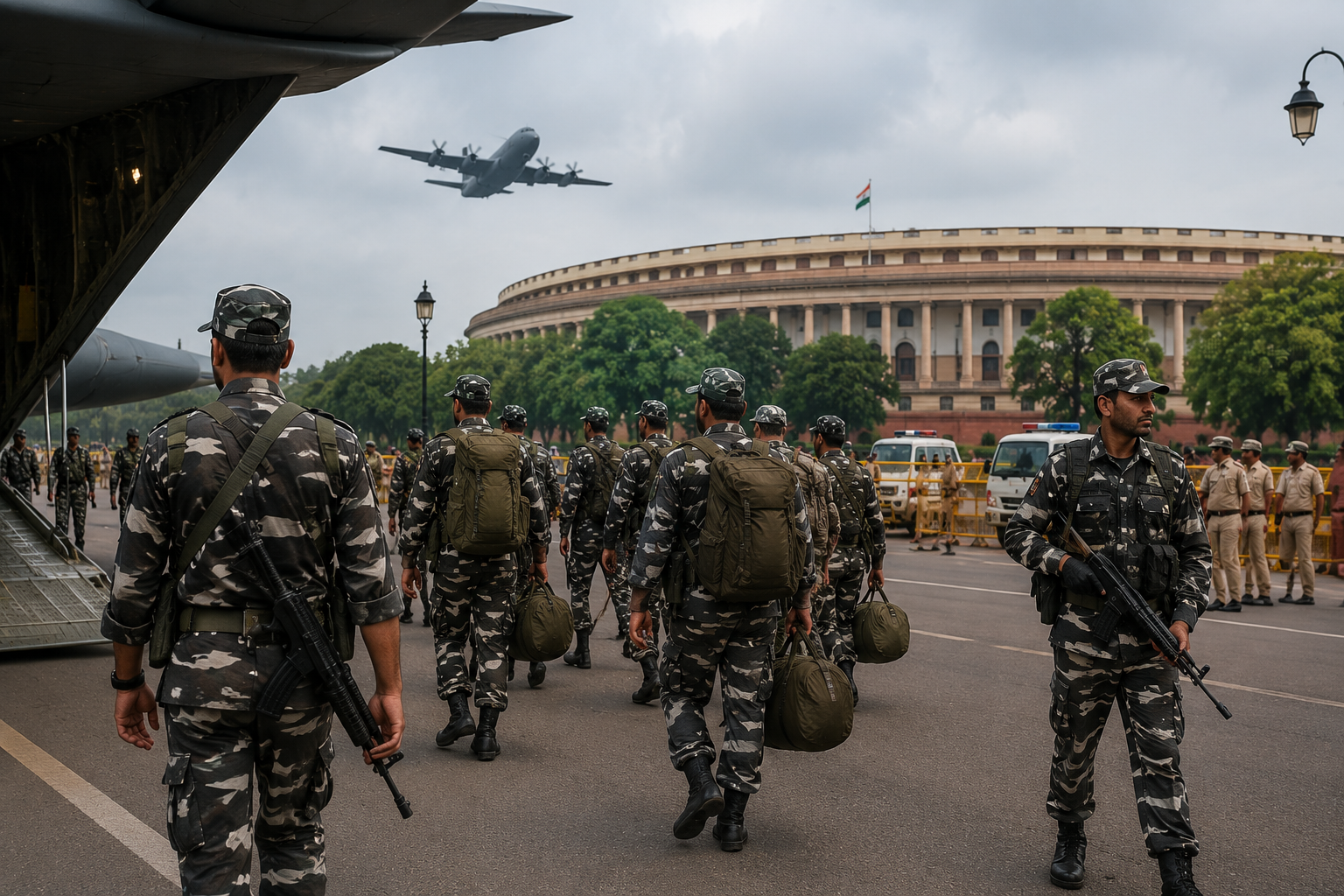
Ministry of Home Affairs Airlifts Central Forces from West Bengal to Strengthen Law and Order as Political Demonstrations Intensify in the National Capital
The Union Government has significantly strengthened security arrangements in the national capital by deploying 20 additional companies of the Central Reserve Police Force (CRPF) amid ongoing protests by the Cockroach Janta Party (CJP), demonstrations by various political organizations and the continuing Monsoon Session of Parliament. The decision reflects the Centre's focus on maintaining law and order during a period of heightened political activity and ensuring the smooth functioning of Parliament and government institutions.
According to official sources, the Ministry of Home Affairs (MHA) issued an urgent directive late Tuesday night for the immediate deployment of the additional CRPF personnel. The companies are being airlifted from West Bengal, where they had remained stationed following the Assembly elections earlier this year.
The reinforcement comes as security agencies prepare for large gatherings, demonstrations and potential law-and-order challenges across Delhi over the coming days.
Centre Orders Immediate Deployment
Officials said the Ministry of Home Affairs has instructed the CRPF to move additional personnel to Delhi without delay.
A total of 20 CRPF companies, each consisting of approximately 100 trained personnel, are being transported from Kolkata to the national capital.
Once deployed, these forces will assist the Delhi Police in:
-
Managing large public gatherings
-
Strengthening security around Parliament
-
Protecting government installations
-
Controlling crowds during demonstrations
-
Responding quickly to any law-and-order situation
The rapid mobilization demonstrates the government's preventive approach to security management during politically sensitive periods.
Security Tightened During Parliament's Monsoon Session
The deployment coincides with the ongoing Monsoon Session of Parliament, which traditionally witnesses increased political activity, opposition protests and demonstrations by various organizations.
Security has been enhanced around several sensitive locations, including:
-
Parliament House Complex
-
Central Vista
-
North Block and South Block
-
Ministry offices
-
Diplomatic Enclave
-
Key Metro stations
-
Major government buildings
Multiple security checkpoints and surveillance teams have also been positioned at strategic locations across central Delhi.
Why Additional Forces Were Needed
Security officials indicated that recent protest activities and isolated instances of clashes prompted authorities to strengthen deployment.
The additional CRPF personnel are expected to help:
-
Prevent escalation of demonstrations
-
Maintain public order
-
Safeguard public property
-
Ensure uninterrupted functioning of Parliament
-
Assist local police in managing crowds
Authorities emphasized that the objective is to maintain peace while allowing lawful democratic activities to continue.
CRPF's Role in Internal Security
The Central Reserve Police Force is India's largest central armed police force and plays a critical role in maintaining internal security.
The force is regularly deployed during:
-
Elections
-
Large-scale public protests
-
Religious gatherings
-
Major national events
-
Disaster response operations
-
High-security assignments
Its personnel receive specialized training in crowd control, riot management and emergency response, making the force an essential component of India's internal security framework.
Rapid Action Force Already Supporting Delhi Police
Apart from the newly deployed companies, approximately 30 companies of the CRPF and the Rapid Action Force (RAF) are already assisting the Delhi Police.
The RAF specializes in handling:
-
Riot situations
-
Violent demonstrations
-
Communal disturbances
-
Crowd management
-
Emergency response
Its presence allows authorities to respond swiftly to rapidly evolving situations while minimizing disruption to public life.
Forces Redeployed from West Bengal
The additional CRPF companies were previously stationed in West Bengal following the state's Assembly elections.
Although polling had concluded months ago, the personnel remained there based on administrative requirements.
Following the latest directive from the Ministry of Home Affairs, these units have now been reassigned to Delhi to strengthen the capital's security infrastructure.
The move highlights the flexibility of central security agencies in reallocating resources based on evolving operational needs.
Multi-Layer Security Strategy Across Delhi
Security agencies have adopted a comprehensive, multi-layered approach to safeguarding the city.
The strategy includes:
-
Enhanced patrolling
-
CCTV surveillance
-
Vehicle checks at key entry points
-
Intelligence monitoring
-
Drone surveillance in sensitive areas
-
Deployment of Quick Reaction Teams (QRTs)
-
Coordination between central and local agencies
Authorities are also monitoring social media and intelligence inputs to assess potential security risks and respond proactively.
Public Advisory for Residents
Delhi Police and security agencies have advised citizens to remain cautious during the period of heightened security.
Residents have been requested to:
-
Avoid unnecessary travel near designated protest sites
-
Follow official traffic advisories
-
Cooperate with security personnel during inspections
-
Use alternate routes if required
-
Stay informed through verified government updates
Traffic congestion and temporary movement restrictions may occur around central Delhi depending on the scale of demonstrations.
Balancing Security and Democratic Rights
Experts note that managing public demonstrations requires a careful balance between ensuring public safety and protecting citizens' democratic right to peaceful protest.
The deployment of additional security personnel aims to:
-
Facilitate peaceful demonstrations
-
Prevent violence
-
Protect public infrastructure
-
Ensure safety of commuters
-
Maintain continuity of government operations
Authorities have reiterated that preventive deployment is intended to reduce risks rather than restrict lawful public expression.
Possible Impact on Business and Daily Life
An expanded security presence may temporarily influence activity in parts of the capital.
Potential short-term effects include:
-
Traffic diversions
-
Delays in public transport
-
Increased security checks
-
Restricted access to high-security zones
-
Temporary disruption for businesses located near protest areas
Officials have indicated that restrictions will be reviewed regularly based on the evolving situation.
What Markets Will Watch
While the deployment itself is an administrative security measure, investors will monitor developments for any broader implications.
Key factors include:
-
Duration and scale of protests
-
Impact on transport and logistics
-
Parliamentary proceedings
-
Government policy announcements
-
Business continuity in the National Capital Region
Historically, markets have viewed preventive security deployments as routine unless they result in prolonged disruptions to economic activity.