PM Modi Assures Full Central Support While Emergency Agencies Continue Search for Workers Trapped Inside NHPC's Teesta Stage VI Hydroelectric Project
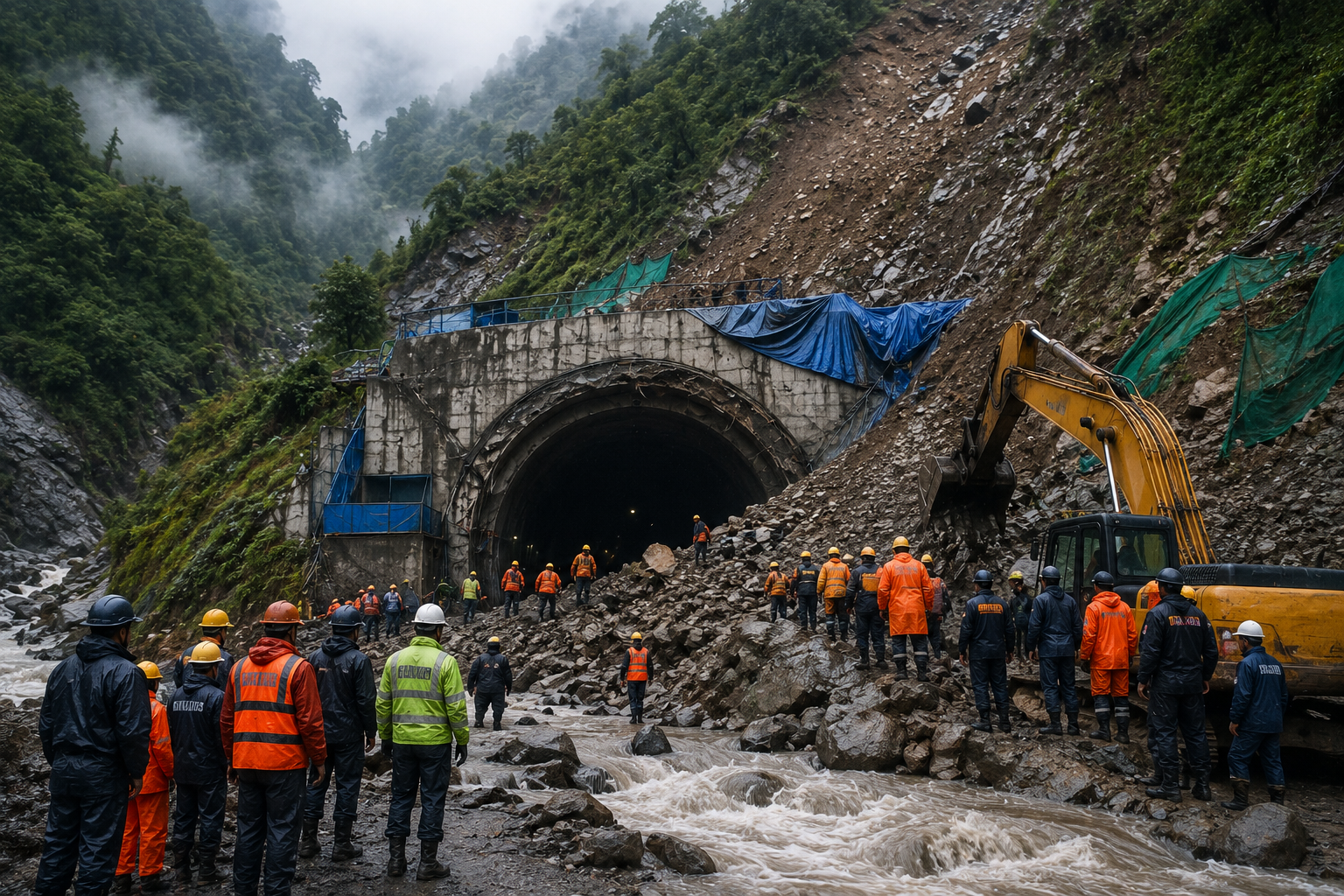
A devastating tunnel collapse at the under-construction Teesta Stage VI Hydroelectric Project in Sikkim has claimed the lives of eight workers, while several others remain trapped inside as rescue teams race against time under extremely hazardous conditions. The accident, triggered by a landslide in Namchi district, has once again highlighted the safety challenges associated with large infrastructure projects in the Himalayan region. Rescue operations continued through the night and into Tuesday despite heavy rainfall, unstable terrain and the presence of hazardous underground gas. (hindustantimes.com)
The incident occurred at Samardung in Jholungey, where a section of the under-construction tunnel collapsed after a landslide sealed the entrance. Initial reports indicated that 27 workers were inside the tunnel when the accident occurred. While several workers managed to escape shortly after the collapse, many remained trapped deep inside the tunnel. (hindustantimes.com)
Death Toll Rises as Rescue Enters Critical Phase
Authorities confirmed that eight workers have lost their lives in the accident, while rescue teams continue searching for those believed to be trapped nearly three kilometres inside the tunnel.
Officials stated that recovering the bodies and reaching the remaining workers has become increasingly difficult because of continuous rainfall, unstable geological conditions and poor visibility inside the tunnel. Rescue personnel are proceeding cautiously to avoid triggering additional cave-ins that could endanger both survivors and emergency responders. (hindustantimes.com)
Prime Minister Narendra Modi Reviews Situation
Sikkim Chief Minister Prem Singh Tamang confirmed that Prime Minister Narendra Modi personally contacted him to enquire about the tragedy and monitor the progress of rescue operations.
According to the Chief Minister, the Prime Minister expressed condolences to the families of the deceased workers and assured the state government of every possible assistance from the Centre. The assurance includes support for rescue operations as well as all necessary resources required to deal with the emergency. (hindustantimes.com)
Landslide Triggers Major Industrial Accident
Officials believe the accident was caused by a landslide that suddenly blocked the entrance of the tunnel, trapping workers inside while destabilising the surrounding rock formations.
The collapsed tunnel forms part of the NHPC Teesta Stage VI Hydroelectric Project, one of the important hydroelectric developments in Sikkim aimed at strengthening India's renewable energy infrastructure.
The difficult Himalayan terrain, combined with heavy monsoon rainfall, has historically increased the risk of landslides and geological instability in the region. (hindustantimes.com)
Hazardous Gas Makes Rescue Operations Extremely Dangerous
Rescue efforts have been severely hampered by the presence of hazardous gas inside the tunnel.
Several rescue personnel reportedly experienced dizziness and breathing difficulties while attempting to enter the collapsed section. Officials believe the gas is naturally emanating from underground rock formations disturbed during the landslide, although investigations will determine its exact composition once rescue operations conclude. (theweek.in)
Specialised rescue teams equipped with gas masks, oxygen support systems and protective equipment have been deployed to minimise risks while searching for trapped workers.
Multiple Agencies Join Rescue Mission
A large-scale emergency response has been launched involving multiple state and central agencies.
The rescue operation includes personnel from:
-
National Disaster Response Force (NDRF)
-
State Disaster Response Force (SDRF)
-
Sikkim Police
-
Fire and Emergency Services
-
District Administration
-
Specialised rescue teams from neighbouring West Bengal
Heavy machinery, ambulances, excavation equipment and emergency medical teams have also been stationed at the accident site to support rescue efforts. (theweek.in)
Heavy Rain and Difficult Terrain Slow Progress
Continuous rainfall across Sikkim has significantly complicated rescue operations.
Loose soil, recurring landslides and unstable mountain slopes have restricted the movement of heavy machinery near the tunnel entrance. Rescue teams are also facing poor visibility and narrow access points, making excavation work slow and highly risky.
Authorities have indicated that ensuring the safety of rescuers remains a priority while operations continue around the clock. (hindustantimes.com)
Infrastructure Safety Under Fresh Spotlight
The tragedy has once again drawn attention to safety standards across large infrastructure and hydropower projects located in geologically sensitive Himalayan regions.
Experts note that tunnel construction in mountainous terrain requires continuous geological surveys, real-time monitoring systems, emergency evacuation plans and advanced ventilation mechanisms to reduce risks associated with landslides, gas emissions and structural instability.
The incident is expected to prompt detailed reviews of construction safety protocols and disaster preparedness measures at similar projects across the country.
Economic and Project Implications
Apart from the humanitarian loss, the accident may also have implications for project execution and infrastructure timelines.
Construction work at the Teesta Stage VI project is likely to remain suspended until rescue operations conclude and safety inspections are completed. Any prolonged disruption could increase project costs, delay commissioning schedules and lead to additional compliance requirements for contractors involved in the project.
Infrastructure developers operating in high-risk regions may also face stricter regulatory oversight and enhanced safety audits following the incident.
What Happens Next
Authorities have stated that rescue operations will continue until every trapped worker has been accounted for. Once the emergency phase concludes, a detailed investigation is expected to determine the exact cause of the collapse, evaluate safety practices at the construction site and recommend measures to prevent similar accidents in future infrastructure projects.
Insight
While the immediate focus remains on saving lives and supporting affected families, the incident also highlights the execution risks associated with large hydroelectric and infrastructure projects in environmentally sensitive regions. Investors tracking the engineering, construction and power sectors may closely monitor the progress of the rescue operation, any impact on the Teesta Stage VI project's timeline, potential cost escalations and regulatory responses related to worker safety and project execution.