NEET Paper Leak, Ram Temple Donation Allegations and Other Opposition Demands Lead to Multiple Adjournments as Government Pushes Ahead with Legislative Agenda
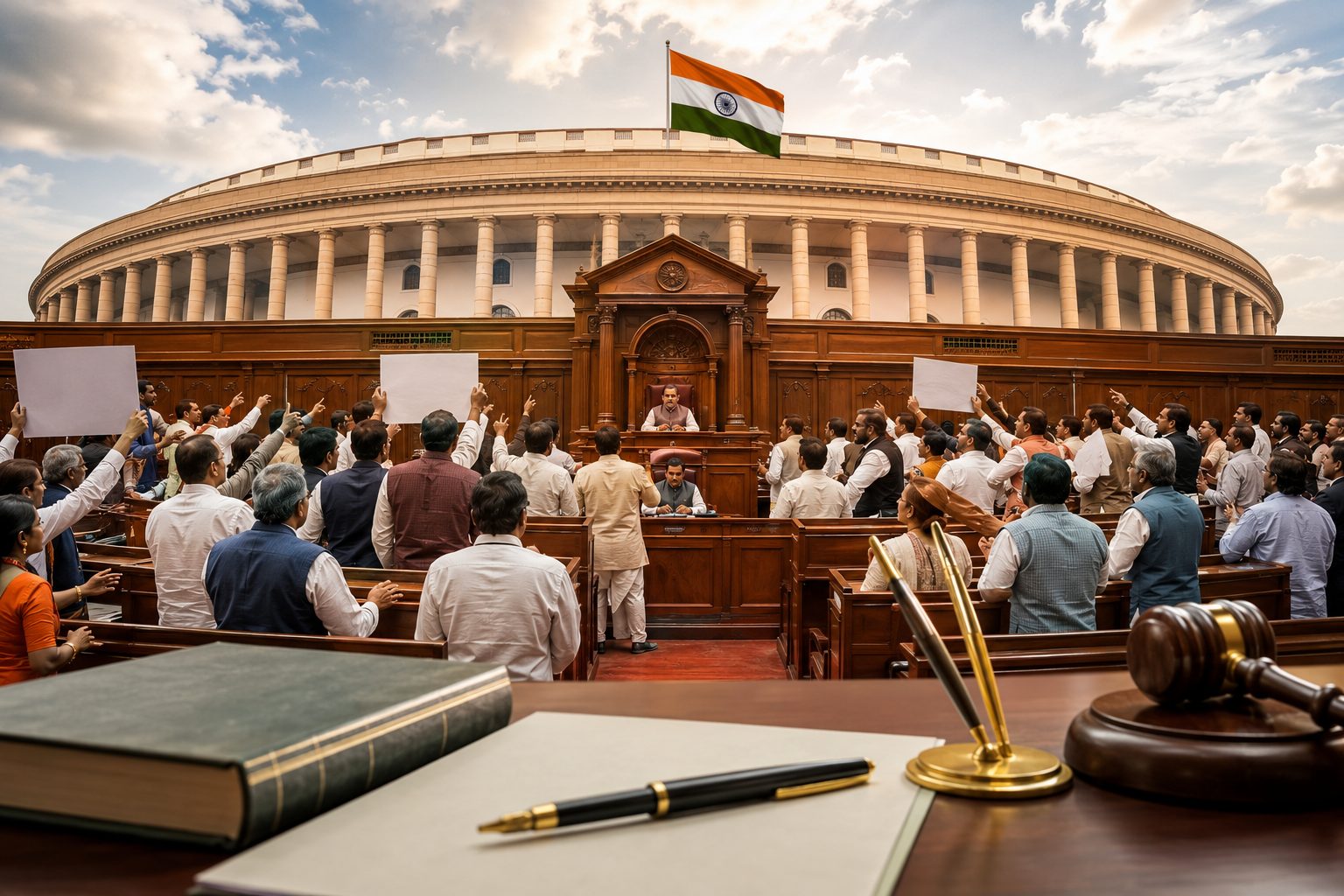
The Monsoon Session of Parliament commenced amid intense political confrontation on Monday, with repeated protests by opposition members bringing Lok Sabha proceedings to a standstill on the very first day. The House witnessed four consecutive adjournments as opposition MPs raised slogans, displayed placards, and demanded immediate discussions on issues including the alleged NEET examination paper leak and allegations related to the Ram Temple donation fund.
Despite the disruptions, the government managed to introduce an important judicial reform bill aimed at increasing the sanctioned strength of judges in the Supreme Court of India, signalling its intent to continue pursuing its legislative agenda throughout the session.
The stormy start indicates that the Monsoon Session is likely to witness sharp debates, political confrontations, and prolonged discussions on several national issues, making it one of the most closely watched parliamentary sessions of the year.
Opposition Protests Bring House Proceedings to a Halt
Lok Sabha assembled at 11:00 AM, but proceedings were disrupted almost immediately.
As the Question Hour began, opposition members entered the well of the House, raised slogans, and displayed banners demanding discussions on various issues.
The protests prevented the House from conducting its scheduled business, forcing the Speaker to adjourn proceedings repeatedly throughout the day.
The disruptions reflected growing political tensions between the government and opposition ahead of several key legislative discussions.
Major Issues Raised by the Opposition
Opposition parties sought immediate debate on multiple issues that they described as matters of national importance.
Among the primary demands were:
-
Discussion on the alleged NEET examination paper leak.
-
Action against individuals responsible for examination irregularities.
-
Debate on allegations concerning Ram Temple donation funds.
-
Greater accountability from the government.
-
Immediate responses to public concerns.
The opposition insisted that these issues deserved priority before any legislative business could proceed.
Speaker Appeals for Parliamentary Decorum
Before the first adjournment, Lok Sabha Speaker Om Birla urged members to maintain the dignity of Parliament.
The Speaker expressed concern that some members continued raising slogans even while obituary references were being read for former Members of Parliament.
He observed that such conduct did not uphold parliamentary traditions and appealed to all members to preserve the decorum of the House.
Despite repeated appeals, protests continued throughout the day.
Repeated Adjournments Mark Opening Day
The House witnessed multiple adjournments as opposition protests continued unabated.
Timeline of Adjournments
11:00 AM
Proceedings disrupted during Question Hour.
House adjourned until 12:00 Noon.
12:00 PM
Protests resumed immediately after the House reconvened.
Proceedings adjourned until 12:30 PM.
12:30 PM
Opposition members continued raising slogans during Zero Hour.
House adjourned until 1:00 PM.
1:00 PM
Fresh appeals by the Chair failed to restore order.
Lok Sabha was adjourned once again until 2:00 PM.
The repeated interruptions significantly reduced the time available for legislative business.
Government Introduces Supreme Court Judges Bill
Despite the disruptions, the government succeeded in introducing a significant piece of legislation.
Union Law Minister Arjun Ram Meghwal introduced a bill seeking to replace an ordinance that increases the sanctioned strength of judges in the Supreme Court.
Highlights of the Bill
-
Increase total number of Supreme Court judges.
-
Expand sanctioned strength from 34 to 38 judges, including the Chief Justice of India.
-
Reduce judicial backlog.
-
Improve efficiency of the justice delivery system.
-
Strengthen judicial capacity.
The move is expected to help address the increasing number of pending cases before the country's highest court.
Zero Hour Could Not Function
The repeated protests also prevented the House from conducting Zero Hour, during which Members of Parliament usually raise urgent matters of public importance.
Repeated requests by the Chair asking protesting members to return to their seats failed to restore normal proceedings.
As a result, scheduled discussions could not be taken up.
Chair Criticises Continued Disruptions
Presiding Officer Dilip Saikia, who chaired proceedings during later adjournments, urged opposition members to participate in constructive debate instead of disrupting parliamentary business.
He stated that Parliament remained the appropriate forum for discussing public issues and criticised the continued display of banners and placards inside the House.
According to the Chair, repeated disruptions prevented meaningful discussions on issues affecting citizens.
Government Signals Readiness for Debate
Government representatives maintained that they remained open to discussing national issues within the framework of parliamentary procedures.
The ruling side argued that:
-
Parliament provides adequate opportunities for debate.
-
Legislative work should continue uninterrupted.
-
Public interest requires smooth functioning of the House.
The government expressed disappointment over repeated disruptions affecting parliamentary productivity.
Monsoon Session Expected to Be Legislatively Busy
The Monsoon Session is expected to feature discussions on several important legislative proposals.
Among the anticipated areas of focus are:
-
Judicial reforms.
-
Economic legislation.
-
Financial sector reforms.
-
Governance measures.
-
Infrastructure initiatives.
-
Administrative reforms.
-
Social welfare programmes.
Efficient functioning of Parliament will be essential for advancing these legislative priorities.
Political Confrontation Likely to Continue
The opening day's events indicate that political tensions are likely to remain elevated throughout the session.
Several contentious issues continue to dominate the political agenda, including:
-
Examination reforms.
-
Governance and transparency.
-
Economic conditions.
-
Inflation.
-
Employment.
-
Federal issues.
These topics are expected to feature prominently in parliamentary debates over the coming weeks.
Impact on Legislative Productivity
Frequent adjournments significantly reduce Parliament's ability to conduct business.
Extended disruptions can result in:
-
Delay in passing legislation.
-
Reduced scrutiny of government policies.
-
Lower parliamentary productivity.
-
Limited debate on public issues.
-
Increased legislative uncertainty.
Balancing political debate with legislative efficiency remains a continuing challenge for Parliament.
Markets Closely Monitor Parliamentary Proceedings
Although political protests do not always trigger immediate market reactions, investors closely follow parliamentary developments because they influence policy implementation.
Financial markets will monitor progress on:
-
Economic reforms.
-
Taxation measures.
-
Infrastructure legislation.
-
Financial sector initiatives.
-
Investment-related policies.
-
Regulatory changes.
Smooth passage of key reforms generally supports investor confidence and economic stability.
Key Issues Investors Should Watch
As the Monsoon Session progresses, market participants will closely observe:
-
Progress of major bills.
-
Government-opposition negotiations.
-
Judicial reform measures.
-
Economic policy announcements.
-
Infrastructure initiatives.
-
Parliamentary productivity.
The government's ability to advance its legislative agenda despite political resistance will remain an important indicator for policy continuity.
Broader Implications for Governance
The Monsoon Session arrives at a time when India continues to pursue ambitious infrastructure expansion, financial reforms, and economic development initiatives.
Constructive parliamentary functioning is expected to play a crucial role in:
-
Strengthening governance.
-
Accelerating reforms.
-
Enhancing policy certainty.
-
Supporting long-term economic growth.
-
Maintaining investor confidence.
A productive session would help reinforce India's reform momentum despite ongoing political differences.