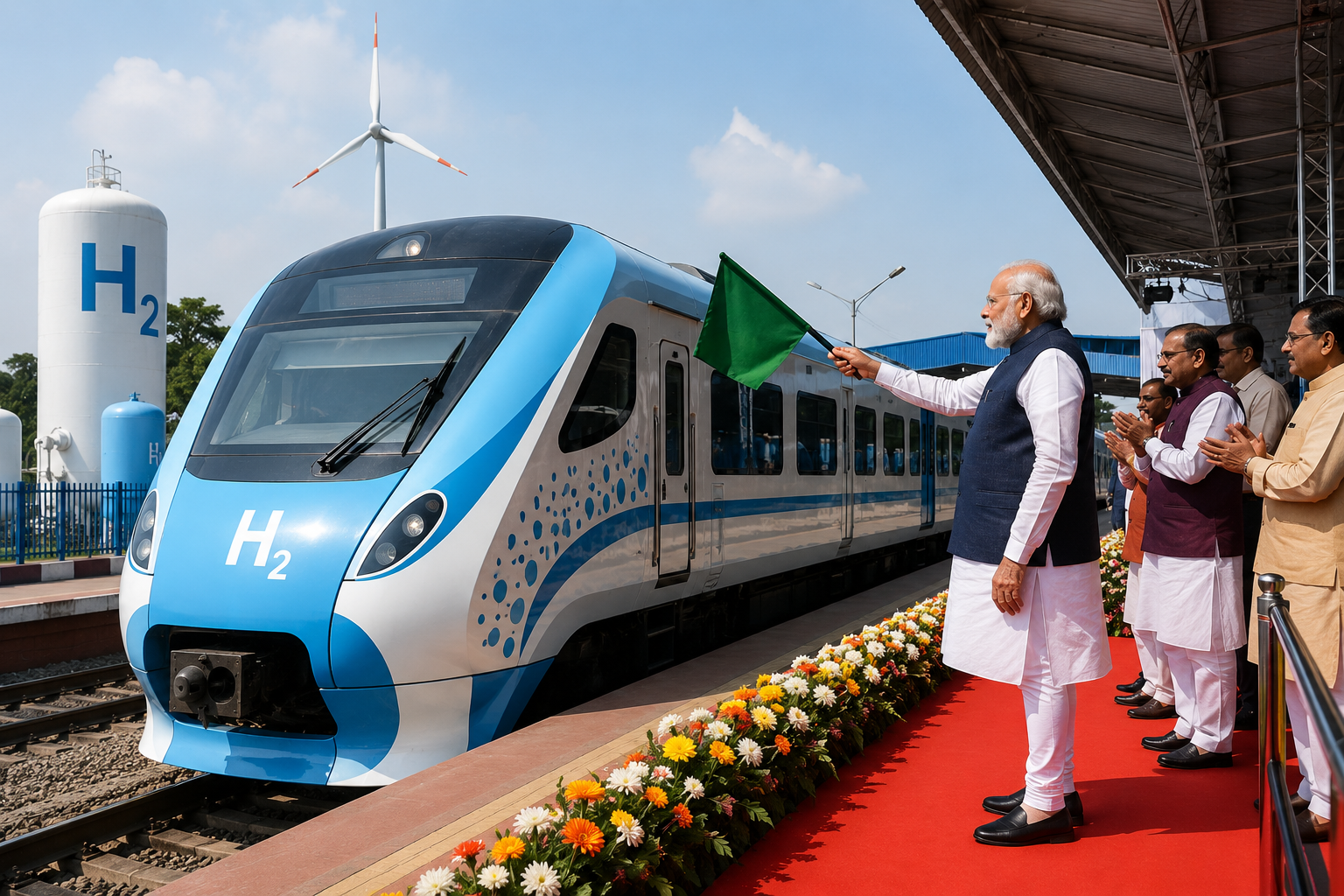
Prime Minister Narendra Modi Flags Off Indigenous Hydrogen Train from Haryana's Jind; Landmark Project Boosts Clean Energy, Railway Innovation and Make in India Vision
India achieved a major milestone in sustainable transportation as Prime Minister Narendra Modi inaugurated the country's first hydrogen-powered passenger train from Jind in Haryana, marking the beginning of a new era in environmentally friendly railway technology. The launch places India among a select group of countries that have successfully deployed hydrogen-powered trains for passenger services and reinforces the government's commitment to clean mobility and energy transition.
The hydrogen-powered train will operate on the 89-kilometre Jind–Sonipat route, completing the journey in nearly two hours while stopping at 12 stations along the route. Developed using indigenous technology, the project represents a significant achievement for Indian Railways and demonstrates the country's growing engineering capabilities in advanced transportation systems.
The launch also aligns with India's broader ambitions under the National Green Hydrogen Mission, which seeks to position the country as a global leader in green hydrogen production and application across multiple sectors.
A Historic Moment for Indian Railways
The inauguration of the hydrogen-powered train marks one of the most significant technological advancements in the history of Indian Railways.
Prime Minister Narendra Modi flagged off the train in the presence of Railway Minister Ashwini Vaishnaw, Haryana Governor Ashim Kumar Ghosh, and Chief Minister Nayab Singh Saini, along with students who participated in the inaugural journey.
Designed, engineered and integrated entirely in India, the train showcases the country's increasing expertise in high-end railway technology and supports the government's Atmanirbhar Bharat initiative aimed at promoting indigenous manufacturing and innovation.
The project also demonstrates Indian Railways' commitment to adopting next-generation technologies that reduce environmental impact while improving operational efficiency.
How Hydrogen Fuel Cell Technology Works
Unlike conventional diesel-powered locomotives, hydrogen trains generate electricity onboard through hydrogen fuel cells.
Inside the fuel cell, hydrogen reacts with oxygen from the atmosphere to produce electricity that powers the train's motors. The only by-product generated during this process is water vapour, making hydrogen trains one of the cleanest forms of railway transportation currently available.
This eliminates harmful emissions such as carbon dioxide, nitrogen oxides, and particulate matter that are typically associated with diesel locomotives.
The technology also offers significantly quieter operations, reducing noise pollution for both passengers and nearby communities.
Key Features of India's First Hydrogen Train
India's hydrogen-powered passenger train incorporates several advanced engineering features that place it among the most capable hydrogen trainsets globally.
Technical Specifications
-
Route: Jind – Sonipat
-
Distance: 89 kilometres
-
Journey Time: Approximately 2 hours
-
Intermediate Stops: 12 stations
-
Coaches: 10
-
Propulsion System: 3,200 Horsepower
-
Fuel: Hydrogen Fuel Cells
-
Emissions: Zero Carbon Emissions During Operation
With a 10-coach configuration, the train is among the longest hydrogen-powered passenger trains developed worldwide.
Its 3,200 HP propulsion system also makes it one of the most powerful hydrogen-powered trainsets currently operating globally.
Environmental Benefits
Hydrogen-powered trains offer several important environmental advantages over traditional diesel locomotives.
Zero Tailpipe Emissions
The fuel cell process produces only water vapour, eliminating carbon emissions during operation.
Lower Air Pollution
Hydrogen trains significantly reduce harmful pollutants that contribute to urban air quality issues.
Reduced Fossil Fuel Dependence
The technology decreases reliance on imported diesel, improving India's long-term energy security.
Lower Noise Levels
Hydrogen trains operate more quietly than conventional diesel locomotives, enhancing passenger comfort while reducing environmental noise pollution.
Supports India's Green Hydrogen Mission
The railway project is closely aligned with India's National Green Hydrogen Mission, launched to accelerate the production and utilization of green hydrogen across the economy.
The mission seeks to:
-
Reduce carbon emissions
-
Promote renewable energy
-
Lower fossil fuel imports
-
Build domestic hydrogen manufacturing capabilities
-
Position India as a global exporter of green hydrogen
Railways represent one of several sectors where hydrogen technology is expected to play an increasingly important role alongside steel, shipping, fertilizers, and heavy transportation.
Reducing Dependence on Railway Electrification
One of the major advantages of hydrogen-powered trains is their ability to operate without continuous overhead electrification infrastructure.
Unlike electric trains that depend on external power supply through overhead wires, hydrogen trains generate electricity onboard using fuel cells.
This makes them particularly suitable for:
-
Remote railway routes
-
Semi-electrified corridors
-
Heritage railway lines
-
Regional passenger services
The technology offers a clean alternative for routes where complete electrification may not be economically feasible.
Economic Opportunities for Indian Industry
The introduction of hydrogen rail technology is expected to stimulate growth across multiple industries.
Potential beneficiaries include:
-
Renewable energy producers
-
Hydrogen manufacturing companies
-
Fuel cell developers
-
Industrial gas companies
-
Railway equipment manufacturers
-
Engineering firms
-
Infrastructure developers
As India's hydrogen economy expands, these sectors could witness significant investment and employment generation.
Boost for 'Make in India'
A major highlight of the project is its indigenous development.
The train has been designed and integrated using Indian engineering expertise, reinforcing the government's vision of strengthening domestic manufacturing capabilities in high-value technology sectors.
Developing advanced railway systems domestically reduces import dependence while creating opportunities for future exports of railway technology.
Indian Railways' Decarbonisation Strategy
Indian Railways has set ambitious sustainability goals, including becoming a Net Zero Carbon Emitter in the coming years.
Hydrogen-powered trains complement several ongoing initiatives, including:
-
Railway electrification
-
Solar power installations
-
Energy-efficient stations
-
Regenerative braking
-
Bio-toilets
-
Green station certification
The adoption of hydrogen technology further diversifies Indian Railways' clean energy portfolio.
Challenges Before Large-Scale Deployment
While the successful launch represents an important milestone, widespread deployment will require addressing several challenges.
These include:
-
Scaling up green hydrogen production
-
Establishing hydrogen refuelling infrastructure
-
Reducing hydrogen production costs
-
Building specialized maintenance facilities
-
Training technical personnel
-
Developing safety protocols for hydrogen storage and transportation
Continued investment and technological advancements will be necessary to achieve commercial scalability.
Global Race Towards Hydrogen Mobility
Hydrogen-powered trains are gradually gaining acceptance worldwide as countries seek low-carbon transportation alternatives.
Several nations have already introduced hydrogen rail systems for regional passenger services, and India's entry into this technology places it among the global leaders investing in next-generation railway solutions.
As clean transportation becomes a priority worldwide, hydrogen technology is expected to play a growing role alongside battery-electric mobility.
Investment Perspective
The successful deployment of hydrogen-powered trains opens new opportunities across several sectors.
Investors may closely monitor companies involved in:
-
Hydrogen production
-
Electrolysers
-
Industrial gases
-
Renewable energy
-
Railway engineering
-
Fuel cell technology
-
Green infrastructure
Government incentives under the Green Hydrogen Mission could accelerate investment in these industries over the coming decade.
Outlook
The launch of India's first hydrogen-powered passenger train represents far more than a technological achievement—it signals the country's determination to build a cleaner, more sustainable transportation ecosystem while strengthening indigenous engineering capabilities. As hydrogen production scales up and infrastructure expands, the technology has the potential to transform railway operations on non-electrified routes and significantly reduce the sector's carbon footprint.
For India's economy, the project supports multiple long-term objectives, including energy security, lower fossil fuel dependence, manufacturing growth, and climate commitments. If backed by continued policy support and investment, hydrogen-powered rail transport could become a cornerstone of India's green mobility strategy and position the country as a global leader in clean transportation innovation.