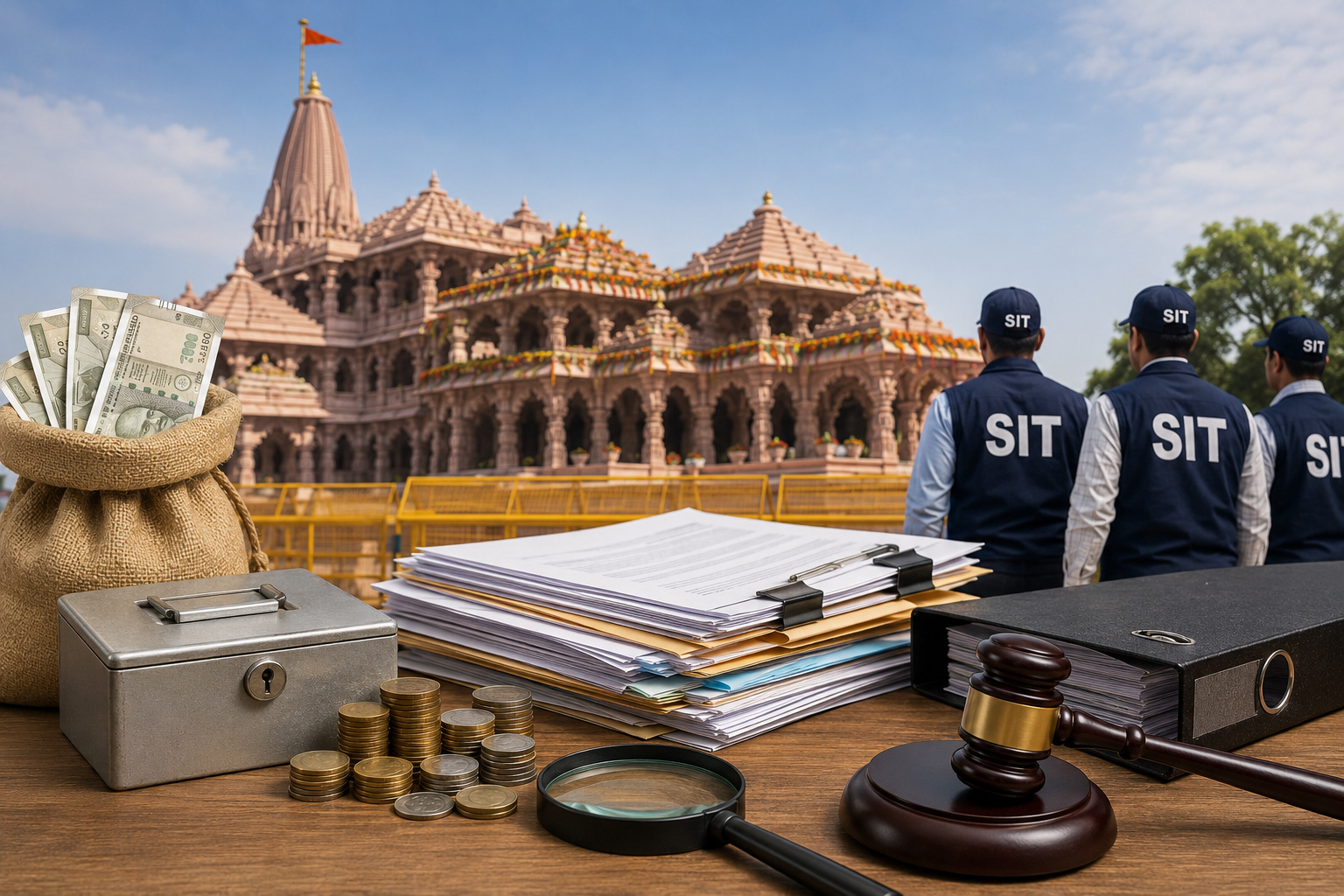
Investigation into Alleged Donation Misappropriation Nears Completion as Temple Trust Prepares to Strengthen Transparency, Financial Controls and Security Protocols
The Special Investigation Team (SIT) constituted to investigate the alleged embezzlement of donations at the Shri Ram Janmabhoomi Temple in Ayodhya is expected to submit its final report to the Uttar Pradesh government shortly, marking a significant development in one of the country's most closely monitored financial investigations involving a major religious institution.
The findings of the report are expected to shape the future administrative and financial governance of the temple, with recommendations likely to focus on improving transparency, strengthening internal controls and enhancing accountability in the management of donations received from millions of devotees every year.
Officials familiar with the investigation indicated that the report could be submitted within the next 24 hours. The recommendations are expected to be discussed extensively during the upcoming meeting of the Shri Ram Janmabhoomi Teerth Kshetra Trust scheduled for July 22, where trustees may consider implementing a series of institutional reforms aimed at preventing similar incidents in the future.
The case has attracted nationwide attention, not only because of the importance of the Ram Temple but also due to growing public expectations regarding transparency and financial governance in charitable and religious institutions.
Investigation Nearing Completion After Two-Month Probe
The Uttar Pradesh government constituted the three-member SIT on June 13 following a request from the Shri Ram Janmabhoomi Teerth Kshetra Trust after allegations of irregularities surfaced in the handling of temple donations.
Originally assigned a 15-day timeline, the investigation was subsequently extended to allow officials to gather additional evidence, examine financial records, review surveillance footage and question individuals connected with the alleged misappropriation.
Sources indicate that:
-
The investigation has entered its final stage.
-
No further extension of the SIT's tenure is expected.
-
The report is likely to provide recommendations on both criminal accountability and systemic reforms.
The completion of the report will mark an important milestone in determining the future course of legal proceedings as well as administrative restructuring.
Purpose of the Investigation Extends Beyond Criminal Liability
While identifying those responsible for the alleged financial misconduct remains one of the primary objectives, the SIT has also been examining weaknesses in the temple's operational systems.
Investigators have reportedly reviewed:
-
Donation collection procedures.
-
Cash handling practices.
-
Counting and reconciliation mechanisms.
-
Internal monitoring systems.
-
CCTV surveillance coverage.
-
Staff responsibilities and supervision.
The recommendations are expected to focus on eliminating operational vulnerabilities while improving financial transparency.
Temple Trust Set to Review Recommendations
The Shri Ram Janmabhoomi Teerth Kshetra Trust is expected to deliberate on the SIT's recommendations during its scheduled meeting later this month.
Discussions are likely to cover:
-
Administrative restructuring.
-
Strengthening financial governance.
-
Enhanced accountability mechanisms.
-
Improved operational protocols.
-
Technology-driven monitoring systems.
Any major policy decisions are expected to be announced after trustees complete their review of the report.
Preliminary Findings Already Led to Significant Action
Earlier during the investigation, the SIT submitted a preliminary report that triggered several immediate developments.
These included:
-
Registration of a criminal case.
-
Arrest of multiple accused individuals.
-
Recovery of allegedly misappropriated cash.
-
Resignation of senior temple trust functionaries.
-
Expansion of the ongoing investigation.
The final report is expected to provide a comprehensive assessment of the alleged irregularities along with recommendations for long-term institutional improvements.
Multiple Arrests and Cash Recovery
Authorities have already made substantial progress during the investigation.
According to officials:
-
Eight individuals have been arrested.
-
Cash allegedly diverted from temple donations has been recovered.
-
Financial records have been scrutinised.
-
Electronic evidence has been examined.
-
Witness statements have been recorded.
Further legal proceedings are expected once the final report is submitted.
Supreme Court Monitoring Adds Further Significance
The matter has also come under judicial scrutiny after petitions seeking an independent and time-bound investigation reached the Supreme Court.
The petitioners have sought various forms of oversight, including:
-
A status report on the ongoing investigation.
-
Greater transparency in financial management.
-
Independent forensic examination.
-
Audit of trust finances.
-
Court-monitored investigation.
The Supreme Court has directed the SIT to submit a status report while continuing to hear petitions related to the matter.
Judicial oversight has further increased public attention on the investigation and its eventual findings.
Temple Trust Introduces Immediate Corrective Measures
Even before the investigation concludes, the temple trust has initiated several operational reforms designed to strengthen security and improve accountability.
The proposed measures include:
Pocketless Uniforms for Cash Handlers
Personnel involved in handling donations will wear specially designed uniforms without pockets to reduce the possibility of concealment.
Complete CCTV Surveillance
Blind spots within donation counting areas are being eliminated to ensure continuous monitoring of cash-handling activities.
Improved Cash Counting Procedure
Cash counting will now be conducted on designated floor mats instead of tables to improve visibility and supervision.
Joint Supervision During Counting
The process will require the mandatory presence of:
-
Two representatives from the temple trust.
-
Two officials from the State Bank of India.
Security Screening
Individuals entering and exiting cash-counting areas will undergo mandatory frisking procedures.
These initiatives aim to minimise operational risks while improving public confidence.
Growing Focus on Governance in Religious Institutions
The controversy has sparked broader discussions about governance standards in large charitable and religious organisations that receive significant public donations.
Financial governance experts increasingly recommend:
-
Digital accounting systems.
-
Independent internal audits.
-
Automated reconciliation.
-
Multi-layer approval mechanisms.
-
Stronger surveillance infrastructure.
-
Regular compliance reviews.
Such practices are becoming increasingly important as donation volumes continue to grow.
Importance of Transparency for Public Trust
Religious institutions depend heavily on public confidence.
Experts believe transparent financial practices help:
-
Protect charitable contributions.
-
Improve operational efficiency.
-
Reduce opportunities for fraud.
-
Strengthen institutional credibility.
-
Encourage greater public participation.
The current investigation is expected to accelerate the adoption of stronger governance frameworks across major religious organisations.
Possible Long-Term Reforms
The SIT's recommendations may encourage broader institutional reforms beyond the Ram Temple.
Potential changes could include:
-
Digital donation management.
-
Automated cash reconciliation systems.
-
Independent audit committees.
-
Technology-based inventory and cash tracking.
-
Periodic compliance inspections.
-
Enhanced banking integration.
Such measures could become benchmarks for governance across other large religious trusts.
Key Developments So Far
The investigation has already resulted in several notable developments:
-
Formation of a Special Investigation Team.
-
Submission of a preliminary report.
-
Registration of an FIR.
-
Arrest of eight accused.
-
Recovery of alleged embezzled funds.
-
Resignation of senior trust officials.
-
Implementation of immediate administrative safeguards.
-
Ongoing Supreme Court oversight.
Further legal action is expected after authorities review the final report.
Outlook
The completion of the Special Investigation Team's inquiry represents a crucial turning point for the Shri Ram Janmabhoomi Temple's governance framework. While the investigation seeks to establish accountability for the alleged financial irregularities, its broader significance lies in the opportunity to strengthen transparency, internal controls and financial management within one of India's most prominent religious institutions.
As the temple continues to receive substantial donations from devotees across the country and abroad, adopting stronger governance practices will be essential to maintaining public trust. If the recommendations are implemented effectively, the reforms could serve as a model for other charitable and religious organisations, demonstrating how robust oversight and modern financial systems can safeguard public contributions while enhancing institutional credibility.