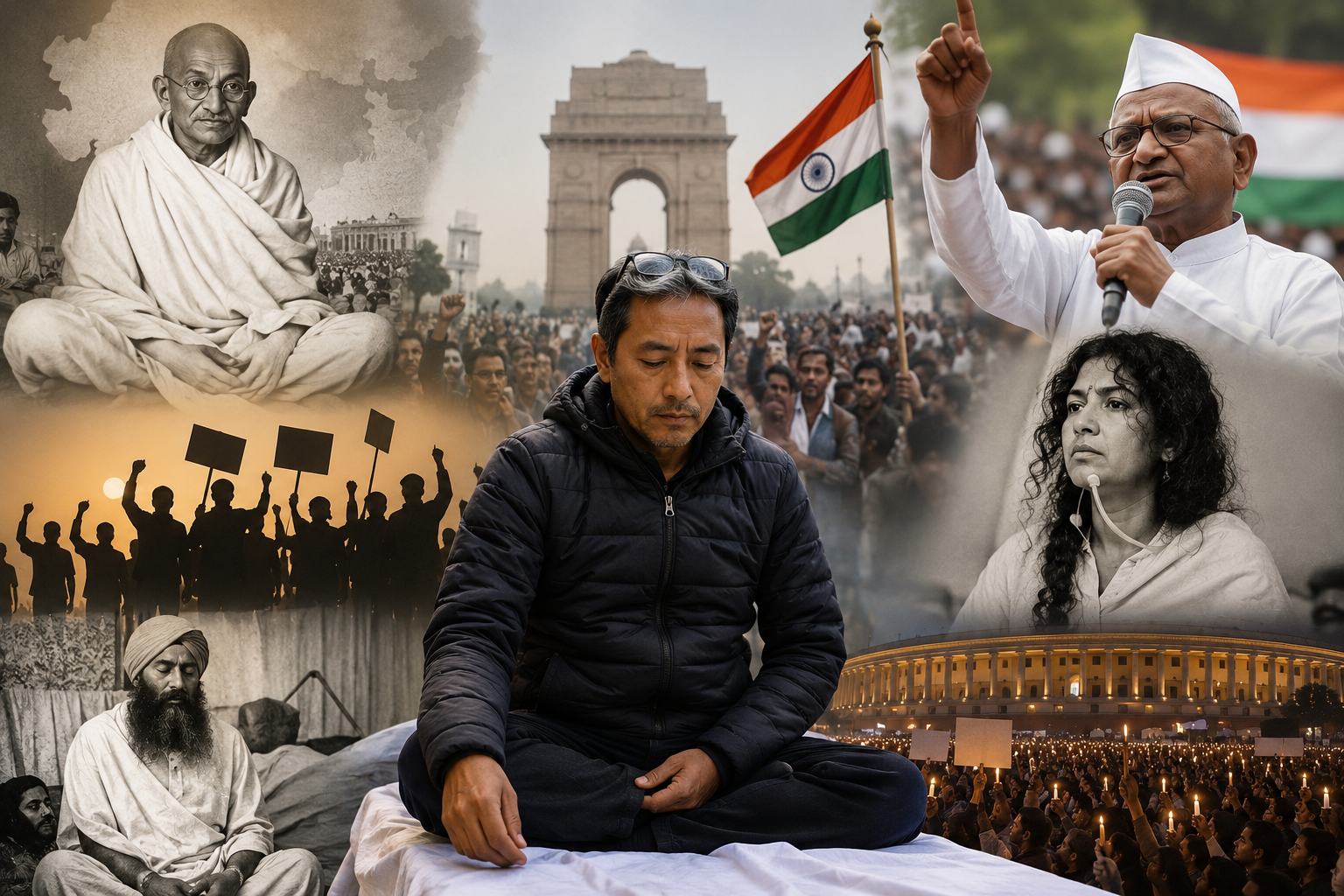
From Potti Sriramulu's Statehood Movement to Anna Hazare's Anti-Corruption Campaign and Sonam Wangchuk's Ongoing Protest, Hunger Strikes Have Left a Lasting Mark on India's Democracy
Hunger strikes have occupied a unique place in India's democratic tradition, serving as one of the most powerful forms of peaceful protest. Inspired by the philosophy of non-violence championed during the freedom movement, fasting has often been used by social reformers, political leaders and activists to highlight issues that they believe require urgent government attention.
The latest chapter in this long history is the indefinite hunger strike by education reformer and environmental activist Sonam Wangchuk, whose protest has once again sparked a nationwide discussion about the role of peaceful civil resistance in shaping public policy. While the outcome of his campaign remains uncertain, India's history offers several examples where prolonged fasts significantly influenced governance, legislation, state formation and public consciousness.
From the creation of Andhra Pradesh to landmark anti-corruption reforms and environmental activism, hunger strikes have repeatedly demonstrated their ability to mobilise citizens and influence decision-makers.
The Tradition of Fasting as Democratic Protest
Long before Independence, fasting emerged as a moral instrument of protest through Mahatma Gandhi's philosophy of non-violent resistance. Rather than relying on confrontation, hunger strikes sought to appeal to the conscience of both the government and society.
After 1947, this method continued to evolve as citizens used peaceful fasting to demand administrative reforms, social justice, environmental protection and political accountability.
Although every hunger strike has not resulted in immediate success, many have reshaped national conversations and influenced policy over the long term.
Why Hunger Strikes Continue to Matter
Unlike demonstrations or political campaigns, hunger strikes involve a high degree of personal sacrifice, often drawing widespread public sympathy and media attention.
Their effectiveness generally depends on several factors:
-
Public support.
-
Media coverage.
-
Political environment.
-
Government willingness to negotiate.
-
The broader significance of the issue being raised.
History shows that when these elements align, hunger strikes can become powerful catalysts for change.
Sonam Wangchuk Revives Debate on Peaceful Protest
Education innovator and environmental activist Sonam Wangchuk has once again brought hunger strikes into the national spotlight through his ongoing fast at Delhi's Jantar Mantar.
The protest has generated extensive public discussion regarding education, governance and democratic accountability while also drawing comparisons with earlier landmark movements.
Medical experts have warned about the health risks associated with prolonged fasting, underscoring the seriousness of such protests.
Whether the campaign ultimately succeeds or not, it has already revived interest in India's long tradition of non-violent civic activism.
Potti Sriramulu: The Hunger Strike That Created Andhra State
One of the most influential hunger strikes in independent India was undertaken by freedom fighter Potti Sriramulu.
Objective
Demand the creation of a separate state for Telugu-speaking people.
Duration
58 days.
Following his death in 1952, widespread protests erupted across southern India, compelling the central government to announce the formation of Andhra State in 1953.
The movement later became the foundation for India's linguistic reorganisation of states, fundamentally reshaping the country's administrative map.
Darshan Singh Pheruman's Campaign for Punjab
In 1969, Sikh leader Darshan Singh Pheruman launched a fast demanding the transfer of Chandigarh and Punjabi-speaking regions to Punjab.
Key Objective
Implementation of pending issues following Punjab's reorganisation.
Duration
74 days.
Although his principal demands remained unresolved, the protest became an enduring symbol of political commitment and highlighted regional aspirations within India's federal structure.
Irom Sharmila's 16-Year Fight for Human Rights
Perhaps the world's longest political hunger strike was undertaken by Irom Sharmila, often called the "Iron Lady of Manipur."
Cause
Repeal of the Armed Forces (Special Powers) Act (AFSPA).
Duration
November 2000 to August 2016.
Her protest followed the Malom incident in Manipur and drew international attention to human rights concerns in India's northeastern region.
Although AFSPA was not repealed during her fast, her campaign became a globally recognised symbol of peaceful resistance and civil rights advocacy.
Anna Hazare and the Anti-Corruption Movement
In 2011, social activist Anna Hazare launched one of the largest public movements in post-independence India.
Primary Demand
A stronger anti-corruption law through the Jan Lokpal Bill.
His hunger strike rapidly evolved into a nationwide campaign supported by millions of citizens, civil society organisations, professionals and students.
The movement intensified public pressure on policymakers and ultimately contributed to the enactment of the Lokpal and Lokayuktas Act, 2013, strengthening India's anti-corruption framework.
Swami Nigamananda's Environmental Campaign
Environmental activist Swami Nigamananda undertook a prolonged hunger strike against illegal mining along the Ganga River.
Cause
Illegal sand mining and environmental degradation.
Duration
115 days.
His protest brought national attention to environmental conservation and prompted authorities to increase action against illegal mining activities, while also highlighting the growing role of environmental activism in India.
Common Threads Across Historic Hunger Strikes
Despite addressing diverse issues, India's major hunger strikes share several important characteristics.
Non-Violent Resistance
Each movement relied on peaceful protest rather than confrontation.
Personal Sacrifice
The willingness of protesters to risk their health often generated significant public sympathy.
Mass Public Participation
Movements that attracted broader citizen support generally exerted greater influence on policymakers.
Media Amplification
Extensive media coverage helped transform local issues into national debates.
How Public Opinion Shapes Outcomes
Historical experience suggests that the success of hunger strikes depends as much on public engagement as on the protest itself.
Movements such as those led by Potti Sriramulu and Anna Hazare succeeded because they resonated with wider sections of society and created sustained public pressure.
In contrast, some equally determined protests achieved limited policy outcomes despite extraordinary personal sacrifice.
The Digital Era Has Changed Protest Movements
Modern hunger strikes operate in a vastly different environment compared with earlier decades.
Today, digital platforms and social media allow protests to:
-
Reach national audiences instantly.
-
Generate widespread public engagement.
-
Encourage real-time debate.
-
Increase transparency.
-
Mobilise supporters more quickly.
This digital amplification has transformed the way peaceful movements evolve and influence public discourse.
The Democratic Significance of Peaceful Protest
Hunger strikes continue to demonstrate the importance of peaceful civic engagement in a democratic society.
Rather than relying solely on electoral politics or legal challenges, they offer citizens another avenue to raise issues of public concern and encourage dialogue between governments and society.
Their legacy extends beyond immediate outcomes, often inspiring future movements and influencing broader democratic culture.
Lessons for Policymakers and Citizens
Historic hunger strikes highlight several important lessons:
-
Public trust remains central to democratic governance.
-
Peaceful dialogue can be more effective than confrontation.
-
Timely engagement with public concerns may prevent prolonged conflicts.
-
Civic participation continues to play a vital role in policy development.
These lessons remain relevant as India navigates increasingly complex social, environmental and governance challenges.
Outlook
India's history of hunger strikes illustrates the enduring strength of non-violent democratic protest. From Potti Sriramulu's sacrifice that led to the creation of Andhra State to Anna Hazare's anti-corruption campaign and Irom Sharmila's global human rights movement, these fasts have shaped public policy, influenced legislation and strengthened democratic debate.
As Sonam Wangchuk's ongoing hunger strike attracts national attention, its eventual impact will depend on public support, constructive dialogue and the government's response. Regardless of the immediate outcome, India's democratic history shows that peaceful protests often leave a lasting legacy, reminding both citizens and policymakers that meaningful change can emerge through perseverance, public participation and non-violent civic action.