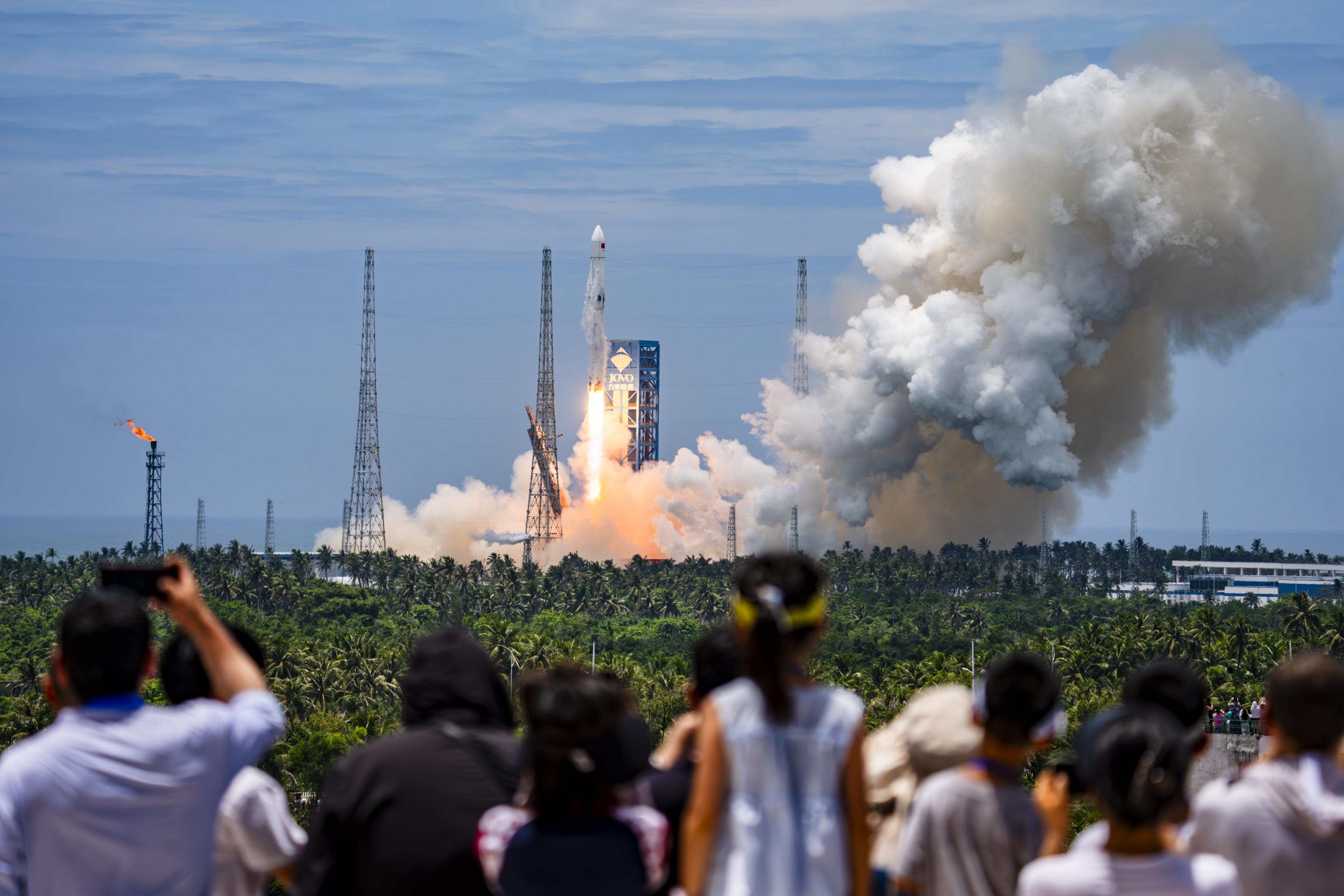
Milestone Places China Among Global Leaders in Reusable Space Technology as Nation Advances Lunar Missions, Commercial Launch Services and Long-Term Space Exploration Goals
China has successfully completed the controlled recovery of an orbital-class reusable rocket booster following the maiden flight of its Long March-10B launch vehicle, marking a watershed moment in the country's rapidly advancing space programme. The achievement represents China's first successful recovery of the first stage of an orbital-class carrier rocket and is widely regarded as one of the most significant milestones in its efforts to develop reusable launch technology.
The successful mission brings China closer to joining an elite group of spacefaring nations capable of routinely recovering and reusing large rocket boosters—a technology that has fundamentally transformed the economics of space exploration over the past decade. While the United States, led by SpaceX, pioneered reusable orbital rocket recovery in 2015, China's latest success demonstrates its accelerating progress in narrowing the technological gap and strengthening its position in the increasingly competitive global space industry.
The breakthrough is expected to play a crucial role in supporting China's ambitious plans for lunar exploration, satellite deployment, commercial launch services, deep-space missions and the long-term development of a sustainable space economy.
A Major Leap for China's Space Programme
The successful recovery of the Long March-10B booster marks the beginning of a new era for China's launch capabilities.
Until now, most Chinese launch vehicles were designed as expendable rockets, meaning that expensive first-stage boosters were discarded after every launch.
The ability to recover these boosters significantly changes the economics of future missions by enabling hardware reuse, reducing manufacturing costs and shortening launch preparation cycles.
The milestone demonstrates China's growing expertise in advanced propulsion systems, autonomous navigation, flight control software and precision landing technologies.
Why Reusable Rockets Matter
Reusable rockets have become one of the most revolutionary innovations in modern aerospace engineering.
Traditionally, launch vehicles were designed for single-use missions, requiring entirely new rockets for every satellite deployment or space mission.
Reusable launch systems allow expensive rocket stages to return safely after launch, undergo inspection and refurbishment, and then fly again on future missions.
This approach offers multiple advantages:
-
Lower launch costs.
-
Higher launch frequency.
-
Reduced manufacturing expenses.
-
Improved operational efficiency.
-
Faster mission turnaround.
-
Greater commercial competitiveness.
As global demand for satellite launches continues to grow, reusable rockets are becoming increasingly essential for both government and commercial space programmes.
How Booster Recovery Works
Recovering an orbital-class rocket booster is one of the most technically demanding tasks in aerospace engineering.
After separating from the upper stage during ascent, the booster must perform several complex manoeuvres.
These include:
-
Reorienting itself in flight.
-
Restarting its engines.
-
Managing hypersonic descent.
-
Maintaining aerodynamic stability.
-
Executing precision guidance.
-
Performing a controlled landing.
Each phase requires sophisticated onboard computers, advanced sensors, autonomous flight software and highly reliable propulsion systems.
The successful completion of these operations demonstrates a high degree of technological maturity.
Long March-10B: A Next-Generation Launch Vehicle
The Long March-10B has been developed as part of China's next generation of launch vehicles designed to support increasingly ambitious space missions.
The rocket is expected to play an important role in:
-
Human spaceflight.
-
Lunar exploration.
-
Space station logistics.
-
Scientific satellite launches.
-
Deep-space exploration.
-
Commercial launch services.
Reusable first-stage capability significantly enhances the long-term operational efficiency of the launch system while reducing mission costs.
Closing the Gap with Global Space Leaders
China's achievement comes more than ten years after SpaceX successfully landed the first stage of its Falcon 9 rocket in December 2015.
That achievement transformed the global launch industry by proving that reusable orbital rockets could operate reliably and economically.
Since then, reusable rockets have become central to commercial launch economics, enabling more frequent launches while dramatically lowering costs.
China's successful booster recovery signals its determination to establish similar capabilities through domestically developed technology and engineering expertise.
Supporting China's Lunar Ambitions
Reusable launch systems are expected to become a cornerstone of China's long-term space strategy.
The country has outlined ambitious objectives that include:
-
Crewed Moon landings.
-
Permanent lunar research facilities.
-
Expanded Tiangong Space Station operations.
-
Mars exploration missions.
-
Asteroid exploration.
-
Deep-space scientific research.
Lower launch costs made possible through reusable rockets will improve the financial sustainability of these programmes over the coming decades.
Commercial Space Industry Set to Benefit
China's rapidly expanding commercial aerospace sector is also expected to benefit from reusable launch technology.
Private and state-backed space companies are increasingly investing in:
-
Satellite launch services.
-
Earth observation satellites.
-
Broadband satellite constellations.
-
Rocket manufacturing.
-
Space transportation.
-
Reusable propulsion systems.
The successful recovery of Long March-10B provides valuable technological experience that could accelerate innovation throughout China's broader commercial space ecosystem.
Economic Importance of Reusability
Reusable rockets have transformed the economics of space exploration by significantly lowering the cost of reaching orbit.
Reduced launch costs encourage:
-
More frequent satellite deployments.
-
Expansion of broadband connectivity.
-
Climate monitoring missions.
-
Scientific research.
-
Commercial manufacturing in space.
-
National security applications.
As launch prices continue to decline, new commercial business models become economically viable, further expanding the global space economy.
Strategic Importance Beyond Commercial Launches
Reusable launch capability also carries important strategic implications.
Independent access to space has become increasingly important for:
-
National security.
-
Satellite communications.
-
Navigation systems.
-
Weather forecasting.
-
Disaster management.
-
Earth observation.
-
Defence infrastructure.
Countries possessing advanced reusable launch technology strengthen both their technological leadership and strategic autonomy.
Technical Challenges Remain
Although the successful recovery represents a major breakthrough, developing a fully operational reusable launch system remains a long-term process.
China must now demonstrate:
-
Consistent booster recoveries.
-
Multiple successful reuse cycles.
-
Rapid refurbishment capability.
-
High launch reliability.
-
Cost-effective operations.
-
Commercial scalability.
Operational experience accumulated over repeated missions will ultimately determine the economic benefits of the technology.
Global Competition in Space Intensifies
The race to develop reusable rockets has become one of the defining themes of the modern space industry.
Governments and private companies worldwide continue investing heavily in:
-
Advanced propulsion.
-
Artificial intelligence.
-
Autonomous flight systems.
-
Composite materials.
-
Precision manufacturing.
-
Space infrastructure.
China's latest success is expected to intensify competition in the global commercial launch market while accelerating technological innovation across the aerospace sector.
Future Growth Opportunities
The reusable launch ecosystem creates opportunities across multiple industries.
Potential beneficiaries include:
-
Aerospace manufacturers.
-
Satellite companies.
-
Advanced materials producers.
-
Semiconductor suppliers.
-
Artificial intelligence developers.
-
Robotics companies.
-
Precision engineering firms.
-
Space communications providers.
As launch costs decline, demand for these technologies is expected to increase substantially.
Long-Term Outlook
The global space economy is projected to expand rapidly over the coming decades, driven by increasing demand for satellite communications, Earth observation, navigation services, scientific research and commercial space activities.
Reusable launch systems are expected to become one of the foundational technologies supporting this growth.
China's latest achievement demonstrates that reusable rockets are no longer limited to a handful of private aerospace companies but are becoming an increasingly important strategic capability for major space powers.