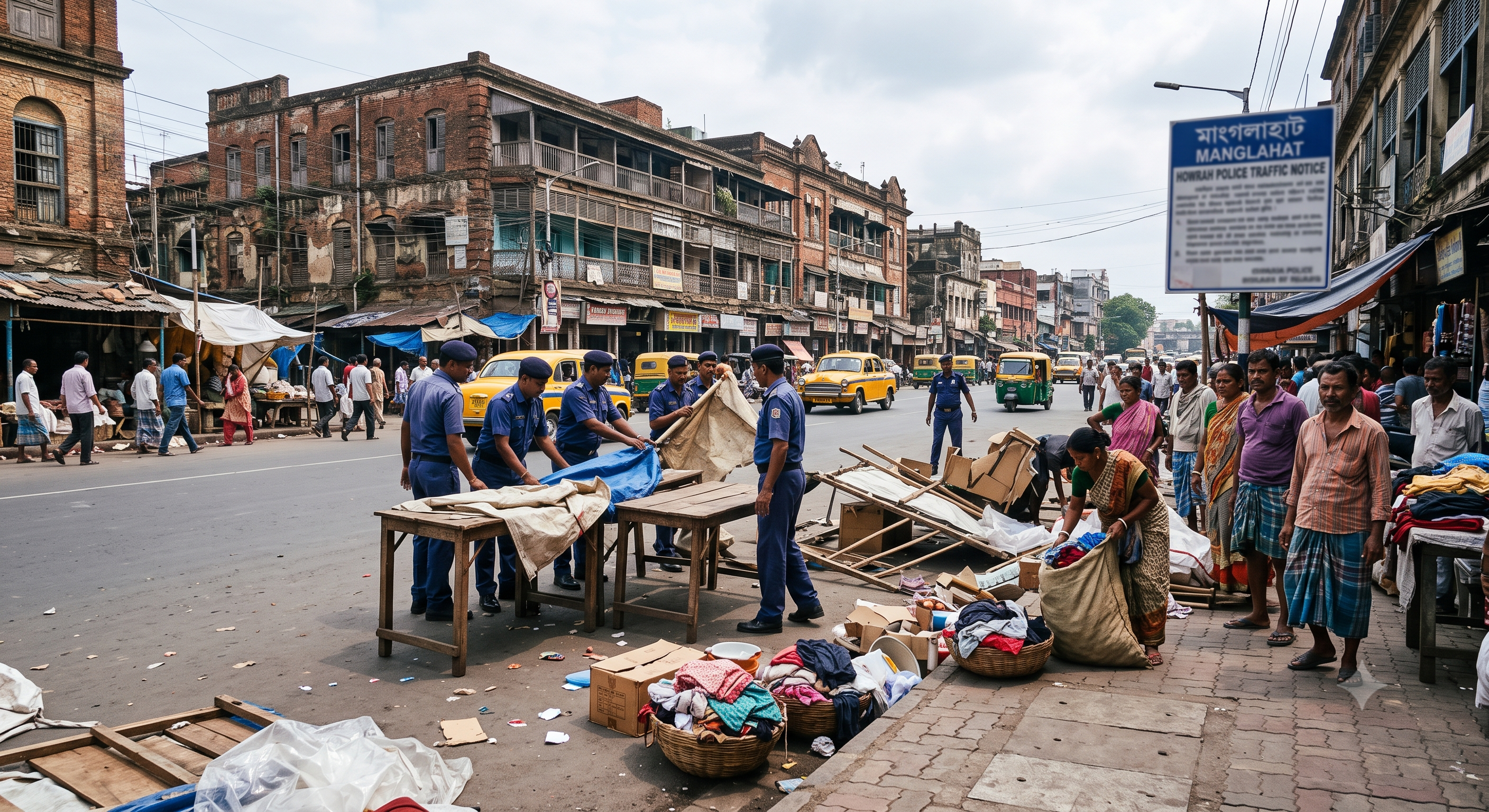
Court Says Hawkers Must Establish Legal Rights; Affidavits Sought From Both Sides in Century-Old Howrah Market Dispute
The Calcutta High Court has declined to provide interim relief to hawkers operating at the historic Manglahat market in Howrah, allowing police authorities to continue action aimed at maintaining road and pavement space.
The order came after the Howrah Hawkers' Samity approached the court alleging excessive action by police officials and seeking protection against eviction and disruption of their businesses.
Justice Saugata Bhattacharyya refused to issue an interim order restraining police action, observing that the hawkers’ association had not been able to establish, at the preliminary stage, a clear right to continue business activities while occupying public roads and pavements.
The court directed all parties to submit affidavits and decided to examine the matter further based on detailed submissions.
Hawkers Challenge Police Action in Howrah
The dispute relates to Manglahat, one of Howrah’s oldest trading areas, where hundreds of small vendors have traditionally conducted business.
The hawkers’ association alleged that police authorities were taking excessive measures against vendors, affecting their livelihoods and daily earnings.
Seeking legal protection, the association requested the court to prevent authorities from removing hawkers or interfering with their businesses until a final decision was reached.
The petition highlighted the historical presence of hawkers in the area and argued that many families depend on these businesses for their livelihood.
Court Balances Livelihood Rights and Public Access
While hearing the matter, the High Court considered the competing interests involved in the dispute.
On one hand, street vendors depend on public spaces for their economic survival. On the other hand, roads and pavements serve an essential public purpose by allowing movement of vehicles and pedestrians.
The court observed that the association had failed to demonstrate a prima facie legal entitlement to continue hawking activities in a way that obstructs public pathways.
The judge refused to issue any immediate order stopping police action related to maintaining public roads and pedestrian spaces.
Street Vendors’ Rights vs Urban Management Challenges
The Manglahat dispute reflects a wider challenge faced by urban authorities across India — managing the balance between informal employment and organised city planning.
Street vending provides income opportunities to millions of people, but unregulated occupation of public spaces often leads to concerns related to:
-
Traffic congestion
-
Pedestrian movement
-
Emergency access
-
Public hygiene and safety
-
Urban infrastructure management
Authorities frequently face the challenge of ensuring that enforcement measures do not unfairly impact vulnerable groups while maintaining public order.
Legal Framework Governing Street Hawkers
Street vendors in India are governed under the Street Vendors (Protection of Livelihood and Regulation of Street Vending) Act, 2014, which aims to protect the livelihood rights of vendors while regulating vending activities.
The law provides mechanisms such as:
-
Town vending committees
-
Identification of authorised vendors
-
Regulation of vending zones
-
Protection against arbitrary eviction
However, disputes often arise over implementation, licensing, relocation and use of public spaces.
The Howrah case is expected to examine whether the affected vendors have valid rights or permissions under applicable regulations.
Police Action Focuses on Road and Pavement Clearance
Authorities have maintained that steps are necessary to ensure proper use of roads and pavements.
Urban areas frequently experience pressure due to increasing population, rising traffic and limited public space.
Officials argue that maintaining clear pathways is important for:
-
Smooth traffic movement
-
Pedestrian safety
-
Emergency services access
-
Better urban management
The court’s refusal to restrict police action indicates that public infrastructure concerns will remain an important factor during the proceedings.
Next Hearing: Parties Asked to File Detailed Responses
The High Court has directed both sides to submit affidavits explaining their respective positions.
The court is likely to consider issues including:
-
Whether vendors possess legal authorisation to operate
-
Whether alternative arrangements are available
-
The extent of obstruction caused by vending activities
-
Responsibilities of civic authorities
The next stage of proceedings will determine how the court balances livelihood concerns with public interest.
Conclusion: Court Seeks Fair Balance Between Livelihood and Public Space
The Calcutta High Court’s decision does not end the dispute but sets the direction for further legal examination.
While recognising the importance of livelihood opportunities, the court has also highlighted the need to protect public roads and pedestrian spaces.
The Manglahat case could become significant for similar disputes involving street vendors, urban development and the management of public areas across cities.