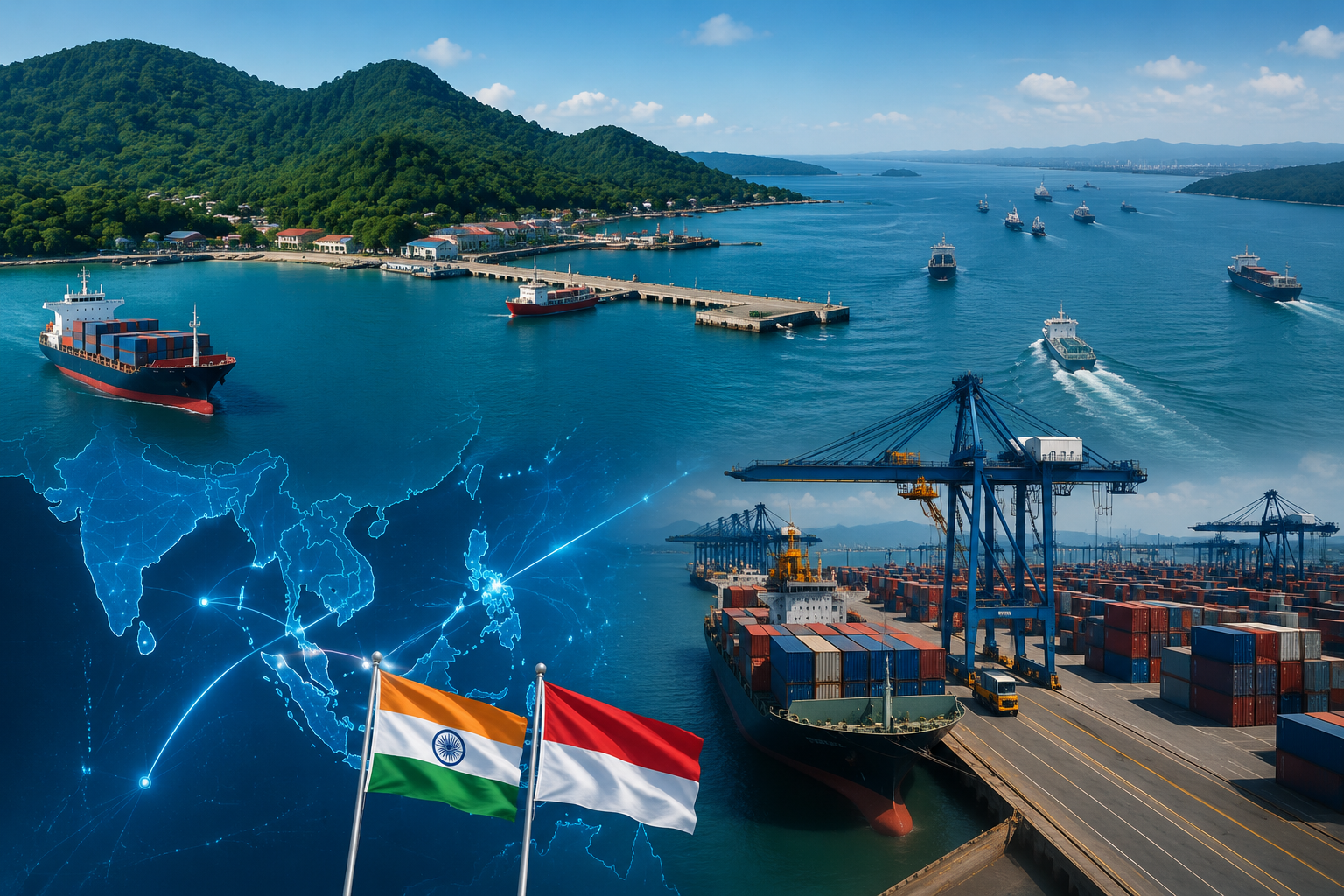
India-Indonesia partnership around Sabang Port could reshape regional trade, connectivity and Indo-Pacific strategy
India is strengthening its maritime ambitions with renewed focus on the development of Sabang Port in Indonesia, a strategically located facility near the Strait of Malacca, one of the world’s most important maritime trade routes.
The proposed cooperation between India and Indonesia is expected to enhance regional connectivity, support commercial shipping, and strengthen strategic coordination in the Indo-Pacific region. The project aligns with India’s long-term vision of expanding economic engagement with Southeast Asia under the Act East Policy while improving its maritime presence across key sea lanes.
Sabang Port: A Strategic Location Near Global Shipping Routes
Located on Weh Island in Indonesia’s Aceh province, Sabang Port occupies a highly advantageous position at the northern entrance of the Strait of Malacca.
The Strait of Malacca is a critical maritime corridor connecting the Indian Ocean with the South China Sea and the Pacific Ocean. It serves as a major route for global energy shipments, manufacturing trade, and container movement.
The port’s location gives it strategic importance because it sits close to one of the busiest shipping lanes in the world, where thousands of vessels pass every year.
For India, access and cooperation around Sabang provide an opportunity to deepen maritime links with Southeast Asia while supporting trade and security objectives.
Connecting India’s Great Nicobar Project with Southeast Asia
One of the major strategic advantages of Sabang Port is its proximity to India’s upcoming transshipment infrastructure at Great Nicobar Island.
The two locations are separated by a relatively short maritime distance, creating possibilities for a future regional shipping corridor connecting the eastern Indian Ocean with Southeast Asian markets.
A stronger link between Great Nicobar and Sabang could help India develop an alternative maritime network that improves cargo movement, reduces logistics costs, and strengthens its role in regional trade.
Why the Strait of Malacca Matters for Global Trade
The Strait of Malacca plays a vital role in international commerce. It acts as a gateway between major Asian economies and global markets.
The route is particularly important because:
-
A large volume of global trade passes through the waterway.
-
It is a key route for crude oil and LNG shipments.
-
Major economies depend on uninterrupted maritime movement through the region.
-
Any disruption could impact shipping costs and supply chains worldwide.
With increasing geopolitical competition in the Indo-Pacific, countries are focusing on securing reliable maritime connectivity and developing strategic partnerships.
Economic Potential of Sabang Port Development
The development of Sabang Port could create significant economic opportunities for India, Indonesia, and the wider region.
The port has the potential to support:
Regional Transshipment Hub
Sabang could emerge as a regional transshipment destination, allowing cargo from different countries to be consolidated and redistributed efficiently.
Growth in Maritime Trade
The port could facilitate movement of:
-
Containers
-
Petroleum products
-
Coal
-
Iron ore
-
Fertilisers
-
Agricultural commodities
This could improve trade efficiency between South Asia and Southeast Asia.
Tourism and Local Economic Growth
Improved connectivity could also benefit tourism, fisheries, and local businesses in Indonesia’s Aceh province while encouraging greater people-to-people exchanges between India and Indonesia.
Strategic Importance for India’s Maritime Security
The importance of Sabang extends beyond commercial activities.
The port could support India’s maritime operations by providing logistical advantages in the eastern Indian Ocean region. Possible areas of cooperation include:
-
Maritime surveillance support
-
Humanitarian assistance and disaster relief operations
-
Naval logistics and maintenance activities
-
Regional security coordination
The initiative reflects India’s broader approach of strengthening partnerships rather than relying only on traditional defence arrangements.
Part of India’s Expanding Indo-Pacific Strategy
The Sabang project fits into India’s larger Indo-Pacific framework, which focuses on maintaining open sea routes, encouraging regional cooperation, and promoting secure maritime trade.
India has been expanding cooperation with countries across Southeast Asia as competition for influence in the region increases.
The development of strategic infrastructure partnerships allows India to strengthen economic ties while ensuring greater participation in regional maritime affairs.
India-Indonesia Relations Enter a New Phase
India and Indonesia have shared a growing strategic partnership, particularly in areas such as defence, trade, and maritime cooperation.
While discussions around Sabang began several years ago, progress had been gradual. The renewed focus indicates stronger political commitment from both nations to accelerate cooperation.
The project also complements broader initiatives involving infrastructure development, defence collaboration, and regional connectivity.
Challenges Ahead for the Sabang Project
Despite its strategic potential, the project will require careful execution.
Key challenges include:
-
Large-scale infrastructure investment requirements
-
Environmental considerations
-
Coordination between multiple stakeholders
-
Ensuring commercial viability
-
Managing regional geopolitical sensitivities
Successful implementation will depend on long-term planning, investment, and cooperation between India and Indonesia.
Conclusion: Sabang Could Become a Key Maritime Asset for India
Sabang Port represents an important step in India’s journey towards becoming a stronger maritime power.
With its location near the Strait of Malacca, connectivity with the Great Nicobar project, and potential role in regional trade, the port could become a valuable asset for India’s economic and strategic interests.
As competition in the Indo-Pacific continues to grow, infrastructure partnerships like Sabang could play a crucial role in shaping the future of regional connectivity, trade security, and maritime cooperation.