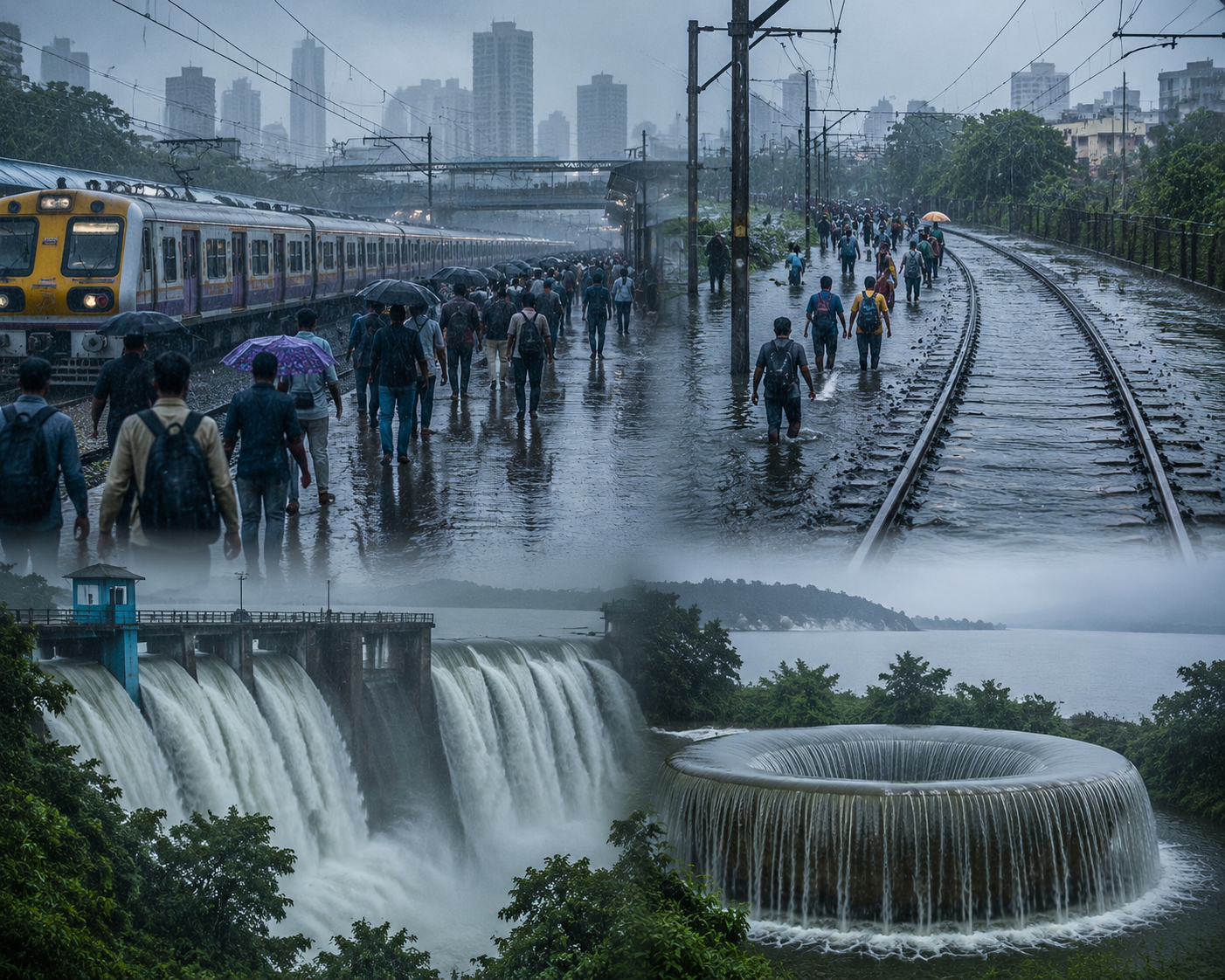
Heavy monsoon showers disrupt suburban rail network, affect Gujarat and Pune routes; Mumbai reservoirs receive strong inflows
Mumbai witnessed another spell of intense monsoon activity on Wednesday as heavy rainfall accompanied by thunderstorms disrupted transport services, affected railway operations and caused inconvenience to thousands of commuters.
The downpour led to waterlogging at multiple locations, delayed suburban train services and impacted long-distance train movement towards Gujarat and Pune. At the same time, strong rainfall in catchment areas resulted in Tulsi Lake and Vihar Lake overflowing, improving the city’s water storage position.
While the rainfall provided relief to Mumbai’s reservoirs, authorities remained focused on managing infrastructure challenges caused by heavy showers.
Heavy Rainfall Disrupts Mumbai’s Suburban Train Network
Mumbai’s suburban railway system, considered the backbone of daily transportation for millions of residents, faced delays due to rain-related issues.
Services on both major railway networks:
-
Central Railway
-
Western Railway
were running late by around 25 to 30 minutes.
The delays affected thousands of office-goers travelling during morning peak hours.
Despite disruptions, metro services and public buses continued operating normally, providing alternative transportation options for commuters.
Vasai-Virar Flooding Leaves Passengers Stranded
One of the most affected sections was the Vasai-Virar railway corridor in Palghar district, where waterlogging disrupted train movement.
Western Railway temporarily suspended suburban services beyond Vasai Road after floodwaters rose above track levels.
Several passengers were stranded, and videos circulated showing commuters walking along flooded railway tracks using mobile phone flashlights.
Some passengers reportedly used alternative transport options, including tractors, to move between affected areas.
The disruption highlighted the challenges faced by Mumbai’s transport infrastructure during periods of extreme rainfall.
Long-Distance Train Services Towards Gujarat Hit
Heavy rainfall also impacted long-distance rail connectivity between Mumbai, Gujarat and other regions.
Waterlogging near railway infrastructure in south Gujarat affected mail and express train movement.
According to railway authorities:
-
39 trains were cancelled
-
21 trains were short-terminated
-
46 trains were rescheduled
Train operations near Sachin station in Surat were temporarily affected due to water accumulation near a bridge area.
Services resumed after water levels reduced and safety inspections were completed.
Mumbai-Pune Rail Route Still Recovering After Landslide
The Mumbai-Pune railway route continued facing challenges following a landslide in the Bhor Ghat section between Karjat and Lonavala earlier in the week.
Restoration work remained underway, affecting several long-distance services.
Railway authorities took measures such as:
-
Diverting trains
-
Cancelling selected services
-
Short-terminating trains
to ensure passenger safety.
Track Damage Near Neral Restored by Central Railway
Heavy rainfall also affected railway infrastructure between Neral and Shelu stations in Raigad district.
The ballast beneath the tracks was washed away due to intense rainfall during early morning hours.
Railway teams detected the issue around 4 AM and immediately began repair work.
According to railway officials, both tracks were restored and train services resumed before 6:15 AM.
Tulsi and Vihar Lakes Overflow After Strong Catchment Rainfall
While transportation faced disruptions, heavy rainfall brought positive news for Mumbai’s water supply system.
Vihar Lake started overflowing around 9 PM on Tuesday, followed by Tulsi Lake at approximately 11:43 PM.
Both lakes are among Mumbai’s seven important reservoirs supplying drinking water to the city.
The overflow occurred after continuous rainfall in their catchment areas.
Reservoir Levels Improve But Overall Storage Remains Moderate
According to the Brihanmumbai Municipal Corporation (BMC), Mumbai’s seven reservoirs together had around 41.43% of their total live storage capacity.
Current reservoir status:
| Reservoir | Storage Status |
|---|---|
| Modak Sagar | Around 72% full |
| Tansa | Nearly 69% full |
| Bhatsa | Around 36% full |
| Middle Vaitarna | Around 35% full |
| Upper Vaitarna | Around 21% full |
| Vihar | Overflowing |
| Tulsi | Overflowing |
The combined water stock stood at approximately 598,589 million litres, compared with the total capacity of around 1,447,363 million litres.
Rainfall Intensity Higher in Suburban Areas
Mumbai recorded significant rainfall over the 48-hour period ending Wednesday morning.
BMC data showed:
-
Island city: 61.13 mm rainfall
-
Eastern suburbs: 86.66 mm rainfall
-
Western suburbs: 86.90 mm rainfall
The rainfall pattern indicated stronger activity in suburban regions, where several areas witnessed water accumulation.
IMD Predicts More Rainfall Activity in Mumbai
The India Meteorological Department (IMD) forecast a generally cloudy sky with intermittent light to moderate rainfall across Mumbai and nearby regions.
Authorities advised citizens to remain cautious, particularly during travel hours, as weather conditions may continue to impact transportation.
High Tide Expected to Increase Waterlogging Risk
Mumbai authorities are monitoring tidal conditions along with rainfall activity.
Forecasted high tides:
-
3.77 metres at 5:17 PM on Wednesday
-
3.49 metres at 7 AM on Thursday
During heavy rainfall events, high tides can slow the drainage process and increase the possibility of water accumulation in low-lying areas.
Tulsi Lake’s Importance in Mumbai’s Water Supply Network
Located inside Sanjay Gandhi National Park, Tulsi Lake is among Mumbai’s smallest but important drinking water reservoirs.
Key details:
-
Constructed in 1879
-
Catchment area: 6.76 sq km
-
Water spread area: Around 1.35 sq km when full
-
Live storage capacity: 8,046 million litres
-
Daily supply contribution: Around 18 million litres
The lake’s overflow eventually flows into Vihar Lake, forming part of Mumbai’s interconnected water system.
Monsoon Challenges Highlight Need for Infrastructure Upgrade
The latest rainfall episode once again highlighted the pressure on Mumbai’s urban infrastructure during extreme weather events.
Key challenges include:
-
Railway track flooding
-
Drainage limitations
-
Road and transport disruptions
-
Commuter safety concerns
With climate patterns becoming increasingly unpredictable, investments in resilient infrastructure, improved drainage systems and weather preparedness are gaining importance.
Outlook: Mumbai Remains on Alert as Monsoon Intensifies
Heavy rainfall has provided some relief for Mumbai’s water reserves but has also tested the city’s transport and civic infrastructure.
Railway authorities, civic agencies and disaster management teams continue to monitor rainfall conditions and undertake restoration work wherever required.
As the monsoon season progresses, authorities are expected to maintain heightened preparedness to manage possible flooding, transportation disruptions and public safety challenges.