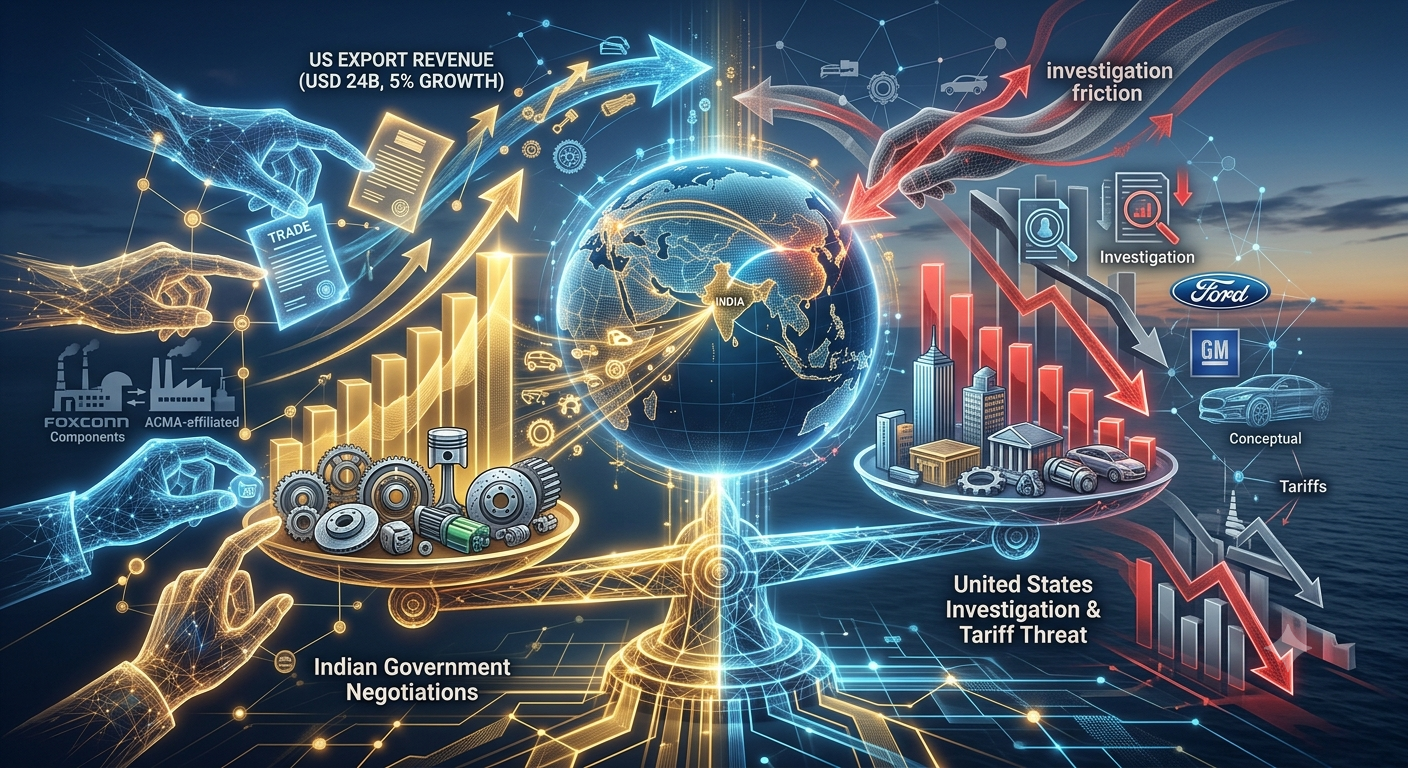
The Indian auto components industry is banking heavily on the union government to negotiate a favorable tariff structure with the United States. The bilateral discussions come at a critical juncture as US trade authorities investigate imports from India, raising concerns over labor practices and alleged subsidy-induced excess manufacturing capacity.
The Automotive Component Manufacturers Association of India (ACMA) highlighted that strategic government intervention is essential to shield domestic manufacturers from potential punitive trade barriers.
High Stakes: The US Reigns as India’s Largest Export Hub
The financial implications of these transatlantic trade negotiations are immense for Indian auto-ancillary companies, given the heavy reliance on American demand.
-
Dominant Export Share: The United States serves as India’s single largest export market for automotive components, accounting for a dominant 26% share of the country's total outward shipments in FY26.
-
Resilient Growth Metrics: Despite growing geopolitical friction, India's overall automotive component exports expanded by 5% Year-on-Year (YoY), scaling to USD 24 billion (approximately ₹2,12,176 crore) in the last fiscal year.
-
Potential Margin Squeeze: Any unilateral imposition of high import tariffs by the US could severely hurt the profit margins of Indian suppliers, making them less competitive against regional rivals in the global supply chain.
Bilateral Engagement: Industry Adopts a 'Wait and Watch' Stance
To safeguard local manufacturing interests, the Indian government is actively holding high-level talks with US representatives to hammer out a mutually beneficial bilateral trade agreement.
Commenting on the developing situation, Vinnie Mehta, Director General of ACMA, urged the industry to remain patient while negotiations continue:
"They (the government) are trying to negotiate the best deal for us. So we need to wait and watch and see how much tariffs eventually they (the US) would be applying on India."
What This Means for Investors
For stock market investors tracking the auto-ancillary space, the progress of these trade talks serves as a major near-term catalyst.
A successful bilateral resolution will provide structural revenue visibility for top-tier component exporters, particularly those specializing in forgings, castings, and electrical assemblies. Conversely, if tariff barriers rise, listed players may be forced to quickly pivot and accelerate their diversification strategies toward European markets and the domestic aftermarket to cushion the impact.