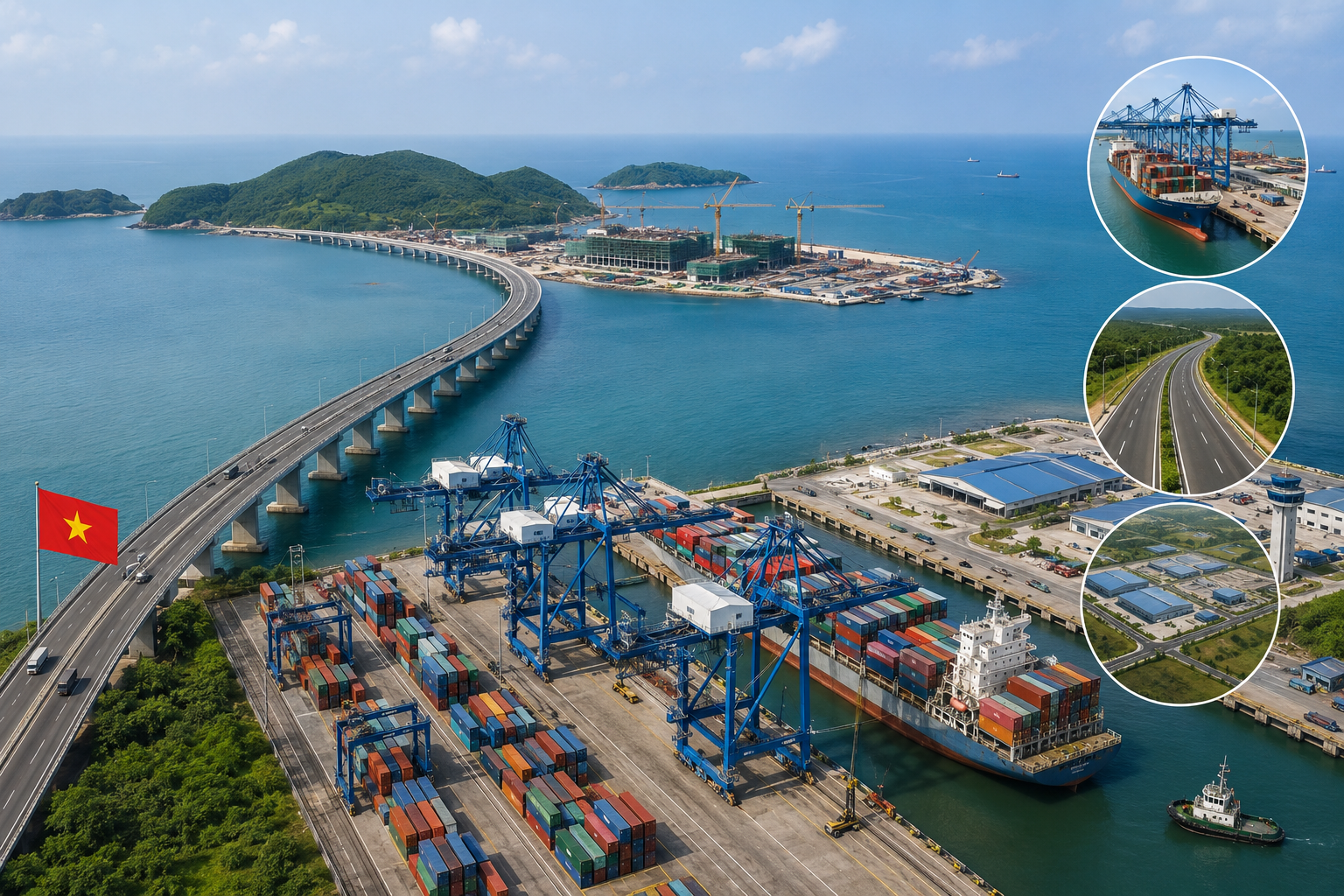
Deep-water port, expressway and logistics corridor aim to transform southern Vietnam into a major trade gateway while strengthening its maritime presence in the Gulf of Thailand
Vietnam has significantly accelerated work on its $4 billion Hon Khoai Port and transport corridor, one of the country's most ambitious infrastructure projects in recent years. Situated off the southern coast of Ca Mau Province, the development combines a deep-water commercial port, an extensive logistics network and transport infrastructure designed to boost economic growth while enhancing Vietnam's strategic presence in the Gulf of Thailand.
The project has gained momentum as geopolitical competition intensifies across Southeast Asia. Although Vietnamese authorities continue to present Hon Khoai as an economic development initiative, analysts believe the accelerated timeline also reflects Hanoi's desire to strengthen its maritime capabilities amid changing regional dynamics.
The port is expected to become a crucial gateway for trade from the Mekong Delta while supporting Vietnam's long-term infrastructure and national security objectives.
Mega Infrastructure Project to Reshape Southern Vietnam
The centrepiece of the development is Hon Khoai Island, which is being connected to mainland Vietnam through an 18-kilometre sea bridge, expected to become the country's longest marine bridge.
The overall project includes:
-
A deep-water international port
-
Modern logistics parks
-
Cargo handling terminals
-
Warehousing infrastructure
-
An 80-kilometre expressway
-
Supporting industrial facilities
Together, these investments are expected to transform one of Vietnam's least-developed coastal regions into a major logistics and shipping hub serving both domestic and international markets.
Deep-Water Port Designed for Ultra-Large Ships
One of the project's biggest advantages is its ability to accommodate some of the world's largest commercial vessels.
Unlike many existing ports in the region, Hon Khoai is being developed as a true deep-water port capable of handling ships of up to 250,000 deadweight tonnes (DWT).
Once operational, the port is expected to process approximately 20 million tonnes of cargo annually, making it one of Vietnam's largest maritime gateways.
The facility is expected to handle:
-
Bulk commodities
-
Energy cargo
-
Agricultural exports
-
Containers
-
Industrial raw materials
The expanded capacity could significantly improve Vietnam's competitiveness in international shipping and logistics.
Boosting Trade from the Mekong Delta
The Mekong Delta is among Vietnam's most important agricultural and seafood-producing regions, accounting for a significant share of the country's exports.
However, limited deep-water port infrastructure has historically forced exporters to transport cargo over long distances before reaching international shipping routes.
The Hon Khoai project is expected to:
-
Reduce logistics costs
-
Shorten export transit times
-
Improve supply-chain efficiency
-
Increase export competitiveness
-
Attract new industrial investment
Industries expected to benefit include agriculture, seafood processing, manufacturing, renewable energy and logistics.
Strategic Location Enhances Maritime Connectivity
Located near major international shipping lanes in the Gulf of Thailand, Hon Khoai occupies a strategically important position for regional maritime trade.
Its location provides direct access to shipping routes connecting:
-
Southeast Asia
-
South Asia
-
East Asia
-
The Middle East
-
Europe
Improved connectivity is expected to strengthen Vietnam's role in global supply chains as international manufacturers continue diversifying production beyond traditional manufacturing hubs.
Regional Developments Add Strategic Importance
The acceleration of the project comes against the backdrop of significant infrastructure developments across Southeast Asia.
Analysts point to several recent developments, including:
-
Cambodia's Funan Techo Canal project
-
Expansion of Ream Naval Base
-
Increasing infrastructure investments across the Gulf of Thailand
-
Growing maritime competition in regional waters
While Vietnamese authorities have not officially linked Hon Khoai to these developments, many regional security experts believe the project reflects broader strategic planning aimed at enhancing Vietnam's maritime resilience.
Potential Dual-Use Infrastructure
Although officially developed as a commercial port, several analysts suggest the infrastructure could also support broader national requirements if needed.
Its deep-water harbour and modern logistics facilities could potentially accommodate:
-
Larger maritime patrol vessels
-
Coast Guard operations
-
Disaster response missions
-
Humanitarian assistance
-
International naval visits
-
Maritime surveillance support
Such flexibility is increasingly common in major port developments across the Asia-Pacific region.
Transforming Ca Mau into an Economic Growth Centre
The project is expected to generate substantial economic benefits for Ca Mau Province, one of Vietnam's southernmost regions.
Local authorities aim to achieve annual economic growth exceeding 10% through 2030, supported by infrastructure-led development.
Expected benefits include:
-
New employment opportunities
-
Growth in construction activity
-
Expansion of logistics businesses
-
Increased tourism potential
-
Industrial development
-
Higher private investment
Construction activity has already stimulated demand for accommodation, restaurants, transportation services and local retail businesses.
Local Communities Witness Early Economic Impact
Even before completion, the project is changing the local economy.
Residents in nearby coastal communities report growing business activity as construction workers, engineers and contractors move into the area.
Small businesses including:
-
Restaurants
-
Guesthouses
-
Convenience stores
-
Transport operators
-
Equipment suppliers
have experienced rising demand, creating new income opportunities for local families.
Many residents now see long-term employment prospects within the region rather than migrating to larger cities.
Infrastructure Supports Vietnam's Long-Term Growth Strategy
The Hon Khoai development aligns closely with Vietnam's broader national development priorities.
The government continues investing heavily in:
-
Transport infrastructure
-
Port modernisation
-
Industrial corridors
-
Logistics efficiency
-
Export competitiveness
-
Regional connectivity
These investments are intended to strengthen Vietnam's position as one of Asia's fastest-growing manufacturing and export economies.
Environmental and Financial Challenges Remain
Despite the strong strategic rationale, the project also presents several challenges.
The construction passes through environmentally sensitive coastal ecosystems, including mangrove forests that require careful management during development.
Economists have also questioned whether:
-
Cargo volumes will justify the large investment
-
Financial returns will materialise quickly
-
Existing ports could have been expanded instead
-
Demand forecasts remain sufficiently robust
However, supporters argue that strategic infrastructure should be evaluated over decades rather than short investment cycles.
Growing Competition for Regional Shipping Hubs
Southeast Asia is witnessing intense competition among countries seeking to strengthen their maritime infrastructure.
Governments across the region are investing billions of dollars in:
-
Deep-water ports
-
Rail freight corridors
-
Industrial parks
-
Airports
-
Logistics hubs
-
Cross-border transport networks
As global companies diversify manufacturing supply chains, countries with efficient logistics infrastructure are expected to attract greater foreign direct investment.
Vietnam aims to position itself among the leading beneficiaries of this structural shift.
Outlook
The Hon Khoai Port project represents a landmark investment in Vietnam's economic and infrastructure development strategy. By combining a world-class deep-water port with modern logistics facilities, expressway connectivity and industrial infrastructure, the project has the potential to reshape southern Vietnam's economic landscape while strengthening the country's integration into global trade networks.
Although questions remain regarding long-term financial returns and project execution, the strategic importance of the development is widely acknowledged. As Vietnam continues expanding its manufacturing base and export capacity, investments such as Hon Khoai are expected to play an increasingly important role in enhancing supply chain efficiency, attracting foreign investment and supporting sustainable economic growth. The project also highlights the growing significance of infrastructure as a key pillar of both economic competitiveness and regional strategic planning in Southeast Asia.