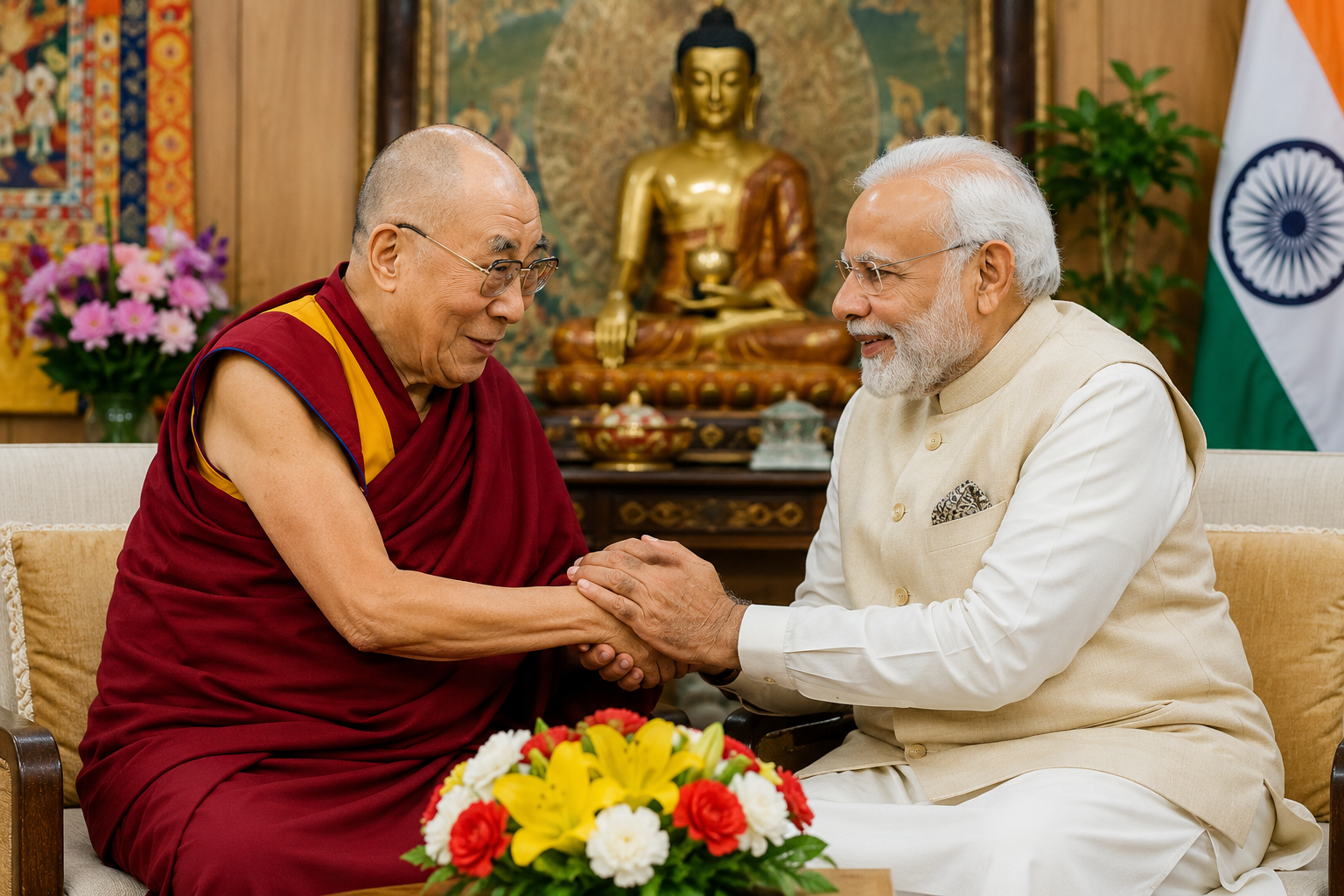
Prime Minister praises the Tibetan spiritual leader's message of harmony and moral leadership as the Dalai Lama marks his 91st birthday in India
Prime Minister Narendra Modi on Monday extended heartfelt birthday greetings to His Holiness the 14th Dalai Lama, paying tribute to the Tibetan spiritual leader's lifelong dedication to peace, compassion and global harmony. In a message shared on social media, the Prime Minister described the Dalai Lama's teachings as a guiding light for millions of people across the world and commended his unwavering commitment to humanity.
The Dalai Lama, one of the world's most respected spiritual figures, celebrated his 91st birthday on July 6. The occasion was marked by prayers, religious ceremonies and congratulatory messages from followers, Buddhist communities and leaders across the globe.
Having lived in India since 1959, the Dalai Lama has become a symbol of peace, interfaith dialogue and non-violence, while Dharamshala in Himachal Pradesh continues to serve as the centre of the Tibetan community in exile.
Prime Minister Modi Pays Tribute
In his birthday message, Prime Minister Narendra Modi highlighted the Dalai Lama's extraordinary contribution to promoting peace and harmony around the world.
The Prime Minister stated that the Tibetan spiritual leader's message of compassion has inspired generations and continues to encourage people to work towards a more peaceful and harmonious world.
He also praised the Dalai Lama's moral courage, spiritual wisdom and lifelong dedication to the welfare of humanity, wishing him good health, happiness and a long life.
The message reflects the high regard in which the Dalai Lama is held both in India and internationally.
A Spiritual Leader Revered Across the World
The Dalai Lama is widely recognised as one of the most influential spiritual leaders of modern times.
Over the decades, he has consistently advocated universal values such as:
- Peace
- Compassion
- Non-violence
- Religious harmony
- Human dignity
- Forgiveness
- Dialogue over conflict
His teachings have transcended geographical, political and religious boundaries, attracting followers from diverse faiths and cultures.
Today, he remains a global ambassador of compassion whose influence extends well beyond the Buddhist community.
Journey from Tibet to India
Born on July 6, 1935, in the small farming village of Taktser in Tibet's Amdo region, the Dalai Lama was recognised in childhood as the reincarnation of the 13th Dalai Lama.
He underwent years of rigorous Buddhist education before assuming spiritual and political leadership of Tibet at a young age.
Following the Tibetan uprising in 1959, he fled Tibet and sought asylum in India.
Since then, he has lived in Dharamshala, Himachal Pradesh, which has become the headquarters of the Tibetan government-in-exile and one of the world's most important centres of Tibetan Buddhism.
India's Enduring Humanitarian Support
India has played a significant role in preserving Tibetan culture and Buddhist traditions by providing refuge to the Dalai Lama and thousands of Tibetan refugees.
Over the past several decades, Tibetan settlements have flourished across different parts of the country, allowing communities to preserve their language, religious practices and cultural heritage.
The Dalai Lama has frequently expressed gratitude to India for safeguarding Tibetan identity while describing the country as the birthplace of Buddhism.
His long association with India has also strengthened cultural and spiritual ties between the Tibetan and Indian communities.
Champion of Peaceful Dialogue
Throughout his life, the Dalai Lama has consistently promoted peaceful engagement as the most effective solution to conflict.
His philosophy emphasises:
- Mutual respect
- Compassion
- Tolerance
- Understanding
- Ethical leadership
- Human values
Rather than encouraging confrontation, he has repeatedly advocated dialogue and reconciliation, making him one of the world's strongest voices for peaceful conflict resolution.
His teachings have inspired governments, educational institutions, humanitarian organisations and millions of individuals worldwide.
Global Recognition and Nobel Peace Prize
The Dalai Lama's efforts to promote peace received international recognition when he was awarded the Nobel Peace Prize in 1989.
The Nobel Committee honoured him for his consistent advocacy of non-violence, human rights and peaceful solutions to international disputes.
The award significantly elevated his global stature and reinforced his position as one of the leading moral voices of the modern era.
He has since received numerous international honours, honorary doctorates and humanitarian awards.
Influence Beyond Religion
While the Dalai Lama is the spiritual head of Tibetan Buddhism, his influence extends into several other fields.
His public lectures frequently explore topics such as:
- Mental health
- Emotional well-being
- Ethics
- Education
- Environmental sustainability
- Scientific research
- Artificial intelligence and ethics
- Global citizenship
He has collaborated with scientists, psychologists and educators to promote dialogue between modern science and ancient wisdom.
His books continue to inspire readers across different age groups and nationalities.
Birthday Celebrations Around the World
The Dalai Lama's birthday is celebrated each year by Buddhist monasteries, Tibetan communities and followers across Asia, Europe, North America and several other regions.
Celebrations generally include:
- Prayer ceremonies
- Meditation sessions
- Cultural performances
- Charity initiatives
- Community gatherings
- Peace conferences
Messages of goodwill also pour in from religious leaders, political figures and humanitarian organisations recognising his lifelong contribution to global peace.
A Continuing Legacy at 91
Despite his advancing age, the Dalai Lama continues to engage with followers through teachings, public messages and spiritual guidance.
His emphasis on compassion, kindness and ethical living remains particularly relevant in a world facing increasing geopolitical tensions, social divisions and environmental challenges.
His philosophy encourages individuals to cultivate inner peace as the foundation for building peaceful societies.
Millions around the world continue to draw inspiration from his message of hope, resilience and universal responsibility.
India's Soft Power and Spiritual Heritage
The Dalai Lama's continued presence in India also highlights the country's role as a global centre for spirituality and religious diversity.
India's tradition of welcoming different faiths and preserving ancient spiritual traditions has strengthened its international image as a nation that values peaceful coexistence and cultural pluralism.
This humanitarian legacy continues to contribute to India's soft power and its standing in global diplomacy.