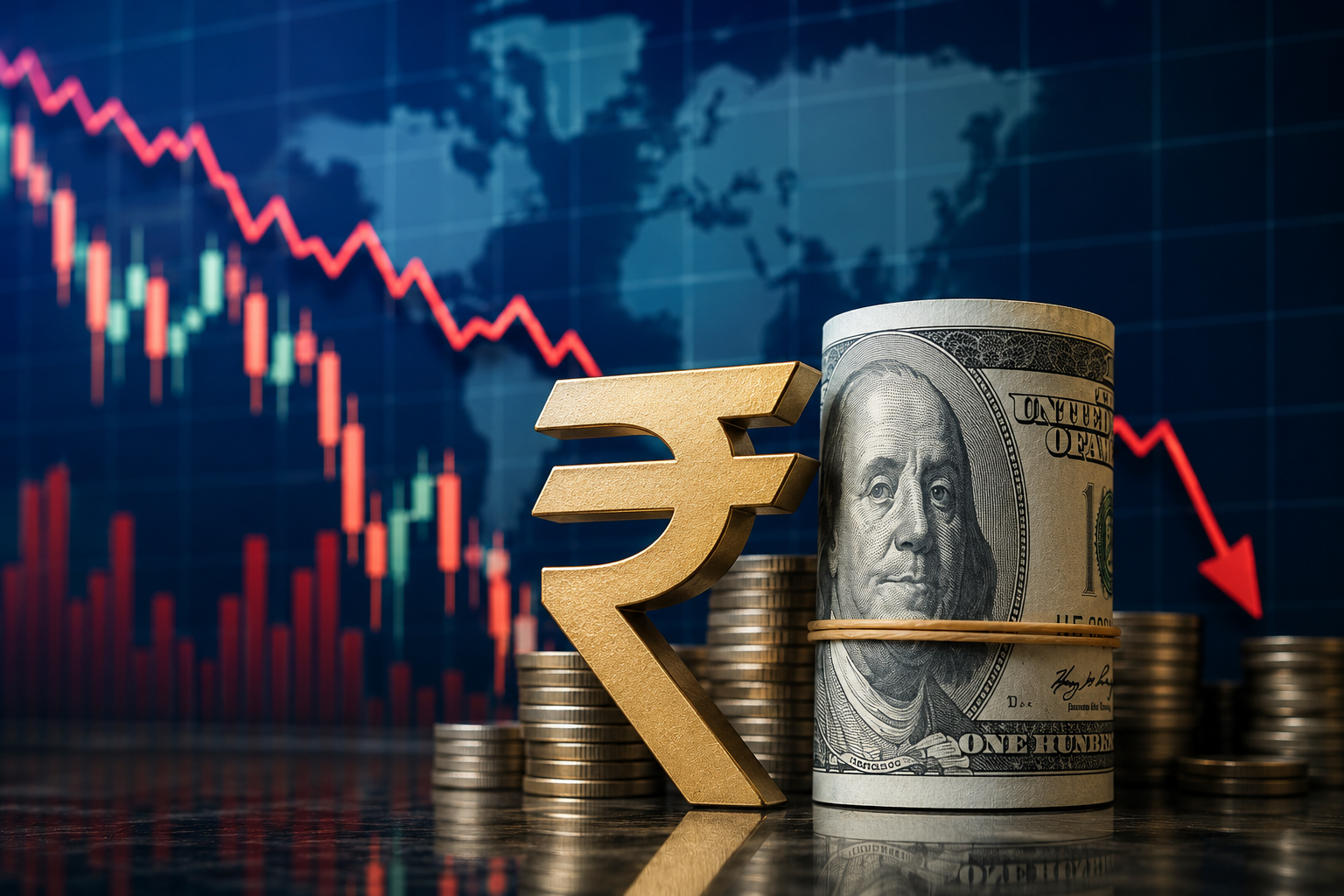
Despite softer crude oil prices and renewed FII buying, the Indian rupee weakens in early trade as global dollar strength, geopolitical uncertainty, and RBI reserve accumulation shape market sentiment.
The Indian rupee started the week on a weaker footing, declining 10 paise to 95.28 against the US dollar during early trading on Monday. The domestic currency came under pressure from a firmer US dollar in global markets, while lingering geopolitical tensions in West Asia and expectations of Reserve Bank of India (RBI) intervention continued to weigh on investor sentiment.
At the interbank foreign exchange market, the rupee opened at 95.25 before slipping further to 95.28, compared with Friday's closing level of 95.18. Although lower crude oil prices and continued foreign investment into Indian equities offered some support, the overall tone in the currency market remained cautious.
Global Dollar Strength Weighs on the Rupee
The primary reason behind the rupee's decline was the renewed strength of the US dollar against major global currencies. The US Dollar Index, which tracks the greenback against a basket of six major currencies, traded around 100.95, reflecting increased demand for the world's reserve currency.
A stronger dollar typically puts pressure on emerging market currencies, including the rupee, as global investors shift capital toward dollar-denominated assets. Currency traders noted that while recent US economic data hinted at slowing growth, investors continue to view the dollar as a safe-haven asset amid global uncertainties.
RBI's Reserve Strategy Limits Rupee Appreciation
Market participants believe the RBI remains focused on rebuilding India's foreign exchange reserves whenever capital inflows increase. Instead of allowing the rupee to strengthen sharply, the central bank is expected to absorb excess dollar inflows by purchasing foreign currency, thereby strengthening its reserve position.
This approach helps maintain export competitiveness while creating a larger buffer against future external shocks such as volatile oil prices, global financial market disruptions, or geopolitical conflicts.
Analysts say this strategy explains why the rupee has not appreciated significantly despite improving domestic fundamentals and a relatively stable macroeconomic environment.
Geopolitical Risks Continue to Influence Currency Markets
Investors are also closely monitoring developments in West Asia, particularly uncertainty surrounding the progress of diplomatic efforts involving the United States and Iran. Although energy prices have moderated from recent highs, geopolitical risks continue to influence global financial markets.
Any disruption in crude oil supply or escalation in regional tensions could increase inflationary pressures for oil-importing countries such as India and negatively affect the rupee.
Lower Oil Prices Provide Partial Relief
Brent crude futures traded around $71.70 per barrel, extending recent declines as concerns over immediate supply disruptions eased.
For India, which imports nearly 85% of its crude oil requirements, lower international oil prices are generally supportive for the rupee as they reduce the country's import bill, improve the current account balance, and help contain inflation.
However, analysts noted that the positive impact of softer crude prices has been offset by persistent global uncertainty and RBI intervention expectations.
Domestic Equity Markets Begin the Week on a Positive Note
Indian equity markets opened higher despite the weakness in the domestic currency. The BSE Sensex gained more than 280 points, while the Nifty 50 climbed above 24,340, supported by buying in banking, auto, and capital goods stocks.
Positive sentiment was further strengthened by continued foreign institutional investment. According to exchange data, Foreign Institutional Investors (FIIs) remained net buyers on Friday, purchasing Indian equities worth ₹1,355.33 crore.
Sustained foreign portfolio inflows continue to demonstrate confidence in India's long-term economic growth prospects, even as short-term currency fluctuations persist.
Forex Reserves Decline After RBI Intervention
The latest RBI data showed that India's foreign exchange reserves declined by $5.65 billion to $666.93 billion during the week ended June 26.
The decline follows earlier interventions by the central bank to stabilise the rupee during periods of heightened volatility. Before recent fluctuations, India's forex reserves had reached a record high of $728.49 billion, providing the country with one of the strongest external buffers among emerging economies.
Economists believe maintaining healthy forex reserves remains a key priority for the RBI as global financial markets continue to face uncertainty.
What Currency Experts Are Watching
Currency strategists believe the rupee remains vulnerable to both domestic and international developments. While easing crude oil prices and stable capital inflows offer support, the currency continues to face headwinds from a stronger dollar and geopolitical risks.
Technical analysts expect the USD/INR pair to remain within a broad trading range over the coming sessions. Any deterioration in global risk sentiment or fresh geopolitical developments could push the rupee closer to the 95.80–96.00 range, while sustained foreign inflows and lower oil prices could provide support around 94.80–95.00.
Investors are also awaiting upcoming US inflation data, central bank commentary, and additional economic indicators that may influence expectations regarding future interest rate decisions by the US Federal Reserve.
Outlook for Investors
The near-term direction of the rupee will largely depend on four key factors: movements in the US dollar, global crude oil prices, foreign institutional investment flows, and RBI intervention in the foreign exchange market.
While India's economic fundamentals remain relatively strong, global developments continue to dictate short-term currency movements. Businesses with significant import exposure, export-oriented companies, and investors with international portfolios are expected to closely monitor currency trends in the coming weeks.