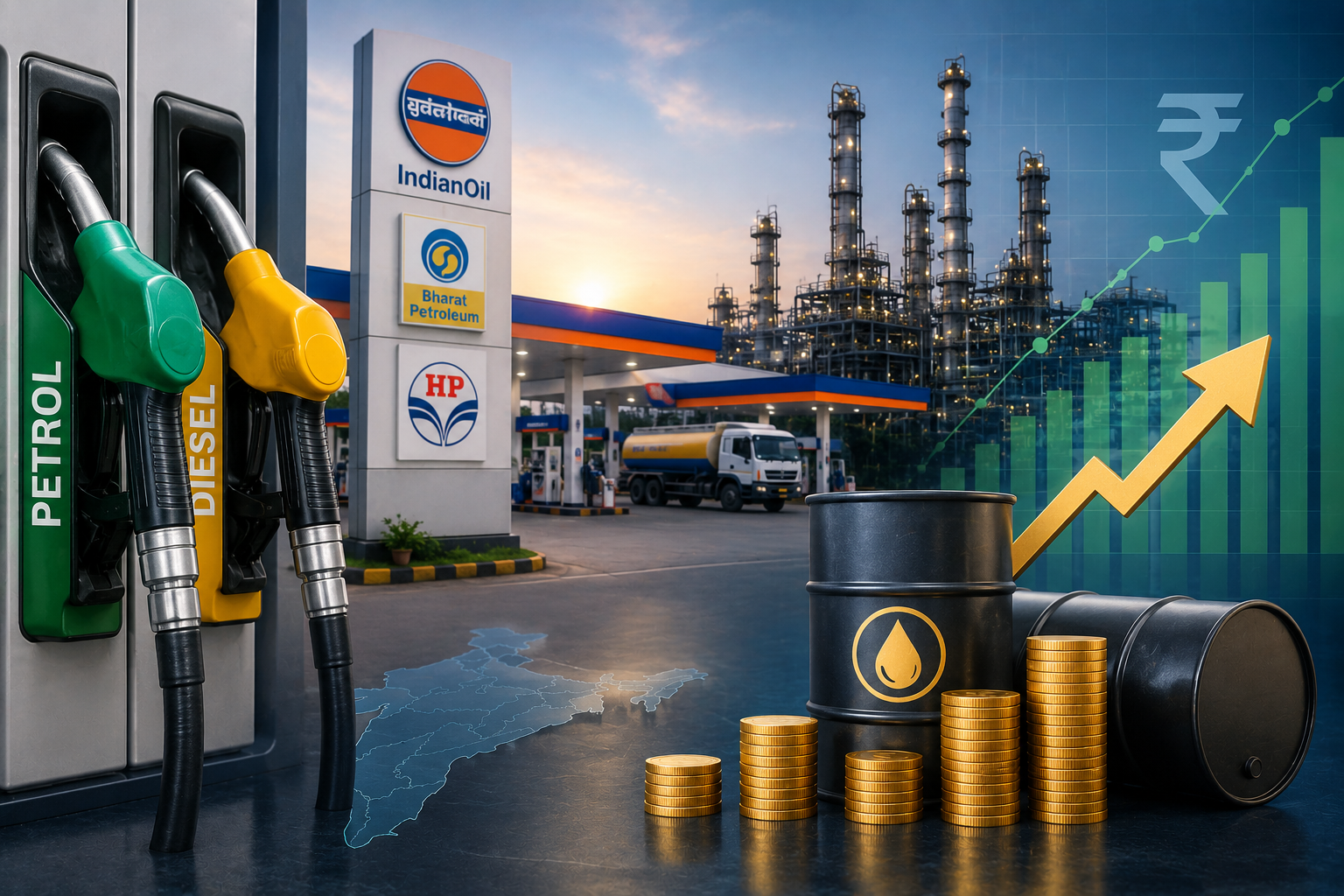
Falling Crude Oil Prices Improve Marketing Margins for Oil Retailers, While Analysts and Government Differ on Under-Recovery Calculations
India's state-owned Oil Marketing Companies (OMCs) are witnessing a sharp improvement in profitability as global crude oil prices soften, significantly reducing the pressure of under-recoveries on petrol and diesel sales. However, analysts and the government continue to hold differing views on the actual extent of marketing gains and the methodology used to calculate fuel under-recoveries.
With Brent crude hovering around $72–73 per barrel, industry experts believe oil retailers have moved back into a healthy profitability zone after facing periods of margin pressure during recent geopolitical tensions.
The improving outlook is expected to strengthen the financial performance of leading public sector oil retailers in the coming quarters, provided global crude prices remain stable.
Analysts See Healthy Marketing Margins
According to a report by DAM Capital, Indian Oil Marketing Companies are currently earning around ₹10 per litre on petrol and diesel sold through retail outlets, reflecting a sharp turnaround in marketing profitability.
The report suggests that the decline in international crude prices has substantially lowered the cost of procuring and refining crude oil while domestic retail fuel prices have largely remained unchanged, resulting in improved marketing margins.
Supporting this view, Prashant Vasisht, Senior Vice-President at ICRA, stated that marketing margins have turned positive with crude oil trading near $72 per barrel.
Industry analysts believe the current pricing environment has restored profitability for fuel retailers after months of volatile crude prices.
Government and Analysts Differ on Under-Recoveries
Despite the positive outlook presented by market analysts, the government maintains a different assessment regarding the calculation of under-recoveries on petrol and diesel.
The divergence primarily stems from differences in the methodology used to estimate the actual cost of fuel procurement and the benchmark prices considered while determining retail marketing margins.
While analysts focus on prevailing international crude prices and current refining economics, government calculations often incorporate broader pricing mechanisms, inventory costs and other operational considerations.
This has led to varying estimates of the profitability enjoyed by Oil Marketing Companies.
Lower Crude Prices Offer Relief to OMCs
Global crude oil prices have moderated in recent weeks after experiencing heightened volatility due to geopolitical developments in the Middle East.
The easing in crude prices has provided significant relief to India's major oil retailers by reducing input costs while allowing retail fuel prices to remain relatively stable.
Improved refining economics and stronger marketing margins are expected to support earnings growth for companies such as:
- Indian Oil Corporation (IOC)
- Bharat Petroleum Corporation Ltd. (BPCL)
- Hindustan Petroleum Corporation Ltd. (HPCL)
The recovery comes after several quarters during which OMCs faced fluctuating profitability due to rapid movements in global energy prices.
Fuel Pricing Formula Remains Under Focus
India follows a market-linked pricing mechanism for petrol and diesel, where domestic fuel prices are influenced by international crude oil prices, exchange rates, refining costs, freight charges, dealer commissions and taxes.
However, retail fuel prices are not always adjusted immediately in line with fluctuations in global crude prices, leading to periods of higher or lower marketing margins for oil retailers.
As a result, estimates of under-recoveries often become a subject of debate among industry participants, policymakers and analysts.
Impact on OMC Financial Performance
Improving marketing margins are expected to positively influence the quarterly earnings of state-owned oil marketing companies.
Higher profitability could strengthen:
- Operating margins.
- Cash flows.
- Balance sheet position.
- Capital expenditure plans.
- Dividend-paying capacity.
At the same time, stable crude prices would also provide greater visibility for inventory management and refining operations.
However, any sharp rebound in international crude prices due to geopolitical disruptions could once again compress marketing margins if retail fuel prices remain unchanged.
Global Factors Continue to Drive Fuel Economics
Although crude prices have eased, several global developments continue to influence the outlook for oil markets.
Market participants remain closely watchful of:
- Geopolitical tensions in the Middle East.
- OPEC+ production decisions.
- Global economic growth.
- Demand recovery in major consuming nations.
- Currency movements, particularly the Indian rupee against the US dollar.
These factors will play a crucial role in determining the sustainability of current marketing margins.
What It Means for Investors
For investors, improving fuel marketing margins are a positive development for India's public sector oil marketing companies. If crude oil remains in the $70–75 per barrel range, companies could report stronger earnings, healthier cash flows and improved return ratios over the coming quarters.
However, investors should continue monitoring global crude price movements and government pricing policies, as both remain key variables influencing the profitability of OMCs