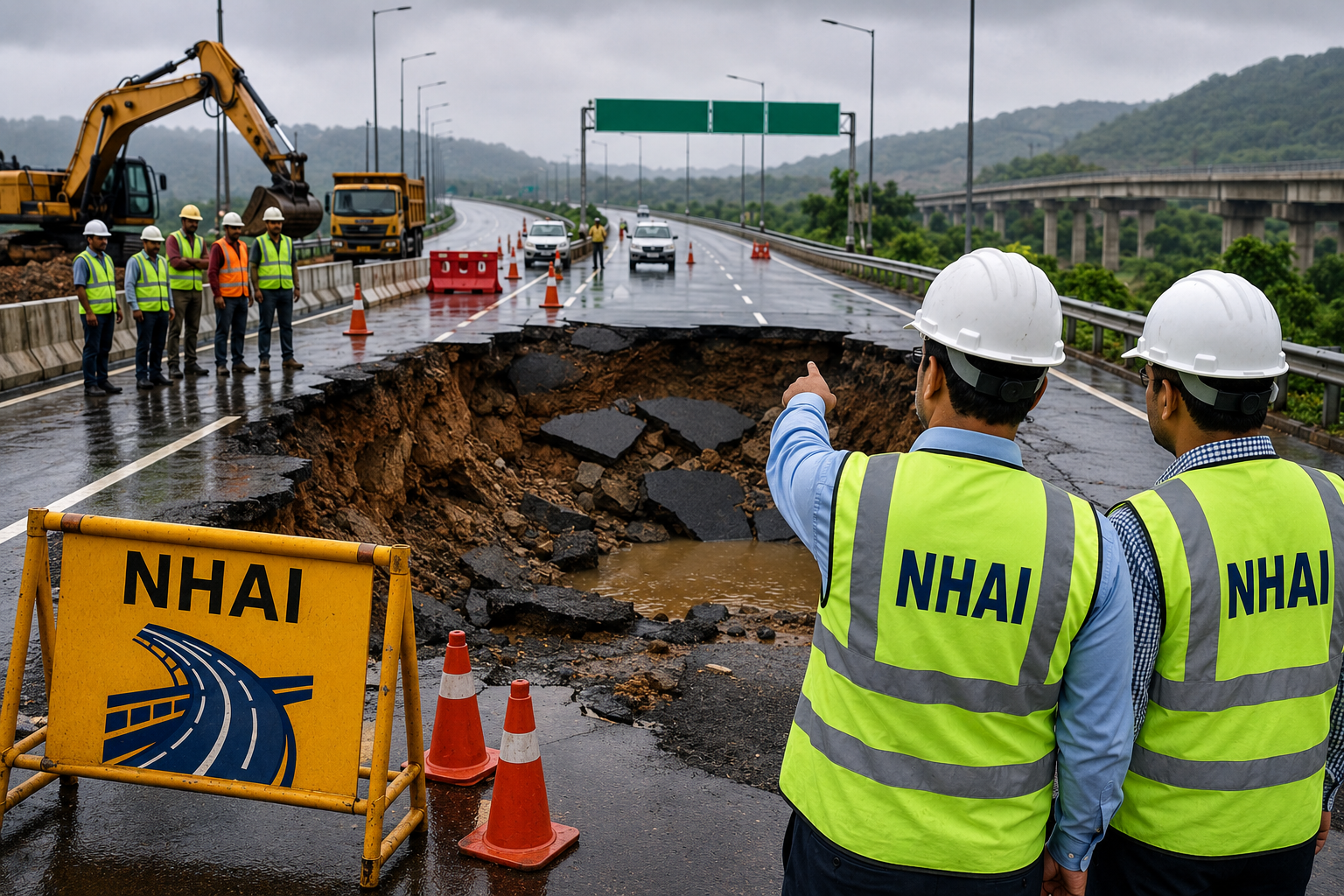
Road Surface Collapse Following Heavy Rainfall Triggers Investigation, Raising Fresh Questions on Quality Control in India's Infrastructure Projects
The National Highways Authority of India (NHAI) has initiated disciplinary action after a section of the under-construction Delhi–Dehradun Expressway suffered a road surface cave-in, an incident that gained widespread attention after videos circulated across social media platforms. The authority has suspended key officials associated with the project and launched a detailed investigation to determine the cause of the failure and identify any lapses in execution or supervision.
According to NHAI, the cave-in occurred on July 1, 2026, after heavy overnight rainfall caused localized water stagnation at the site. The authority stated that the permanent cross-drainage system at the affected location had not yet been fully commissioned, leading to the accumulation of rainwater that weakened a portion of the road surface.
While officials described the incident as localized rather than a structural failure of the expressway, the development has once again highlighted the importance of engineering quality, drainage planning, and project monitoring in India's rapidly expanding infrastructure sector.
Incident Prompts Immediate Administrative Action
Following preliminary investigations, NHAI acted swiftly by suspending:
- The Team Leader of the Authority Engineer
- The Project Manager of the EPC (Engineering, Procurement and Construction) Contractor
Additionally, the authority issued show-cause notices to:
- The Project Director
- The Authority Engineer
- The EPC Contractor
The notices seek explanations regarding project supervision, construction quality, and adherence to engineering standards during execution.
NHAI has indicated that further disciplinary or contractual action will depend on the findings of the ongoing technical investigation.
NHAI Attributes Cave-In to Localized Waterlogging
In its initial assessment, NHAI stated that the road surface collapse resulted from localized water stagnation caused by heavy rainfall combined with delays in operationalizing the permanent drainage infrastructure.
According to the authority, the affected location experienced:
- Intense rainfall during the previous night
- Temporary accumulation of rainwater
- Incomplete commissioning of permanent cross-drainage structures
- Localized weakening of pavement layers
Officials clarified that the issue was confined to a limited section of the project and did not indicate a broader structural failure of the expressway.
Nevertheless, the authority has ordered a comprehensive technical review to validate these preliminary findings.
Why Drainage Systems Are Critical for Highway Infrastructure
Efficient drainage is one of the most important engineering components of any highway project.
Modern expressways are designed with integrated drainage networks that perform several essential functions:
Prevent Water Accumulation
Proper drainage prevents rainwater from collecting on or beneath road surfaces.
Protect Structural Integrity
Continuous removal of water helps preserve the strength of embankments, pavement layers, and foundations.
Improve Road Safety
Well-designed drainage systems reduce waterlogging, hydroplaning risks, and pavement deterioration.
Increase Asset Life
Effective drainage significantly lowers long-term maintenance costs and extends the lifespan of highways.
Infrastructure experts note that even well-constructed roads can suffer localized damage if drainage systems are incomplete or temporarily ineffective during heavy monsoon conditions.
Strategic Importance of the Delhi–Dehradun Expressway
The Delhi–Dehradun Expressway is among India's flagship road infrastructure projects and is expected to substantially improve connectivity between the National Capital Region and Uttarakhand.
Upon completion, the corridor is expected to:
- Reduce travel time between Delhi and Dehradun
- Improve logistics efficiency
- Boost tourism
- Enhance regional economic development
- Facilitate faster freight movement
- Improve access to hill states
The project also forms an important part of India's broader strategy to modernize its highway network through high-speed, access-controlled expressways.
Quality Control Remains Under the Spotlight
The incident has intensified discussions around quality assurance mechanisms in large public infrastructure projects.
Major highway projects generally involve multiple layers of technical oversight, including:
- Independent engineering consultants
- Quality assurance agencies
- Project management consultants
- Government monitoring teams
- Contractor quality audits
- Laboratory testing of construction materials
Industry experts believe continuous monitoring and timely corrective action remain essential for ensuring durable infrastructure, particularly during the construction phase.
Accountability Becoming a Key Focus
NHAI's prompt disciplinary response reflects a growing emphasis on accountability in government-funded infrastructure development.
Public agencies are increasingly focusing on:
- Engineering excellence
- Timely project execution
- Transparent project monitoring
- Contractor accountability
- Safety compliance
- Independent technical verification
Such measures are intended to improve public confidence while ensuring that large infrastructure investments deliver long-term value.
Infrastructure Spending Continues Despite Isolated Setbacks
Although the cave-in has attracted considerable public attention, analysts believe it is unlikely to affect India's broader infrastructure development programme.
The government continues to make substantial investments in:
- National highways
- Expressways
- Railways
- Metro rail systems
- Airports
- Ports
- Logistics parks
- Multi-modal transport corridors
Infrastructure remains one of the key pillars supporting India's long-term economic growth strategy.
Engineering Lessons for Future Projects
The incident offers valuable insights for future highway development across the country.
Infrastructure specialists recommend greater emphasis on:
- Early completion of permanent drainage systems
- Enhanced monsoon preparedness
- Real-time construction monitoring
- Independent engineering inspections
- Improved contractor supervision
- Digital quality management systems
Adopting these practices could help minimize construction-related risks while improving project durability.
What Happens Next?
NHAI is expected to conduct a detailed technical investigation involving engineering experts and project stakeholders.
The review will likely examine:
- Design specifications
- Construction methodology
- Material quality
- Drainage planning
- Project supervision
- Compliance with engineering standards
Based on the findings, the authority may recommend additional corrective measures, impose contractual penalties, or strengthen future quality control protocols across similar infrastructure projects.
Balancing Speed with Quality in India's Infrastructure Push
India's ambitious infrastructure expansion programme continues to transform the country's transportation network, with thousands of kilometres of highways under construction.
As project execution accelerates, maintaining a balance between rapid delivery and uncompromising engineering quality will remain critical.
Robust quality assurance systems, transparent accountability, and timely technical audits will be essential to ensure that infrastructure investments deliver safe, durable, and efficient assets capable of supporting India's long-term economic growth.
NHAI Takes Swift Action After Delhi–Dehradun Expressway Cave-In, Suspends Officials and Orders Probe
Road Surface Collapse Following Heavy Rainfall Triggers Investigation, Raising Fresh Questions on Quality Control in India's Infrastructure Projects
The National Highways Authority of India (NHAI) has initiated disciplinary action after a section of the under-construction Delhi–Dehradun Expressway suffered a road surface cave-in, an incident that gained widespread attention after videos circulated across social media platforms. The authority has suspended key officials associated with the project and launched a detailed investigation to determine the cause of the failure and identify any lapses in execution or supervision.
According to NHAI, the cave-in occurred on July 1, 2026, after heavy overnight rainfall caused localized water stagnation at the site. The authority stated that the permanent cross-drainage system at the affected location had not yet been fully commissioned, leading to the accumulation of rainwater that weakened a portion of the road surface.
While officials described the incident as localized rather than a structural failure of the expressway, the development has once again highlighted the importance of engineering quality, drainage planning, and project monitoring in India's rapidly expanding infrastructure sector.
Incident Prompts Immediate Administrative Action
Following preliminary investigations, NHAI acted swiftly by suspending:
- The Team Leader of the Authority Engineer
- The Project Manager of the EPC (Engineering, Procurement and Construction) Contractor
Additionally, the authority issued show-cause notices to:
- The Project Director
- The Authority Engineer
- The EPC Contractor
The notices seek explanations regarding project supervision, construction quality, and adherence to engineering standards during execution.
NHAI has indicated that further disciplinary or contractual action will depend on the findings of the ongoing technical investigation.
NHAI Attributes Cave-In to Localized Waterlogging
In its initial assessment, NHAI stated that the road surface collapse resulted from localized water stagnation caused by heavy rainfall combined with delays in operationalizing the permanent drainage infrastructure.
According to the authority, the affected location experienced:
- Intense rainfall during the previous night
- Temporary accumulation of rainwater
- Incomplete commissioning of permanent cross-drainage structures
- Localized weakening of pavement layers
Officials clarified that the issue was confined to a limited section of the project and did not indicate a broader structural failure of the expressway.
Nevertheless, the authority has ordered a comprehensive technical review to validate these preliminary findings.
Why Drainage Systems Are Critical for Highway Infrastructure
Efficient drainage is one of the most important engineering components of any highway project.
Modern expressways are designed with integrated drainage networks that perform several essential functions:
Prevent Water Accumulation
Proper drainage prevents rainwater from collecting on or beneath road surfaces.
Protect Structural Integrity
Continuous removal of water helps preserve the strength of embankments, pavement layers, and foundations.
Improve Road Safety
Well-designed drainage systems reduce waterlogging, hydroplaning risks, and pavement deterioration.
Increase Asset Life
Effective drainage significantly lowers long-term maintenance costs and extends the lifespan of highways.
Infrastructure experts note that even well-constructed roads can suffer localized damage if drainage systems are incomplete or temporarily ineffective during heavy monsoon conditions.
Strategic Importance of the Delhi–Dehradun Expressway
The Delhi–Dehradun Expressway is among India's flagship road infrastructure projects and is expected to substantially improve connectivity between the National Capital Region and Uttarakhand.
Upon completion, the corridor is expected to:
- Reduce travel time between Delhi and Dehradun
- Improve logistics efficiency
- Boost tourism
- Enhance regional economic development
- Facilitate faster freight movement
- Improve access to hill states
The project also forms an important part of India's broader strategy to modernize its highway network through high-speed, access-controlled expressways.
Quality Control Remains Under the Spotlight
The incident has intensified discussions around quality assurance mechanisms in large public infrastructure projects.
Major highway projects generally involve multiple layers of technical oversight, including:
- Independent engineering consultants
- Quality assurance agencies
- Project management consultants
- Government monitoring teams
- Contractor quality audits
- Laboratory testing of construction materials
Industry experts believe continuous monitoring and timely corrective action remain essential for ensuring durable infrastructure, particularly during the construction phase.
Accountability Becoming a Key Focus
NHAI's prompt disciplinary response reflects a growing emphasis on accountability in government-funded infrastructure development.
Public agencies are increasingly focusing on:
- Engineering excellence
- Timely project execution
- Transparent project monitoring
- Contractor accountability
- Safety compliance
- Independent technical verification
Such measures are intended to improve public confidence while ensuring that large infrastructure investments deliver long-term value.
Infrastructure Spending Continues Despite Isolated Setbacks
Although the cave-in has attracted considerable public attention, analysts believe it is unlikely to affect India's broader infrastructure development programme.
The government continues to make substantial investments in:
- National highways
- Expressways
- Railways
- Metro rail systems
- Airports
- Ports
- Logistics parks
- Multi-modal transport corridors
Infrastructure remains one of the key pillars supporting India's long-term economic growth strategy.
Engineering Lessons for Future Projects
The incident offers valuable insights for future highway development across the country.
Infrastructure specialists recommend greater emphasis on:
- Early completion of permanent drainage systems
- Enhanced monsoon preparedness
- Real-time construction monitoring
- Independent engineering inspections
- Improved contractor supervision
- Digital quality management systems
Adopting these practices could help minimize construction-related risks while improving project durability.
What Happens Next?
NHAI is expected to conduct a detailed technical investigation involving engineering experts and project stakeholders.
The review will likely examine:
- Design specifications
- Construction methodology
- Material quality
- Drainage planning
- Project supervision
- Compliance with engineering standards
Based on the findings, the authority may recommend additional corrective measures, impose contractual penalties, or strengthen future quality control protocols across similar infrastructure projects.
Balancing Speed with Quality in India's Infrastructure Push
India's ambitious infrastructure expansion programme continues to transform the country's transportation network, with thousands of kilometres of highways under construction.
As project execution accelerates, maintaining a balance between rapid delivery and uncompromising engineering quality will remain critical.
Robust quality assurance systems, transparent accountability, and timely technical audits will be essential to ensure that infrastructure investments deliver safe, durable, and efficient assets capable of supporting India's long-term economic growth.